Squat Racks
A Great Rack and a Great Bench Can Still Be a Bad Pair. Here’s What Actually Fits.
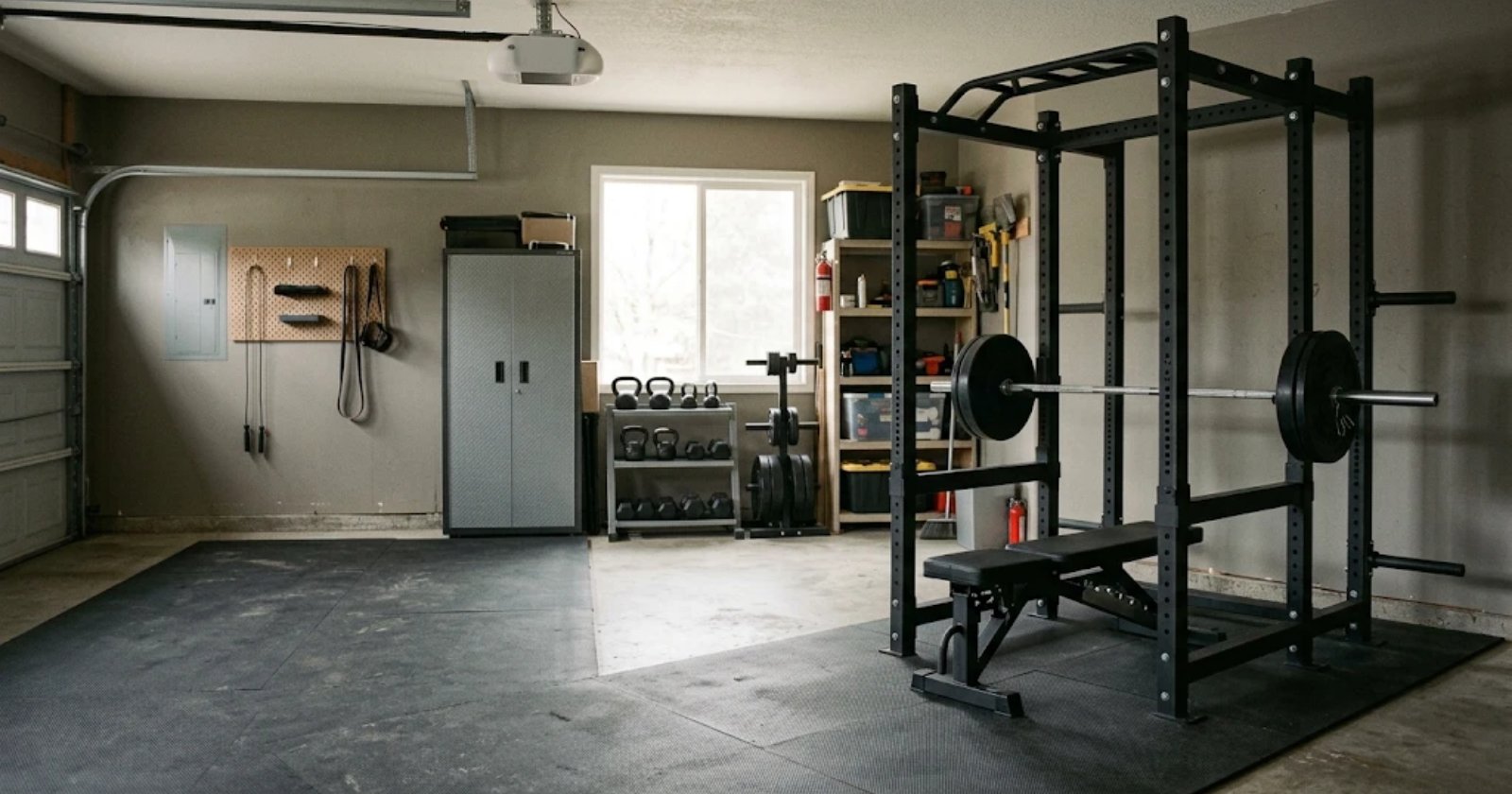
Illustration. The bench has to roll in, clear the rear of the rack and put your eyes under the bar. Plenty of good pairs fail one of the three.
A strong squat rack and a highly rated adjustable bench do not automatically make a good squat rack and bench combination. I found that out by rolling several benches into several racks and pressing in each pairing.
Some benches were too long to position correctly. Others had wide rear stabilizers that hit the rack’s lower crossmember. A few fit perfectly for flat benching and turned awkward the moment the back pad went up. Even when the bench physically fit, its pad height, wheel placement and adjustment ladder could make unracking much harder than the spec sheets suggested.
The problem was rarely the rack or the bench on its own. It was the pairing. A rack and bench are the backbone of most garage gyms, and nearly every pressing swap in the free Machine Swap Playbook assumes you have both working together.
I paired racks from REP Fitness, Rogue Fitness and Titan Fitness, plus a wall-mounted folding rack and an all-in-one cable rack, with adjustable benches from those makers and a couple of cheaper brands. I used each setup for flat bench presses, incline presses, seated shoulder presses, pin presses and dumbbell work. I measured the rack depth, the inside width, the bench length, the pad height, the rear-foot width, the wheel position and the distance from my head to the rear crossmember.
The short version: the REP PR-1100 with a compact REP adjustable bench was the easiest squat rack and bench pairing to live with. Rogue’s Monster Lite felt the most solid but needed more fiddling, and a Titan rack with a compact bench was the budget pick. Folding racks and all-in-one racks each need a particular kind of bench.