Back Training
I Replaced the Lat Pulldown With Dumbbells. Where the Elbow Goes Is the Whole Trick.
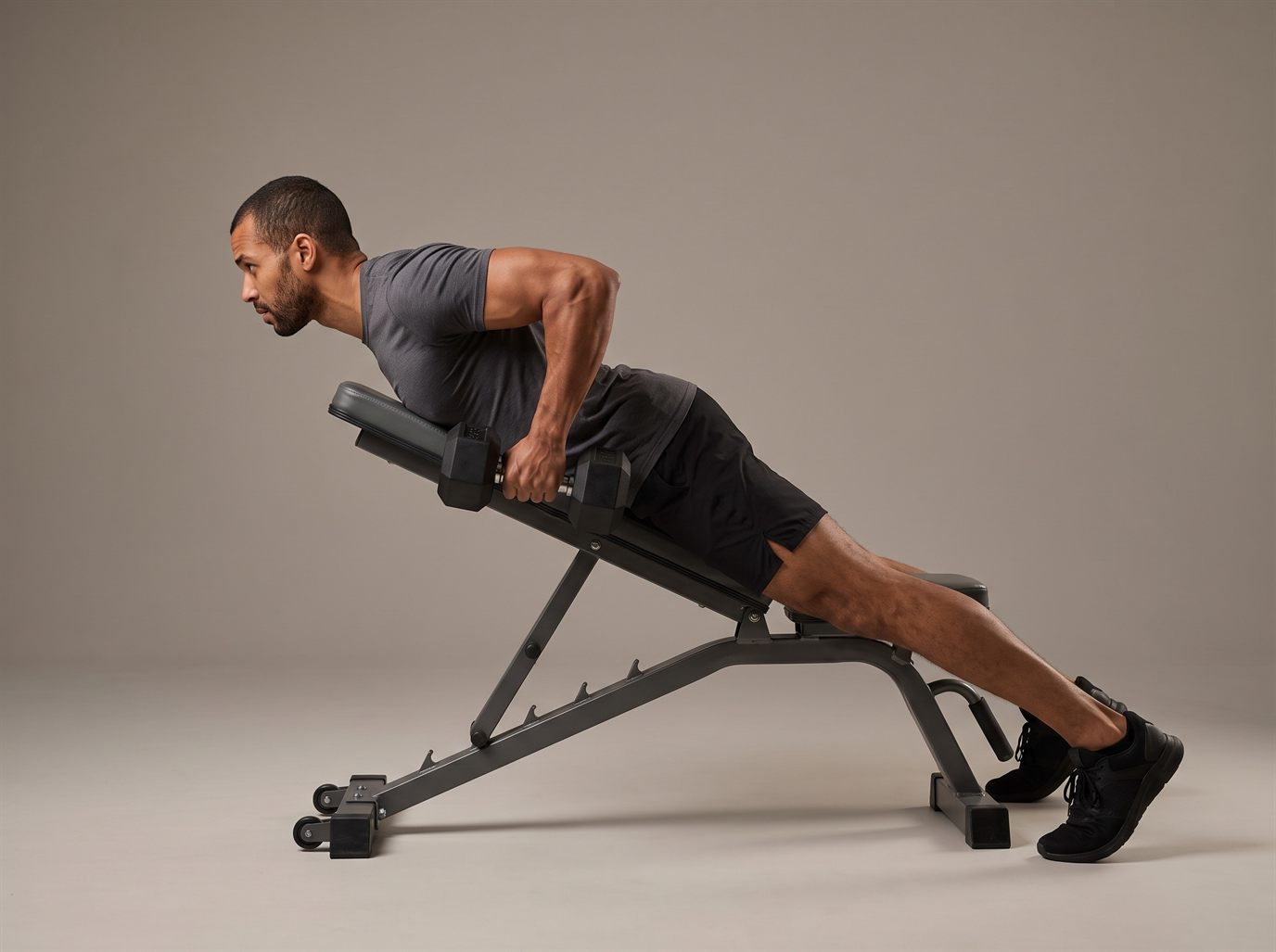
Illustration. The chest-supported dumbbell row on a low incline. Elbows close to the body are what move this row toward the lats.
Most lists of dumbbell lat exercises are really lists of rows. That is not wrong, exactly, but it skips the one detail that decides whether a dumbbell row trains your lats or your upper back — and it is not the exercise. It is where your elbow goes.
I have not had access to a lat pulldown for 24 months. The band version of the pulldown covers a lot of that gap, and I wrote up how the band lat pulldown works as a machine replacement separately. But plenty of home gyms start with dumbbells and a bench, not bands and a high anchor, and “just do rows” was the advice I kept running into.
This post is what I would have wanted instead: three dumbbell lat exercises, the elbow rule that changes what each one trains, an honest look at the pullover, and a single workout that puts them together. If you want the same approach for every machine you are missing, the free Machine Swap Playbook covers all six patterns.
I Trained Without a Lat Pulldown for 24 Months. Three Alternatives Held Up.


Illustration. The half-kneeling band lat pulldown at the finish — the closest lat pulldown alternative to the machine, and the one that needs the least equipment.
The lat pulldown is the most-queued machine in most commercial gyms, and the most-missed machine in most home setups. I have not had access to one for 24 months, and when I moved my training into a garage in May 2026, it was the one station I genuinely thought I would have to replace with money.
I did not. Back training is the part of my program I have had to compromise on least. The reason is not that I found one magic exercise. It is that I stopped looking for a machine-shaped substitute and started matching two specific things: the movement pattern, and where in the rep the hard part lives.
This post is the practical version of that. Three ranked lat pulldown alternatives, what each one actually needs, the load adjustment that keeps the stimulus intact, and the error that quietly ruins the best of them. If you want the same system applied to all six machine patterns rather than just this one, the free Machine Swap Playbook covers eighteen swaps on the same logic.
Continue reading