I Trained Without a Lat Pulldown for 24 Months. Three Alternatives Held Up.

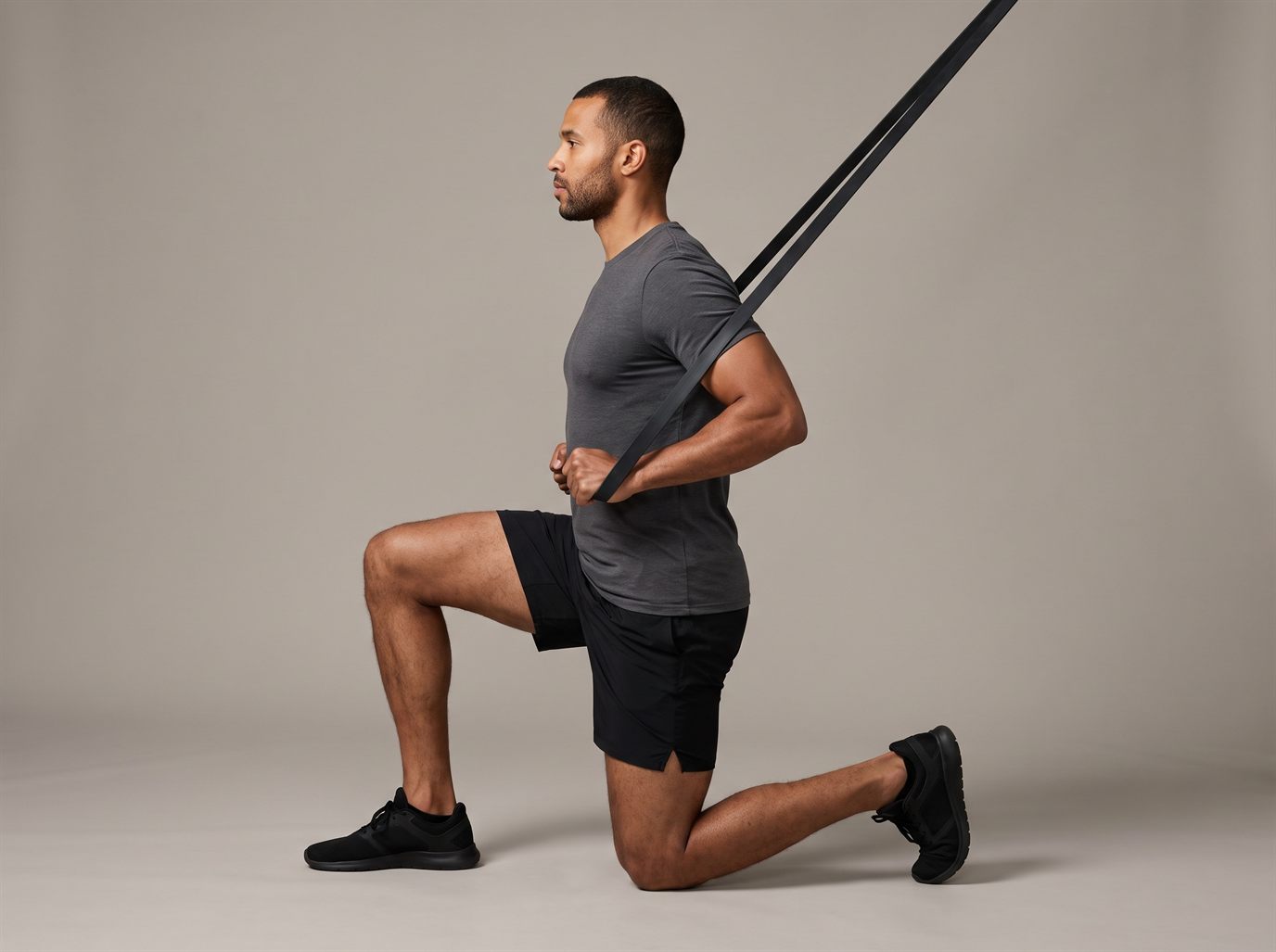
Illustration. The half-kneeling band lat pulldown at the finish — the closest lat pulldown alternative to the machine, and the one that needs the least equipment.
The lat pulldown is the most-queued machine in most commercial gyms, and the most-missed machine in most home setups. I have not had access to one for 24 months, and when I moved my training into a garage in May 2026, it was the one station I genuinely thought I would have to replace with money.
I did not. Back training is the part of my program I have had to compromise on least. The reason is not that I found one magic exercise. It is that I stopped looking for a machine-shaped substitute and started matching two specific things: the movement pattern, and where in the rep the hard part lives.
This post is the practical version of that. Three ranked lat pulldown alternatives, what each one actually needs, the load adjustment that keeps the stimulus intact, and the error that quietly ruins the best of them. If you want the same system applied to all six machine patterns rather than just this one, the free Machine Swap Playbook covers eighteen swaps on the same logic.
Why a Lat Pulldown Alternative Is Harder Than It Looks
Most exercise-substitution advice fails for the same reason: it matches the muscle instead of the movement.
The lat pulldown is a vertical pull. The arm travels from above the head to beside the ribs, driven by shoulder extension and adduction, while the shoulder blade rotates down and pulls toward the spine. Any exercise that reproduces that joint action is in the running. Any exercise that does not — and this includes plenty of things labelled “back exercises” — is training something else, however sore it makes you.
That is the requirement. The ranking is a separate question, and it is the one people skip.
A cable stack holds tension almost flat through the whole range, with the hardest-feeling moment near full contraction. A band gets progressively harder the further you stretch it. A free weight is hardest where the limb is furthest from the joint it rotates around. Same pattern, three completely different places where the rep gets hard.
So a good lat pulldown alternative has to clear two bars: it has to be a vertical pull, and its resistance profile has to either match the cable’s or be corrected with a deliberate load change. Pattern match is the requirement. Profile match is the ranking.
Swap A — The Band Lat Pulldown (Closest Match)
This is the best lat pulldown alternative available to most people, and the cheapest thing on this page.
Half-kneeling, band anchored overhead, elbows driving down and back toward the rear pockets. It reproduces the vertical pull line more faithfully than anything else you can set up in a spare room, and unlike every dumbbell option it needs no bench.
Three things determine whether it works.
Anchor higher than you think. This is the one almost everybody gets wrong. If the band line is shallower than about 60° from the floor, you are doing a horizontal pull with extra steps. You want the anchor roughly 12 inches above your reach — a door anchor at the top of the frame, a rack pin at head height, or a beam.
Lead with the elbows. Drive the points of the elbows down toward your back pockets, and let the hands be hooks. Pull with the hands and your biceps take the set.
Hold the bottom for a full second. The band is at maximum tension only at the finish. That pause is the entire reason this swap ranks first, and skipping it is how people conclude that bands “don’t build anything.”
The research does not support that conclusion either. A 2019 systematic review and meta-analysis in SAGE Open Medicine pooled controlled trials comparing training with elastic bands against weight machines and dumbbells, and found no meaningful difference in strength gains for the upper or the lower body. It measured strength rather than muscle size, and it did not test the lat pulldown specifically. But it does undercut the idea that bands are a lesser tool.
The Load Rule for Bands
A band is not a cable, so the same set-and-rep scheme will not produce the same stimulus. The correction is straightforward:
Band replaces cable → 1.5× the reps, plus a one-second hold at peak contraction.
In practice, 3 × 15 with a one-second hold at the bottom replaces 3 × 10 on the pulldown. Pick a band where rep 13 to 15 is a genuine grind, not a formality.
To add tension, step further from the anchor. To reduce it, step closer. That is worth internalising, because it is free — cheaper than owning more bands, and the reason a graduated set plus a door anchor covers a wider load range than the price suggests.
Swap B — The Dumbbell Pullover
Second on the list, and the one that loads the part of the range the machine barely touches.
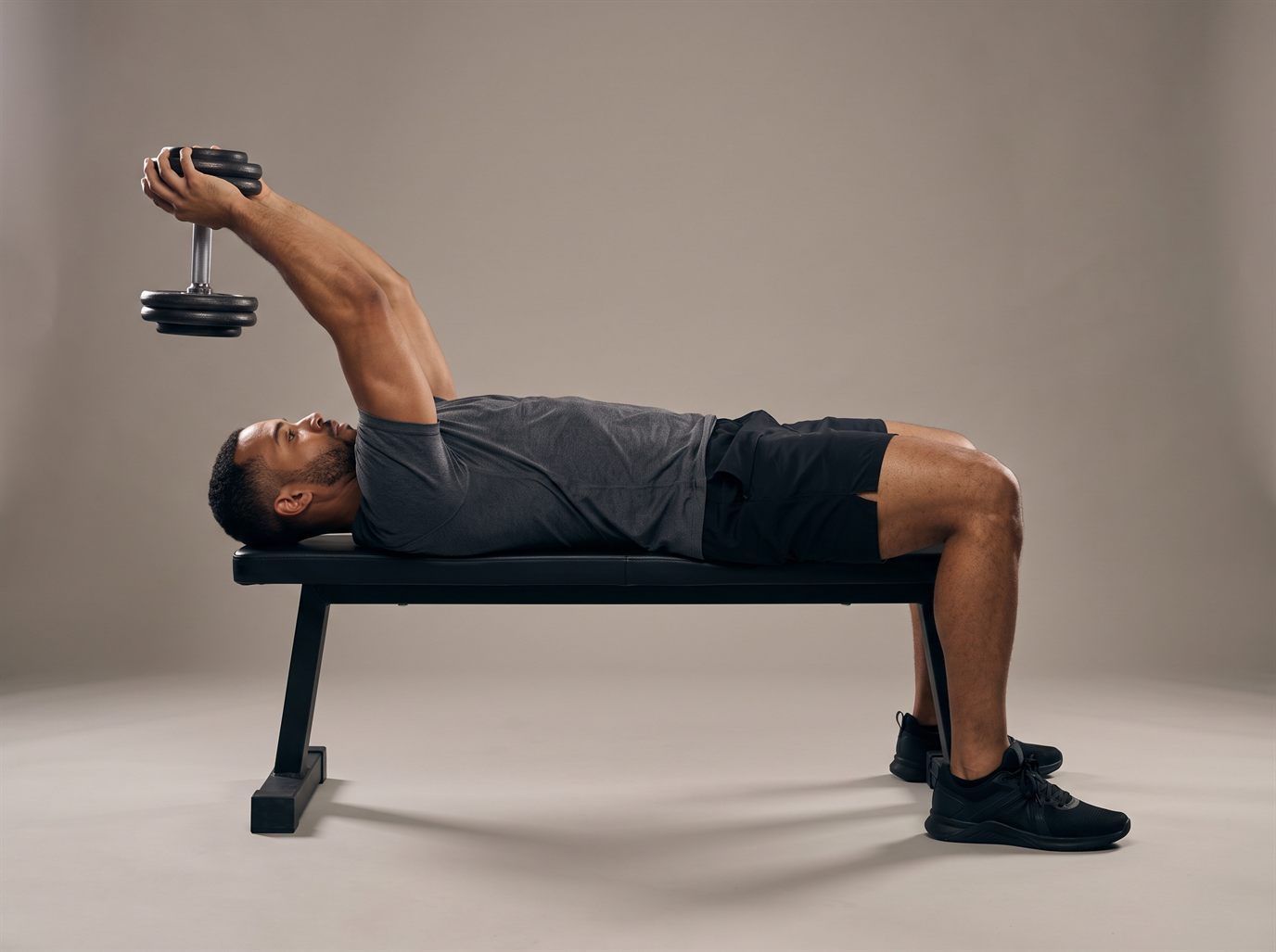
Illustration. The bottom of the dumbbell pullover — arms overhead, ribs down, low back staying on the bench.
One dumbbell, both hands, flat bench. Arms travel overhead and slightly behind the head, elbows locked at a fixed soft bend, ribcage down, low back in contact with the bench.
Set the ribs before the arms move. Exhale, let the ribcage settle toward the pelvis, then lower. Arching to reach further trades lat range for lumbar range, and you feel that the next day.
The elbow angle never changes. Lock a soft bend at the start and hold it. Bending and straightening turns the movement into a triceps extension on a long lever.
Stop at the stretch, not at the pain. End range is where the ribcage wants to lift — about an inch before the ribs break position. Not where the shoulder complains, and not where the internet says.
One honest caveat. EMG research suggests the pullover works your chest more than your lats: a 2026 review of lat activation studies found it preferentially activates the pectoralis major rather than singling out the lats. It still trains the vertical-pull pattern from overhead, which is why it ranks here, but treat it as a pattern match rather than a lat isolation exercise. For dumbbell work that keeps the lats in charge, see the elbow rule for dumbbell lat exercises.
The Load Rule for the Pullover
The pullover is hardest at the deep stretch. The pulldown is hardest at the contraction. Opposite ends of the same pattern, which is exactly the situation the third load rule exists for:
Different part of the range → three-second eccentric, stop one to two reps short.
Start 20% lighter than your first guess, take three seconds on the way down, and stop two reps short for your first two sessions. 3 × 10–12. I got this wrong initially, went by what I could handle on a machine, and spent two weeks with a shoulder that did not appreciate it.
Swap C — The Half-Kneeling One-Arm Lat Row
Third, and the one to reach for when you have dumbbells but no overhead anchor.
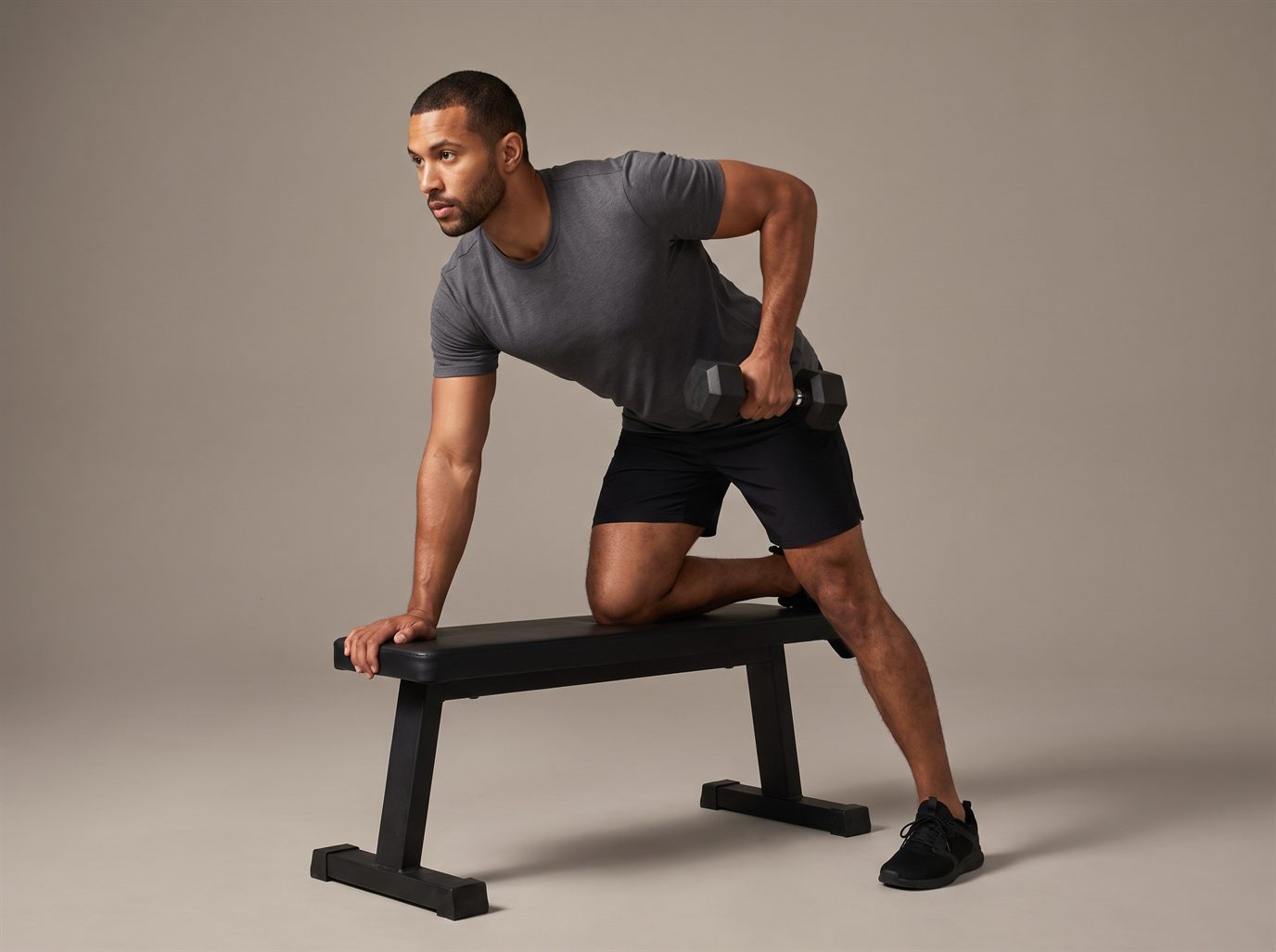
Illustration. The one-arm lat row, braced on a bench. The elbow travels toward the hip, not straight up beside the ribs.
This is a row angled steeply enough to bias the lat rather than the mid-back. Torso at roughly 45°, elbow driven down and back toward the hip, hips level and facing forward.
45°, not parallel. Steeper than a row, shallower than a pulldown. That angle is where the dumbbell’s line of pull sits closest to the lat’s line of action, and it is the whole point of the exercise.
Elbow to the hip pocket. The path is diagonal — down and back, not straight out to the side. Pull to the ribs and you have built yourself a horizontal pull, which you already have.
Hips stay square. The moment the torso rotates to finish a rep, the lat has handed the work to the obliques. Cut the set there.
The Load Rule for Free Weights
Free weight replaces machine → cut the load 20–25%, keep the reps.
Use about 20% less per hand than your machine row equivalent. 3 × 10–12 per side, one-second squeeze at the top. Run the weaker side first and match the stronger side to it.
A machine stabilises you and a dumbbell does not, so handling less absolute load for the same difficulty is the substitution working correctly. It is not you getting weaker.
The Error That Ruins All Three
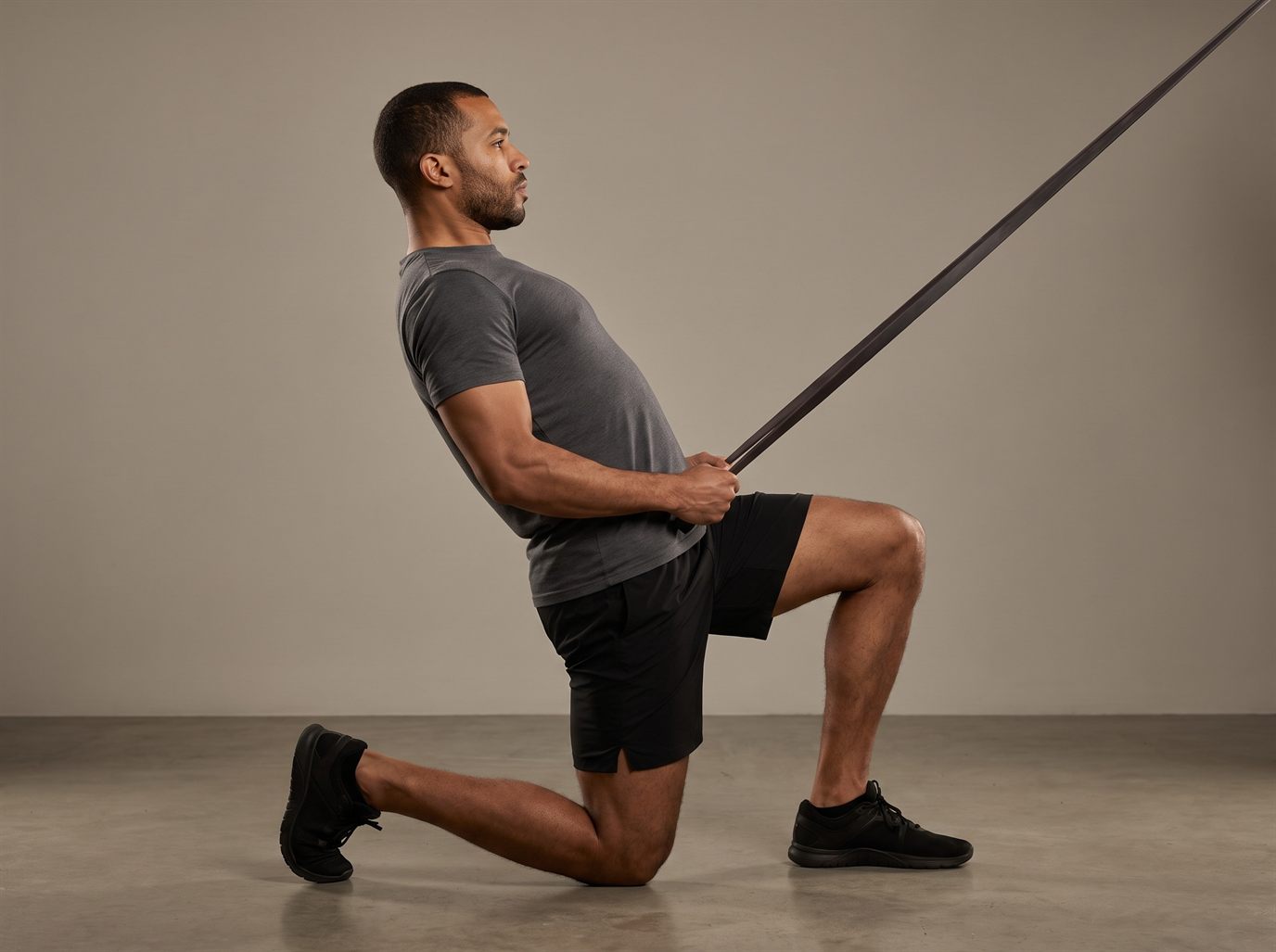
Illustration. The most common failure in any band-based lat pulldown alternative — the body moves backward around the band instead of pulling the band down.
Leaning back to finish the pull. The band wins, the lat loses.
What it looks like: the band never really got pulled down. The body moved backward around it instead — torso 30° past vertical, ribs flared, brace lost, chin jutting forward.
Why it happens is more useful than what it looks like. The band is too heavy at the exact point in the range where it is hardest. Rather than fail the rep, the torso rotates backward to shorten the lever. You end up training a mediocre kneeling hip hinge and calling it back day.
The fix, in order:
- Step closer to the anchor, or drop one band size.
- Squeeze the glute of the down-side leg — that locks the pelvis.
- Exhale and settle the ribs.
- Pull, and end the rep the moment the torso wants to move.
The tell that you fixed it: film one set from the side. Your ear, shoulder and hip should stay on one vertical line from the first rep to the last. If the line breaks on rep nine, your working set was eight.
Lat Pulldown Alternatives Compared
| Swap | Match | Equipment | Resistance profile vs. cable | Prescription |
|---|---|---|---|---|
| Band lat pulldown | ★★★ | Band set + high anchor | Rises toward the finish | 3 × 15, 1s hold at bottom |
| Dumbbell pullover | ★★☆ | Dumbbell + flat bench | Peaks at the deep stretch | 3 × 10–12, −20%, 3s down |
| Half-kneeling lat row | ★★☆ | Dumbbell only | Peaks mid-range | 3 × 10–12 per side, −20% |
| Pull-up / chin-up | ★★★ | Bar + bodyweight | Hardest near the top | Not scalable down without a band |
The band lat pulldown wins on fidelity and cost. It is the only option here that reproduces the overhead line of pull without a bench, and the only one that scales load by taking a step.
The pullover is the most valuable addition, not substitution. Because it loads the stretch rather than the contraction, it covers a part of the range the machine never did. Just do not treat it as a lat isolation exercise: EMG research suggests the chest does much of the work, so pair it with a pull that keeps the elbows close to the body.
Pull-ups deserve an honest caveat. They are a superb vertical pull and I do them. They are a poor alternative for most people, because you cannot reduce the load below your bodyweight without adding a band anyway — at which point you own the equipment for Swap A regardless.
Get the whole system, not just this pattern
The lat pulldown is one of six machine patterns. The Machine Swap Playbook maps every common station to its pattern, gives you three ranked swaps for each with the same star ratings you see above, and puts all three load rules on a single printable page.
Eighteen swaps. Forty pages. Free, no upsell.
What You Actually Need to Buy
The playbook names buying criteria rather than brands on purpose, because criteria stay true after the deals expire. This is the page where the current picks live.
Ranked by how much each purchase unlocks, cheapest first.
Step 0 — A resistance band set with a door anchor
This is the highest-leverage purchase in home training, and it is not close. It unlocks 6 of the 18 swaps in the playbook — one in every single pattern — and it fits in a bag.
What to look for:
- A graduated set, not a single band. You want to change load by changing band, not only by changing your distance from the anchor.
- A door anchor with a fabric-wrapped ball, not a bare strap. The strap versions chew through door frames and slip.
- Sleeved or layered latex if the bands will ever touch a rough floor.
- Handles that swivel, which matters more on vertical pulls than on anything else.
My current pick is the Lifeline Variable Resistance Trainer Kit: bands you combine to change resistance, a door anchor, and handles, all in one carry bag.
If your existing bands are fine but the anchor is the weak point, that is worth buying on its own. A bad anchor is the most common reason people set the band line too low and end up doing Swap A wrong. Lifeline sells its Heavy Duty Door Anchor separately, and it is a cheap fix.
Step 1 — Adjustable dumbbells and an adjustable bench
This unlocks 7 more swaps and again covers every pattern, including both of the dumbbell-based lat pulldown alternatives above. In practice these are one purchase: most of the dumbbell swaps need a bench to exist at all.
Dumbbell criteria: 5 lb increments below 30 lb, because that is where accessory work lives; at least 50 lb per hand; a locking mechanism you would trust directly over your face; a handle you can hold with sweaty hands; a compact shape when loaded light, or rows get awkward.
Bench criteria: a true flat position with no gap at the seat; an incline setting at or near 30°; a pad narrow enough that your shoulder blades can retract past it; a rated capacity above your bodyweight plus your heaviest press, with margin.
I have tested most of the adjustable dumbbell systems worth considering. The honest summary is that they fail in different places rather than one being best:
- I Used PowerBlock Dumbbells for 6 Months. Here Is What Wore Out First. — nothing broke, but the wear pattern tells you how to store them.
- I Tested Ironmaster Adjustable Dumbbells and Timed Every Plate Change — the most durable, the slowest to adjust.
- I Tested NÜOBELL Adjustable Dumbbells and Checked Whether the Price Holds Up — best handle, wholly dependent on the cradle.
- I Ran Bowflex SelectTech Dumbbells Through 500 Sets and Logged Every Fault — the weakest of the four on wear.
- I Lived With Adjustable Dumbbells for a Year and Here Is What Breaks First — the pattern across all of them.
For the bench, my pick is the REP Nighthawk Adjustable Bench: flat, incline and decline in one frame, and it folds away when you need the floor back.
Step 3 — A rack, eventually
A rack unlocks nothing new. It makes what you already own usable alone, and it gives you a fixed high anchor for band pulldowns at exactly the height you want, every time — which is the single biggest quality-of-life upgrade for Swap A.
Buy it when you are training solo and want to press near failure without a spotter. Check your ceiling height before you check the price.
People usually buy this list backwards, starting with the rack because it looks like a gym. Bought in the order above, you have full coverage of all six patterns after Step 1.
Five Things to Check Before You Commit to a Lat Pulldown Alternative
- Can you get an anchor 12 inches above your reach? If not, Swap A is off the table and you are choosing between B and C.
- Do you have a bench with a true flat setting? The pullover needs one. A bench with a permanent slight incline changes where the stretch lands.
- Is your ceiling high enough to kneel with your arms overhead? Basements catch people out here.
- Does your door frame take an anchor safely? Hollow-core and some uPVC frames do not.
- Are you willing to film one set? The lean-back error is invisible from the inside, and everything above depends on catching it.
Free Tools for Replacing the Lat Pulldown
- Machine Swap Finder: all three lat pulldown swaps on one card, with the setup cues and the load rule for each.
- Machine Load Converter: enter what you used on the stack and get a starting point for each swap.
- Swap Fault Finder: describe what feels wrong in your own words and get the fix, in order.
Questions People Ask About Lat Pulldown Alternatives
What is the best lat pulldown alternative at home?
The half-kneeling band lat pulldown, anchored about 12 inches above your reach. It is the only option that reproduces the machine’s overhead line of pull without needing a bench, and load is adjusted by stepping toward or away from the anchor. Use 3 × 15 with a one-second hold at the bottom in place of 3 × 10 on the machine.
Can resistance bands really replace a lat pulldown machine?
Yes, for the pattern — provided you correct for the profile. A band’s tension rises as it stretches, so it is hardest at the finish, while a cable is near-flat throughout. Applying the band load rule — 1.5× the reps plus a one-second hold at peak contraction — closes that gap. Bands fail to replace a pulldown when people keep machine rep schemes and skip the hold.
Is a dumbbell pullover a good lat pulldown alternative?
It is a useful addition, but only a partial substitute. The pullover loads the deep stretch while the pulldown loads the contraction, so it trains the same pattern at the opposite end of the range. EMG research also suggests it works the chest more than the lats, so pair it with a lat-focused pull rather than relying on it alone. Start 20% lighter than you think, take three seconds on the eccentric, and stop one to two reps short.
Are pull-ups better than a lat pulldown?
For stimulus, they are excellent. As an alternative, they are limited, because you cannot scale the load below bodyweight without adding a resistance band — and once you own the band and an anchor, the band lat pulldown is available to you anyway. Most people are best served doing both.
How much weight should I use when I switch off the machine?
Cut the load 20–25% and keep the reps when a free weight replaces a machine. The machine was stabilising you; a dumbbell is not. Handling less absolute load for the same difficulty means the substitution is working, not that you have lost strength.
Why do I feel my biceps instead of my lats?
You are pulling with your hands. Treat the hands as hooks and drive the points of the elbows down and back toward your rear pockets. If it persists on band work, the anchor is probably too low — below roughly 60° from the floor the movement becomes a horizontal pull, and the arms take over.
Do I need a bench for a lat pulldown alternative?
Not for the band version, which is the highest-ranked swap. You need one for the dumbbell pullover. The half-kneeling one-arm lat row needs only a dumbbell and something to brace against.
How do I know if my band is too heavy?
If your torso moves backward to finish the rep, it is too heavy at the hardest point of the range. Step closer to the anchor or drop a band size. Filming one set from the side is the only reliable check — ear, shoulder and hip should hold one vertical line for every rep in the set.
The Verdict on Training Without a Lat Pulldown
After 24 months, the honest finding is that the machine was never the thing I needed. The vertical pull was.
The band lat pulldown is the closest lat pulldown alternative for almost everyone, costs the least, and travels. The dumbbell pullover earns its place by loading a part of the range the machine never did. The half-kneeling lat row is the fallback when there is no overhead anchor, and it is a better exercise than its third-place ranking suggests.
What made the difference was not the exercise list. It was applying the load rule every time — 1.5× reps and a hold for bands, minus 20–25% for free weights, three-second eccentrics when the hard part moves. A substitute that trains the right pattern with the wrong load is still a missed session.
That principle generalises well past this one machine. The Machine Swap Playbook runs the same process for all six patterns — vertical pull, horizontal pull, hip hinge, knee extension, knee flexion, horizontal push — with eighteen ranked swaps and a one-page cheat sheet built to be screenshotted and used standing in front of a taken rack.
→ Send me the playbook — it’s free
Affiliate disclosure: WildnSwole earns a commission when you click a link to a partner and make a purchase. As an Amazon Associate, I earn from qualifying purchases. Commissions do not change what the content recommends and they do not add to what you pay.
The content in this article is for general information only and does not constitute medical or personal training advice. Always consult a qualified professional before making changes to your training.
Leave a Reply