Ironmaster Dumbbell Review: 192 Timed Changes, Worth It?


Illustration. Square plates, a metal handle and a screw at each end: the whole mechanism, and the reason every change is a physical job.
This Ironmaster dumbbell review is built on a stopwatch. I bought the Ironmaster 75 lb Quick-Lock set for $699 in March 2024, and over the next 30 days I timed every plate change: 192 adjustments, measured from the moment I touched a locking screw to the moment both dumbbells were ready to lift.
The short version: they are slow, and the slowness costs less than you would think.
A one-plate change on a single dumbbell started at 25 to 35 seconds and settled at 15 to 22. A large change across both dumbbells started near two minutes and settled at 60 to 80 seconds. Straight sets never noticed the difference. Drop sets never recovered from it.
There is no dial here, no selector pin, no cradle. Square plates slide onto a metal handle, and a threaded screw clamps them down. Every weight change is a physical job, and there is almost nothing inside to break.
How This Ironmaster Dumbbell Review Was Timed
Every adjustment went into a log: starting weight, new weight, how many plates moved, seconds for one dumbbell, seconds for the pair, and whether anything went wrong. A plate out of line counted. A screw that needed another turn counted. A change I fumbled because I was tired counted.
The clock started when I touched the first locking screw and stopped when both dumbbells were loaded and ready to lift. I did not pause rest periods to make the numbers look better. If a change ran long, it ran long.
That produced 192 timed adjustments across 30 days of normal training: straight sets, supersets, a handful of drop sets, and heavy compound work.
How the Quick-Lock System Works
Each Ironmaster dumbbell handle has a square loading post at both ends. Plates slide on. A long threaded screw runs through the stack and locks into the handle.
A weight change is six steps:
- Set the dumbbell on a stable surface.
- Unscrew the locking screw on one side.
- Add or remove plates.
- Reinsert and tighten the screw.
- Repeat on the other end.
- Repeat the whole sequence on the second dumbbell.
The square plates do one useful thing immediately: nothing rolls away while your hands are busy.
The First Week Was Slow
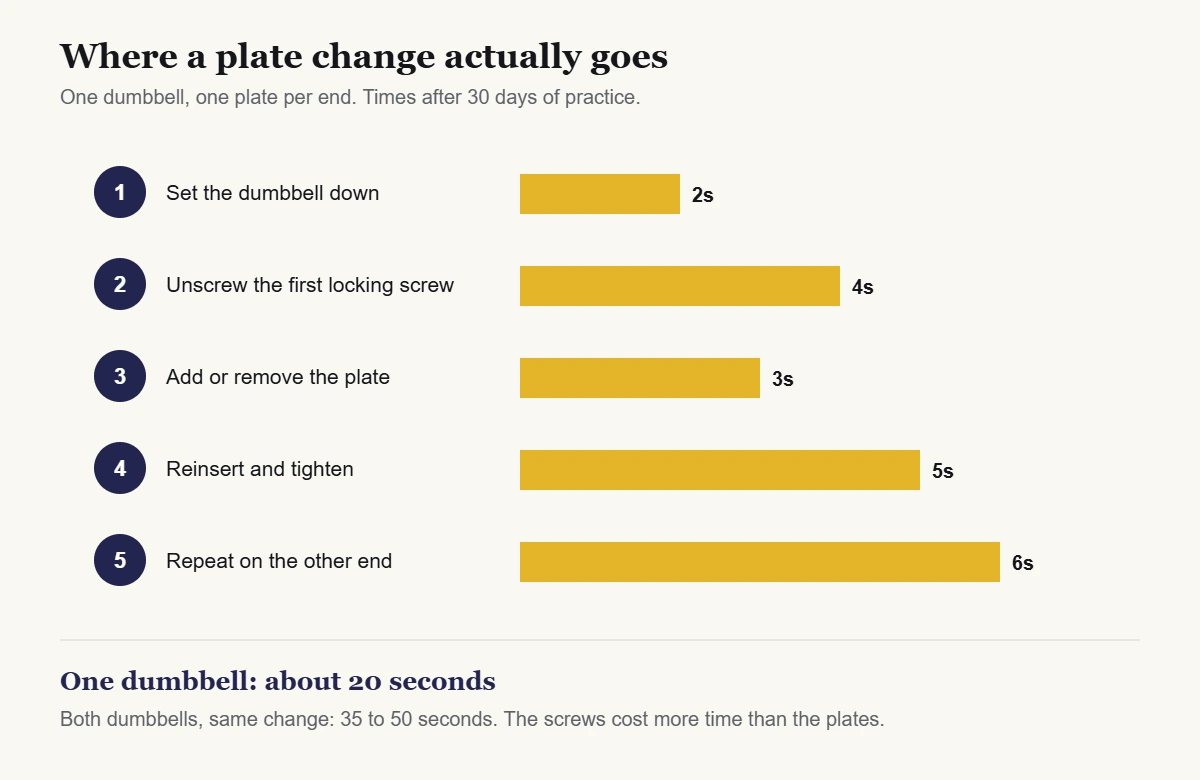
Illustration. Where the seconds go in a single plate change. The screws, not the plates, are the slow part.
My first sessions were clumsy. I checked plate order, checked that both sides matched, and lined up screws that did not want to go in.
| Type of change | First week |
|---|---|
| Small change, one dumbbell | 25 to 35 seconds |
| Small change, both dumbbells | 55 to 75 seconds |
| Large change, one dumbbell | 40 to 55 seconds |
| Large change, both dumbbells | 85 to 120 seconds |
Next to a dial, that is slow enough to feel it.
What Practice Actually Changed
Three habits did the work. I arranged spare plates by size within arm’s reach. I loosened each screw just enough to clear the stack instead of spinning it out. I loaded both dumbbells a step at a time rather than finishing one and starting the other.
| Type of change | After practice |
|---|---|
| Small change, one dumbbell | 15 to 22 seconds |
| Small change, both dumbbells | 35 to 50 seconds |
| Large change, one dumbbell | 25 to 38 seconds |
| Large change, both dumbbells | 60 to 80 seconds |
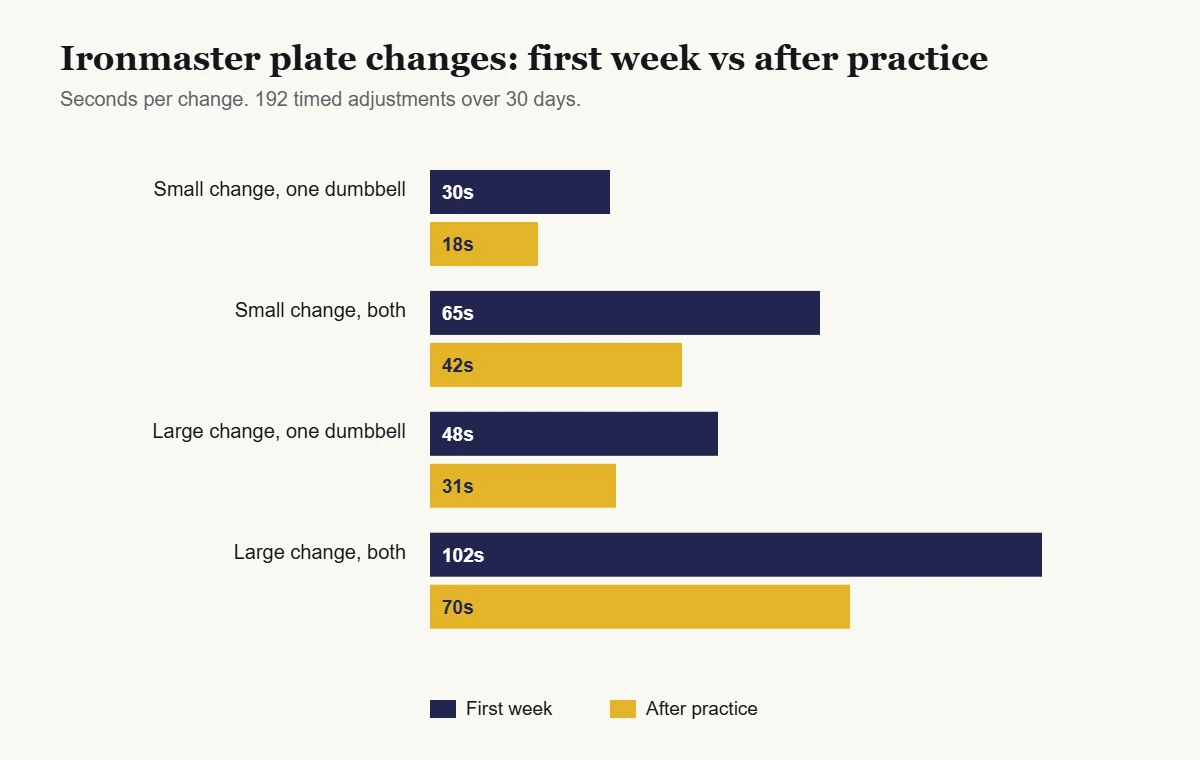
That is roughly a third faster across every category, and it came from organisation rather than technique. The dumbbells never became quick. They became predictable.
Small Change or Large Change
A small change meant one plate off each end. Those were fastest because the rest of the stack stayed put.
A large change meant swapping plate sizes or moving from an isolation weight to a compound weight. Going from lateral raises to rows took far longer than moving between two curl weights. The time depended on how many plates I handled, not on the final number.
Straight Sets: No Problem
Three sets of rows at the same weight require no adjustment at all. Moving to the next exercise gave me a minute or two of rest I wanted anyway, and the change fit inside it.
Grouping exercises by weight removed most changes entirely. Heavy rows, Romanian deadlifts, and split squats at one load, then a single drop to shoulder presses, curls and triceps work. Two changes for an entire session.
Supersets: Plan or Suffer
Supersets are where the design bites. Alternating heavy rows with light lateral raises means changing both dumbbells mid-superset, and 35 to 50 seconds is long enough to kill the effect you were chasing.
Three ways around it: use the same weight for both movements, pair exercises with similar loads, or keep a light pair of fixed dumbbells beside the rack. The third worked best. A cheap 15 or 20 lb pair for raises and rehab work removed most of my superset problems.
Drop Sets: The Real Weakness
A drop set needs the weight to fall in seconds. With fixed dumbbells, you put one pair down and pick up another. With an Ironmaster dumbbell, you unscrew, strip plates, and re-tighten while your forearms are burning.
I could fake it by loosening the screws in advance and planning a one-plate drop. It was not the same. If your training is built on rapid drops, this is the wrong system.
Plate Alignment and the Locking Screws
The square plates stack cleanly. The only alignment problem came from trying to start the screw before the stack was flush. If the openings sat slightly off, the screw caught. Pressing the plates together and nudging them into line fixed it. I never forced one.
The screws held. Across 30 days I had a handful of occasions where a screw moved slightly after high-rep sets, never close to backing out. I started squeezing each screw before a set, which takes about a second and removed the doubt entirely.
How Solid They Feel
This is what you are buying. The plates are clamped between the handle and the screw, so there is no rattle and no clicking during controlled reps. A properly tightened Ironmaster dumbbell feels closer to a fixed dumbbell than any dial system I have used.
Where the Shape Matters
Most exercises do not care. Three do.
One-arm rows were the highlight. Solid stack, metal handle, no movement between the plates, and enough available weight to keep loading.
Lateral raises were the worst fit. Not the lifting, the loading. Raises want small jumps and frequent changes, which is exactly what this system charges you for.
Goblet squats were awkward. Gripping a square end is less natural than cupping a round dumbbell head. I used two dumbbells at my sides instead.
Durability Is the Point
The parts list is short: metal handles, metal plates, threaded screws. Ironmaster publishes the specifications and add-on kits for the Quick-Lock system. There are no plastic selector dials, no internal rotating mechanism, no selection window, no cradle-dependent release, no selector pin to bend.
That is the whole argument for the system. Fewer moving parts, fewer things that can end the dumbbell’s life.
The 75 lb Ceiling Arrives Faster Than You Think
The base kit tops out at 75 lb per dumbbell. That is plenty for presses, raises, and most curls. It is not plenty for one-arm rows or Romanian deadlifts if you have been training for a few years.
I hit that ceiling on one-arm rows inside the first month, which is the one real limit of a 75 lb Ironmaster dumbbell. The fix is an add-on kit, which extends the same handles rather than replacing them, and that is the quiet advantage of a plate-loaded design: the part you outgrow is the cheapest part.
Before you buy the base set, work out where your heaviest dumbbell lift sits today and add 20 lb. If that number is above 75, budget for the expansion at the same time. Buying the kit later costs the same, but training around a ceiling for three months costs progress.
The same maths applies to every adjustable system. A dial set that stops at 52.5 lb per hand is a beginner’s purchase dressed as a permanent one.
Are They Drop-Safe?
No adjustable dumbbell is drop-safe, and this one is no exception. What it tolerates is ordinary handling: a controlled set-down on rubber flooring did not worry me the way it does with a cradle system.
Repeated drops from shoulder height will still damage handles, screws, plates or your floor. Durable is not indestructible.
Storage: The Hidden Cost
An Ironmaster dumbbell saves enormous space against a fixed rack, but the plates you are not using have to live somewhere. Without organisation, every change gets slower because you are hunting for the right plate.
A stand solves five problems at once: it raises the dumbbells to a workable height, keeps plates sorted, reduces bending, speeds up changes, and stops loose plates covering the floor. I would treat one as part of the purchase, not an accessory.
Ironmaster vs Dial Dumbbells
| Category | Ironmaster | Dial system |
|---|---|---|
| Adjustment speed | Slower | Faster |
| Durability | Simple parts | Mechanism dependent |
| Plate rattle | Minimal | Often noticeable |
| Drop tolerance | Better | Usually poor |
| Workout planning | Required | Optional |
| Fast drop sets | Weak | Better |
| Maintenance | Simple | Complex |
My own dial experience backs up the middle rows: across 500 logged sets, the Bowflex dials never failed, but the small faults added up. That is in the 500-set Bowflex SelectTech review. The NÜOBELL sits between the two on feel and price, covered in the NÜOBELL 580 review.
Ironmaster vs PowerBlock
PowerBlock changes weight faster through a selector pin and keeps every plate inside one block, so there is nothing loose to store. Ironmaster feels more like a traditional dumbbell and has fewer permanent mechanical parts.
PowerBlock suits frequent weight changes. Ironmaster suits heavy, planned lifting. Six months of PowerBlock wear is documented in my PowerBlock durability review, and the year-long comparison across designs is in what wears out first on adjustable dumbbells.
What I Paid Against the Alternatives
These are the prices I paid, not current prices:
- Ironmaster 75 lb Quick-Lock: $699 a pair, March 2024
- NÜOBELL 580: $769 a pair, October 2025
- Bowflex SelectTech 1090: $798 a pair, January 2026
- PowerBlock Elite USA 90: $819, June 2024
The Ironmaster dumbbell was the cheapest of the four, and the only one where I never worried about the adjustment mechanism.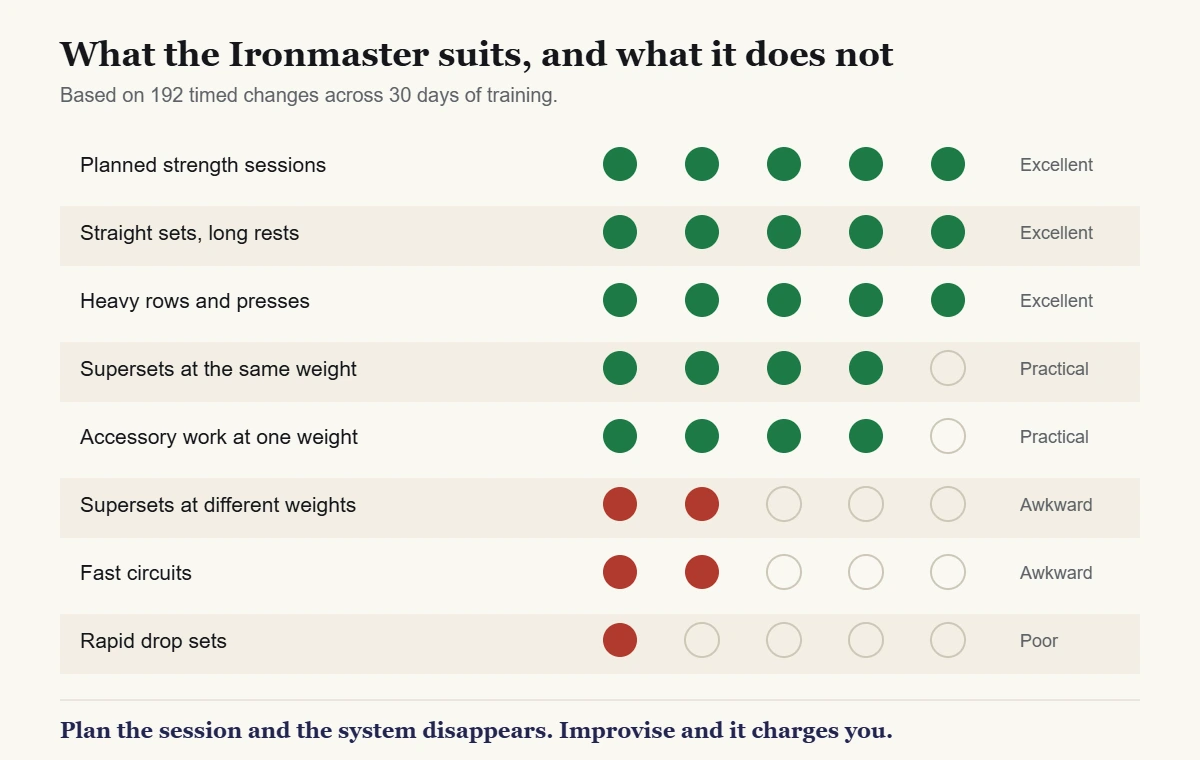
Illustration. Where the design earns its keep, and where it costs you the session.
Who Should Buy Them
- You train with straight sets and real rest periods
- You lift heavy rows, presses, and lower-body work
- You want a dumbbell that feels fixed under load
- You are willing to plan a session by weight
- You value parts you can replace over convenience
Who Should Skip Them
- You run drop sets or fast circuits
- You change weight after nearly every set
- You want a self-contained system with nothing loose to store
- You would rather not handle plates at all
How to Program Around a Slow Ironmaster Dumbbell
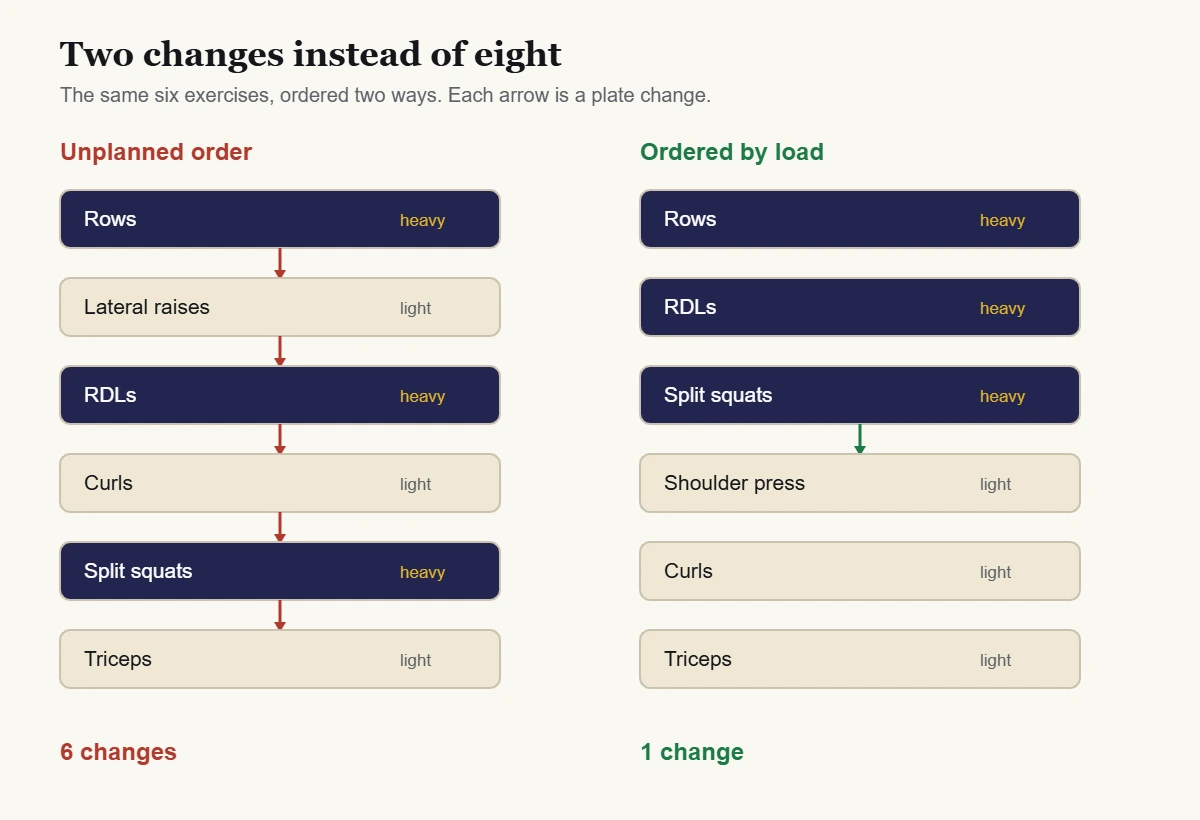
Illustration. The same six exercises, ordered two ways. Sorting by load removed five of the six changes.
Thirty days of timing changed how I wrote sessions more than it changed how I lifted. Five rules removed most of the waiting.
Order exercises by load, heaviest first. Rows, Romanian deadlifts, and split squats share a weight. Presses, curls, and triceps work share a lighter one. A session built that way needs two changes instead of eight.
Pair supersets at the same weight. Rows and floor presses at one load work as a pair. Rows and lateral raises do not, unless you own a second pair.
Keep one light fixed pair within reach. This is the single best fix. A 15 or 20 lb pair covers raises, rear delts, rotator cuff work, and warm-ups, and removes the changes that interrupt the most.
Pre-loosen for planned drops. If a drop set is coming, back the screws off before the working set so the plates are ready to come off. It turns a 40-second change into about 15.
Batch accessory work at one weight. Three exercises at 30 lb beats three exercises at three different weights when each change costs you half a minute.
None of this is necessary with a dial. That is the honest cost of the design: you pay for durability with planning. After a month, it stopped feeling like a constraint and started feeling like structure, but the first two weeks were genuinely annoying.
Ironmaster Dumbbell Review: The Verdict
The Ironmaster dumbbell trades speed for confidence.
After 192 timed changes the pattern was consistent. Small adjustments fit inside a normal rest period. Large ones interrupted the workout. Organising the plates cut roughly a third off both.
The system was excellent for straight sets, heavy compound work and structured strength training. It was poor for fast drop sets and supersets at different weights. If you train the first way, the slower changes cost you almost nothing. If you train the second way, buy a dial.
I finished the month wishing the adjustments were faster. I never finished a set wondering whether the dumbbells would hold.
Free Tools for Choosing Adjustable Dumbbells
- Adjustable Dumbbell Picker: answer a few questions about your room, budget and training, and it tells you which type of adjustable dumbbell suits you, or whether to buy something else first.
- Loadable Weight Rounder: see what a set’s weight jumps mean in practice, and which setting to use when your target falls between two.
Questions People Ask
How long does an Ironmaster weight change actually take?
After a month of practice, 15 to 22 seconds for a one-plate change on a single dumbbell and 35 to 50 seconds for the same change on both. Large changes across the pair ran 60 to 80 seconds. My first week was roughly a third slower than that.
Are Ironmaster dumbbells worth it?
If you train with straight sets and rest periods, yes. The slower changes fit inside rest, and you get a dumbbell with no dial, no selector pin and nothing fragile inside. If you run drop sets or change weight constantly, a dial system will serve you better.
Do the locking screws come loose?
Rarely. Across 30 days I had a few screws move slightly after high-rep sets, never close to backing out. Squeezing each screw before a set takes a second and settles the question.
Can you drop Ironmaster dumbbells?
Not repeatedly. They tolerate ordinary handling better than a cradle-based system, and a controlled set-down on rubber flooring is not a concern. Dropping them from shoulder height will still damage the handles, screws, plates or your floor.
Ironmaster or PowerBlock?
PowerBlock for frequent weight changes and self-contained storage. Ironmaster for heavy planned lifting, a solid feel and simple parts.
Do you need the stand?
Not strictly, but it changes the experience. It raises the dumbbells to a workable height, keeps plates sorted and cuts the time of every change. I would budget for it.
Is 75 lb enough for adjustable dumbbells?
For presses, raises and curls, yes. For one-arm rows and Romanian deadlifts, most lifters pass 75 lb within a year. Ironmaster sells an add-on kit that extends the same handles, so check your heaviest dumbbell lift before choosing between the base set and the expansion.
Do Ironmaster dumbbells need a stand?
No, but the stand changes the experience more than any other accessory. It lifts the dumbbells off the floor, keeps the spare plates sorted and takes seconds off every change. Without it, plate changes slow down because you are hunting for the right plate.
Free guide
Buying your first adjustable dumbbells? Start with the swap list.
The free Machine Swap Playbook maps every common gym machine to the movement it trains and ranks the three purchases that cover the most gaps.
2 Responses to Ironmaster Dumbbell Review: 192 Timed Changes, Worth It?