500 Sets With Bowflex SelectTech Dumbbells: Nothing Broke, But the Friction Adds Up
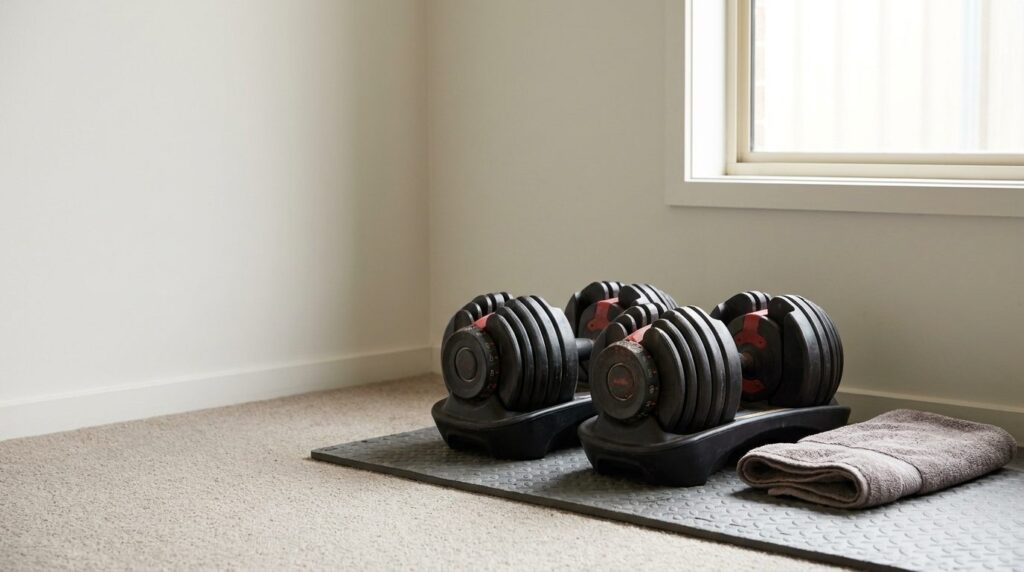
Illustration. Dial-adjustable dumbbells stored the way most people keep them, on the floor rather than on a stand.
Nothing failed. No dial seized, no plate came off mid-repetition, no handle cracked, and after 500 working sets both dumbbells still reached every setting on the dial.
That is the headline, and it is also not the story. What the test actually exposed was a different kind of problem: a set of small interruptions, none of which matter once, all of which keep happening. A stuck dial costs you fifteen seconds. A rattling set is easy to ignore. A misaligned cradle takes a moment to fix. Multiply any of those by a few hundred and you are no longer describing a minor annoyance, you are describing what owning these is like.
This Bowflex SelectTech 1090 review covers the BowFlex Results Series 1090 SelectTech, bought for $399 per dumbbell in January 2026. Five hundred sets is long enough to find the repeating problems and honest enough not to pretend it is a multi-year durability verdict. For what a full year did to the smaller SelectTech 552, see my one-year wear report.
Why 500 Sets
Most adjustable dumbbell reviews, including most Bowflex SelectTech 1090 reviews, are written after a fortnight. They cover weight range, adjustment speed and space savings, all of which you can assess on day one, and none of which tell you what the mechanism does after hundreds of cycles.
A SelectTech has far more that can go wrong than a fixed dumbbell. Two dials per dumbbell must rotate. The selector must catch the right plates. The cradle must hold everything in alignment. The handle must stay comfortable. Because the design uses two dials per dumbbell, the adjustment mechanism was worked far more times than 500.
I counted a fault whenever something interrupted normal use: a dial that would not turn, a plate lifting when it should have stayed behind, rattling loud enough to distract, alignment that stopped a weight change, or grip wear that changed how the set felt. I did not drop them and I did not abuse them.
The Five Things That Actually Went Wrong
Ranked by how often I hit them, not by how bad they were.
| Fault | How often | Severity | What it costs you |
|---|---|---|---|
| Plate rattling | Most common | Low | Feel and noise, no function lost |
| Cradle misalignment | Common | Moderate | Interrupts the weight change |
| Dial resistance | Occasional | Low to moderate | Delays the adjustment |
| Plate sticking | Less frequent | Moderate | Needs a visual check before lifting |
| Grip wear | Gradual | Low | Comfort on longer sets |
| Complete failure | Never | — | Both dumbbells finished the test |
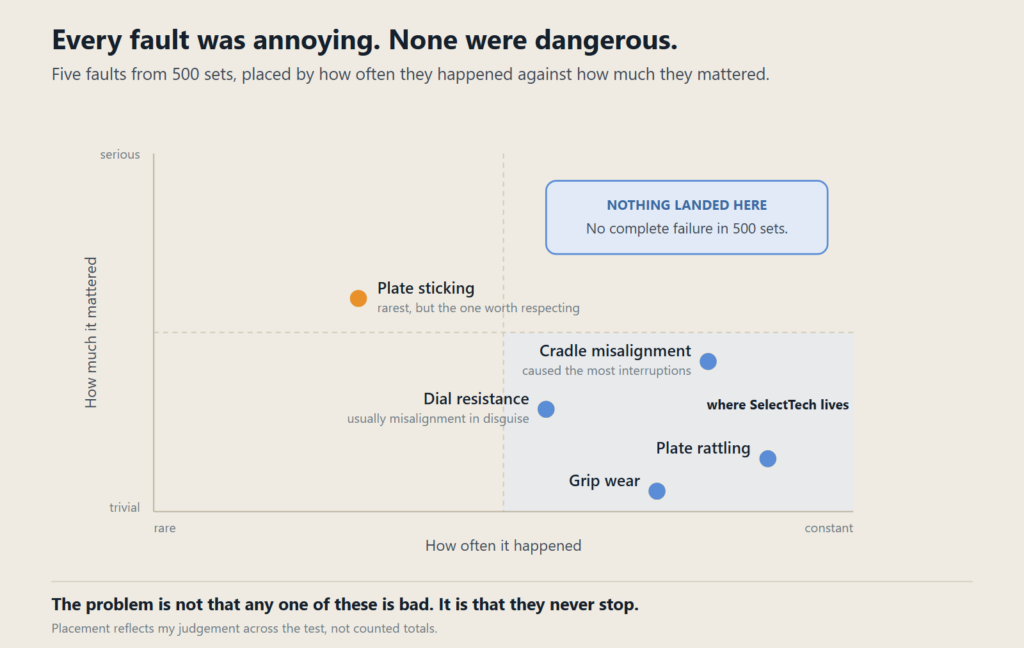
Figure 1. Everything clustered in the same corner. The quadrant that would worry you stayed empty for 500 sets.
Rattling was constant and mostly harmless. Adjustable dumbbells are separate plates held by a selector, so some movement is unavoidable. Slow curls and presses were fine. Walking lunges, Romanian deadlifts, fast rows and hammer curls made it obvious. It never became loud, and it never felt dangerous. It also never went away, and anyone coming from rubber hex dumbbells will notice immediately.
Cradle misalignment caused the most actual interruptions. The cradle is not a storage tray, it is part of the adjustment system. Lower the dumbbell at an angle and a dial will not turn, or one plate sits too high, or one side selects while the other does not.
Dial resistance was almost always misalignment wearing a different hat. When a dial would not move, the cause was nearly always that the dumbbell had not seated properly. I never forced one, and neither should you. The mechanism contains moving plastic parts, and forcing a stuck dial is how a two-second alignment problem becomes a warranty conversation.
Plate sticking was rarer and the one worth respecting. Occasionally an unselected plate lifted slightly with the dumbbell and dropped straight back. It happened most when I pulled the handle up diagonally rather than straight. No unselected plate ever stayed attached through a set, but unexpected plate movement is the one fault on this list that could hurt you.
Grip wear was slow and cosmetic. The handles never cracked, bent or loosened. The surface smoothed where sweat and skin oils collected, and the contoured plastic grip became more noticeable during rows and higher-repetition work. Wipe it down after training. Do not spray liquid directly at the dumbbell, because moisture reaching the selector is a worse problem than a tacky grip.
Where the Speed Promise Breaks
Turning two dials is genuinely fast, far faster than loading plates on a spin-lock set. That advantage is real, and it holds for as long as the dumbbell is sitting square in its cradle.
When it is not, the weight change stops being a dial turn and becomes a cycle: stop turning, lift the handle slightly, realign, press it fully back into the cradle, try again. That is not a catastrophe. It is also not the frictionless experience the product is sold on.
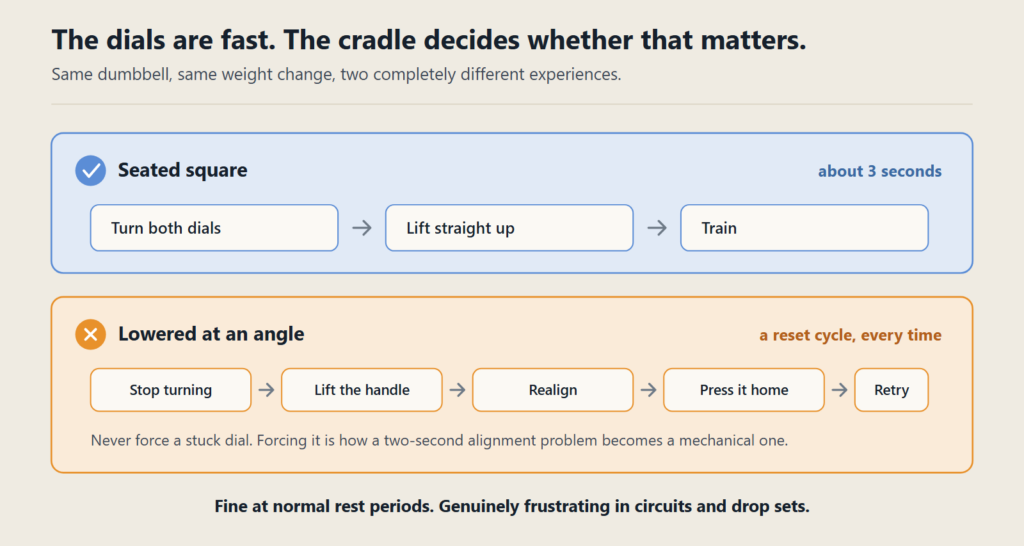
Figure 2. The dial speed is real. It only exists on the first path.
For normal training with standard rest periods this barely registers. For fast circuits or aggressive drop sets it is genuinely frustrating, because the interruptions land exactly when you have no time for them.
Two things reduced it. Cleaning dust, hair and debris out of the cradles with a dry cloth helped the plates settle. And a hard level floor mattered more than I expected, because thick carpet made the cradles feel vague and misalignment more likely.
The Check That Should Be Automatic
Before every set, and especially before a heavy one, this took a couple of seconds and caught every problem before it mattered.
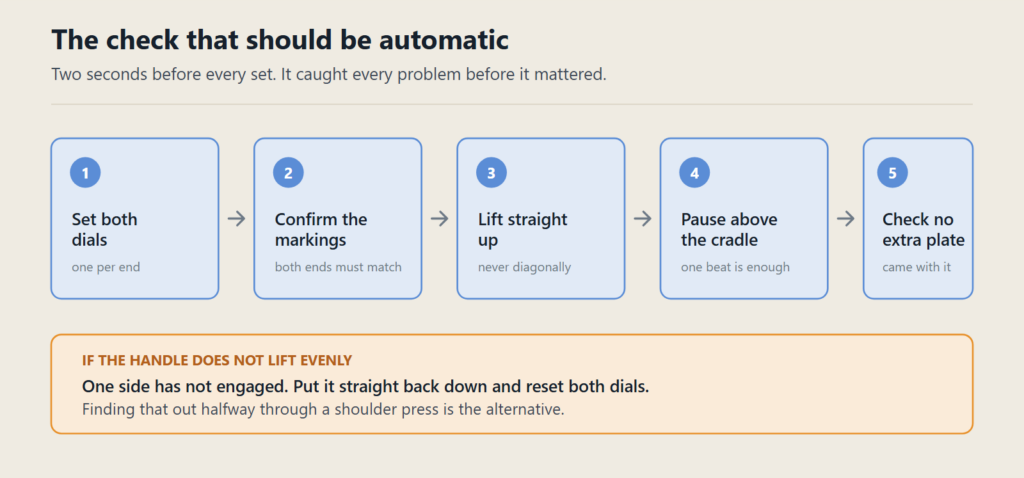
Figure 3. Two seconds per set. It caught every problem before it mattered.
Set both dials. Confirm the markings match on each end. Lift straight up rather than diagonally. Pause briefly just above the cradle. Confirm no extra plate came with it.
If the handle does not lift evenly, one side has not engaged. Put it straight back down, reset both dials, and start again. That is inconvenient. Discovering it halfway through a shoulder press is worse.
How They Actually Feel to Train With
Across 500 sets with the Bowflex SelectTech 1090, the pattern was consistent: fine for controlled work, awkward wherever size or shape mattered.
Shoulder presses and one-arm rows were the best of it. Balanced, easy to load up after a warm-up, and enough weight for productive sets. I avoided clashing them together overhead, since repeated impact is exactly what the mechanism is not built for.
Curls and lateral raises were the worst of it. These dumbbells stay long even at light settings, so they feel bulky near the hips during curls and oversized for the load during raises. Compact fixed dumbbells are simply better here.
Goblet squats were awkward because the ends are not shaped for holding. Two dumbbells at your sides works better.
Floor presses exposed the real limitation. The pressing itself was stable. The problem is that you cannot dump them at the end, so you lower under control or roll to one side. I finished most sets with a repetition still in the tank, which is a training decision the equipment made for me rather than one I chose.
The No-Drop Limitation Is the Real Constraint
Internal selector components, plate guides, the handle housing and cradle alignment are all things a drop can damage. This is not a manufacturer being cautious, it is the actual design.
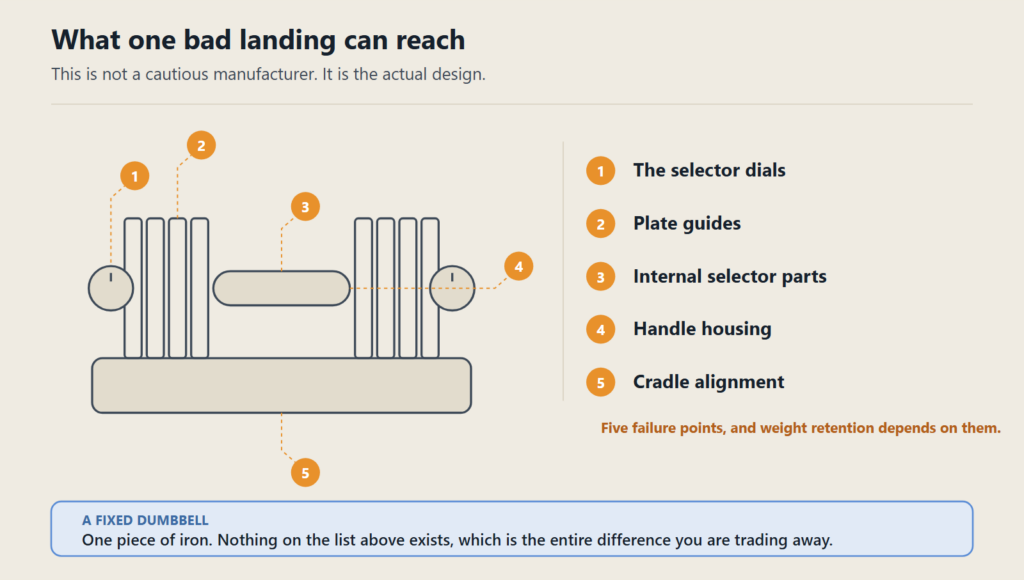
Figure 4. Five failure points a fixed dumbbell simply does not have.
That changed how I trained. I stopped heavy presses before the point where control might go. I planned how to put the Bowflex SelectTech 1090 down before starting floor work. If you routinely release dumbbells after a hard set, this system will fight you the entire time you own it.
What It Still Gets Right
The space saving is not a marketing line, it is the whole reason the category exists. A fixed collection covering the same range needs a multi-tier rack and the floor in front of it. The SelectTech pair needs two cradles.
For an apartment, a bedroom, an office or a small garage, an imperfect adjustable system that fits beats a perfect rack that does not. For a lot of buyers, that single fact settles the decision before any fault log is relevant.
Where It Sits Against the Alternatives
| System | Price I paid | Durability over a long test | Feel at light settings | Verdict |
|---|---|---|---|---|
| Bowflex SelectTech | $798 a pair (1090) | Repeated minor faults, no failures | Long and bulky | Fast dial, most interruptions |
| PowerBlock | $819 (Elite USA 90) | Cosmetic wear only at six months | Compact block | Simplest mechanism to inspect |
| NÜOBELL | $769 a pair | Solid, entirely cradle-dependent | Shortens with the weight | Closest to a fixed dumbbell |
| Ironmaster | $699 a pair | Almost nothing mechanical to fail | Solid throughout | Most durable, by far the slowest |
Against PowerBlock, the pin is easier to inspect than an enclosed dial, and it accumulated less wear over a comparable test. See my six-month PowerBlock wear report.
Against NÜOBELL, you are giving up the knurled steel handle, the compact profile at light weights and the better build, and at the prices I paid, you are not saving money for it: $798 for the pair of 1090s against $769 for the NÜOBELL. See the NÜOBELL 580 review.
Against Ironmaster, you are trading almost all the durability for a much faster weight change, and paying about $100 more for it.
The honest position for SelectTech is this: at close to the same price, the PowerBlock and NÜOBELL both gave me fewer interruptions, and the Ironmaster costs less than all three. Buy the SelectTech if you find it discounted well below them, or if you simply prefer the dial system.
Who Should Buy Them
The Bowflex SelectTech 1090 makes sense if you have limited space, train at home with controlled technique, want a lot of weight options for the money, will not drop them, and can live with plate noise and the occasional reset. If that is you, check today’s price on the Bowflex SelectTech 1090 (affiliate link). It is sold as a single dumbbell, so you need two.
They do not make sense if you drop weights or lift explosively, want commercial-gym durability, are irritated by rattle, need genuinely instant changes for circuits, want compact dumbbells at light settings, prefer a knurled metal handle, or have room for a rack.
Free Tools for Choosing Adjustable Dumbbells
- Adjustable Dumbbell Picker: answer a few questions about your room, budget and training, and it tells you which type of adjustable dumbbell suits you, or whether to buy something else first.
- Loadable Weight Rounder: see what a set’s weight jumps mean in practice, and which setting to use when your target falls between two.
Questions People Ask
Do Bowflex SelectTech dumbbells break easily?
Not in my testing. Across 500 sets nothing failed, no component broke and both dumbbells still reached every setting. The problems were repeated minor interruptions rather than breakages, which is a different complaint but a real one.
Why won’t my Bowflex dial turn?
Almost always because the dumbbell is not seated properly in its cradle, so a plate is out of position and the selector cannot move. Lift the handle slightly, realign, press it fully back into the cradle and try again. Never force it, because forcing a stuck dial is how you turn an alignment problem into a mechanical one.
Is it normal for Bowflex dumbbells to rattle?
Yes. The plates need clearance to engage and disengage from the selector, so some movement is designed in. It is most obvious during fast direction changes and least obvious during slow controlled repetitions. It does not indicate a fault.
Can you drop Bowflex SelectTech dumbbells?
No. A drop can damage the dials, plate guides, selector components, handle housing and cradle alignment. If training to failure and releasing the weights is part of how you lift, buy fixed dumbbells instead.
What happens if a plate lifts when it should not?
Lower the dumbbell straight back into the cradle and reset both dials. It is usually caused by lifting the handle diagonally or by neighbouring plates sitting slightly out of line. Lifting vertically and pausing above the cradle for a second prevents nearly all of it.
Do you need a stand for Bowflex dumbbells?
Not required, but it fixes a real problem. Keeping them on the floor means bending for every adjustment, and tired placement is what causes the misalignment that interrupts weight changes. A stand also makes the dials easier to read.
Bowflex or PowerBlock?
PowerBlock, if durability and a mechanism you can see matter most. At the prices I paid the two were within about $20 of each other, so price should not decide it. Over comparable testing the PowerBlock accumulated less wear and fewer interruptions.
Bowflex SelectTech 1090 Review: The Verdict
After 500 sets, Bowflex SelectTech dumbbells are mostly reliable and not quite confidence-inspiring, and both halves of that sentence are true.
They survived. The dials still work, the selected plates stayed attached through every repetition, the space saving is genuine and no major component failed. Anyone telling you these are fragile has not run them.
What they never did was disappear into the training. Fixed dumbbells ask nothing of you. These ask you to return them carefully, check the markings, lift straight, watch the plates and never drop them. Each request is trivial. Five hundred sets of them is a tax, and whether you are willing to pay it is really the whole review.
If your alternative is a rack that will not fit in your home, pay it happily. If you have the room and you already know you are in this for years, buy something with less to go wrong. At these prices, it costs about the same or less.
Free guide
Replacing the gym with dumbbells? Start with the swap list.
The free Machine Swap Playbook maps every common gym machine to the movement it trains, shows how to load the dumbbell version, and ranks the three purchases that cover the most gaps. Adjustable dumbbells are one of the three. Read it before you order, not after.
Check today's price on the Bowflex SelectTech 1090 (affiliate link, sold as a single dumbbell)
Disclosure: As an Amazon Associate, I earn from qualifying purchases. If you buy through a link in this post, I may earn a small commission at no extra cost to you.
6 Responses to 500 Sets With Bowflex SelectTech Dumbbells: Nothing Broke, But the Friction Adds Up