I Replaced the Lat Pulldown With Dumbbells. Where the Elbow Goes Is the Whole Trick.

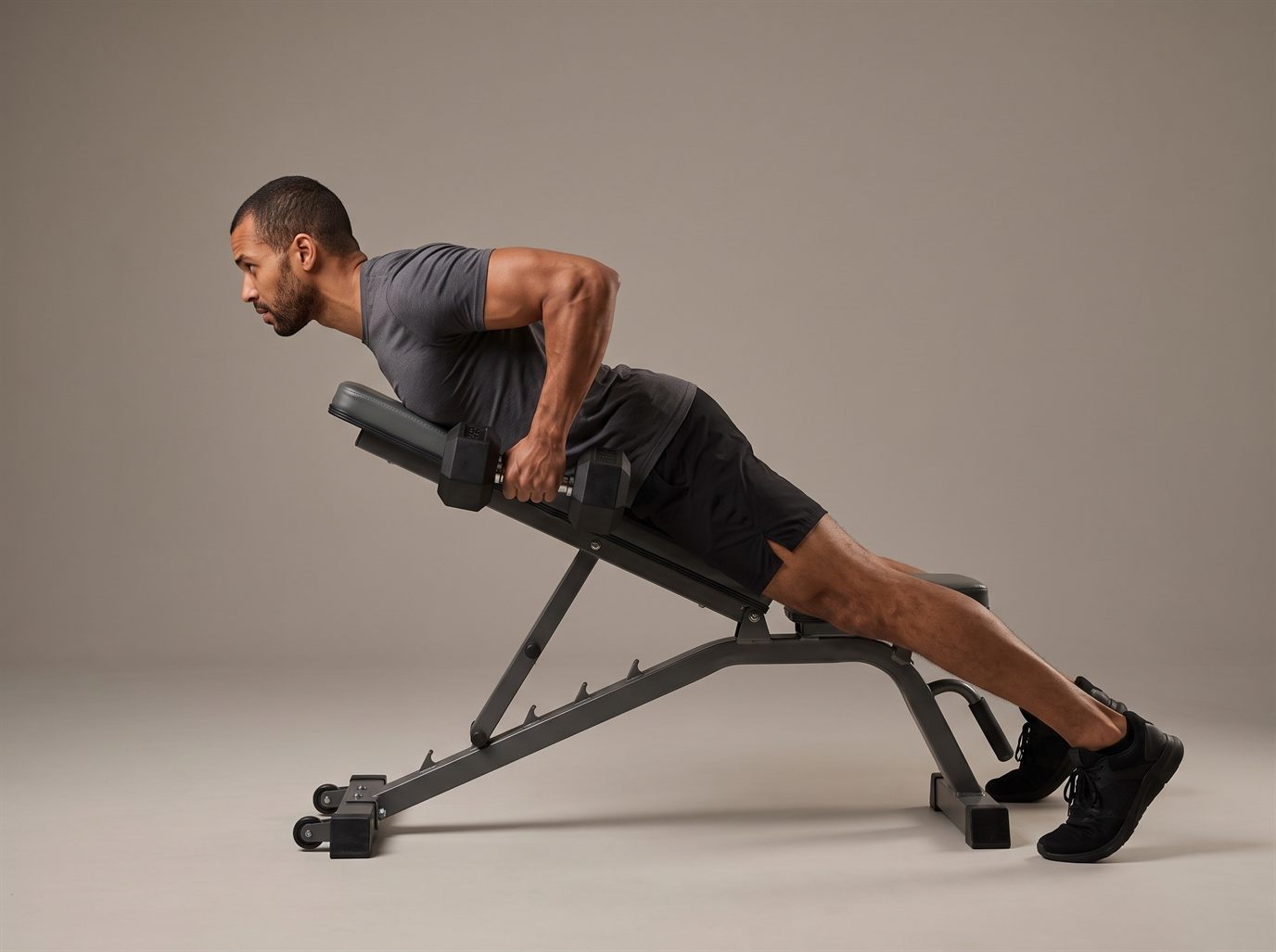
Illustration. The chest-supported dumbbell row on a low incline. Elbows close to the body are what move this row toward the lats.
Most lists of dumbbell lat exercises are really lists of rows. That is not wrong, exactly, but it skips the one detail that decides whether a dumbbell row trains your lats or your upper back — and it is not the exercise. It is where your elbow goes.
I have not had access to a lat pulldown for 24 months. The band version of the pulldown covers a lot of that gap, and I wrote up how the band lat pulldown works as a machine replacement separately. But plenty of home gyms start with dumbbells and a bench, not bands and a high anchor, and “just do rows” was the advice I kept running into.
This post is what I would have wanted instead: three dumbbell lat exercises, the elbow rule that changes what each one trains, an honest look at the pullover, and a single workout that puts them together. If you want the same approach for every machine you are missing, the free Machine Swap Playbook covers all six patterns.
Can Dumbbells Really Train Your Lats?
Yes — with one condition.
The lats pull the upper arm down and back toward the torso: shoulder extension and adduction. Any dumbbell movement that makes the arm do that under load trains them. The problem is that most dumbbell pulls can be done two ways, and only one of them puts the lats in charge.
A 2026 narrative review of lat EMG research in the Journal of Functional Morphology and Kinesiology pulled together 23 studies on pulling exercises. Two of its findings matter here. In the seated row, a narrower grip and a lower shoulder-abduction angle — elbows closer to the body — were each associated with greater lat activation. And across pulling exercises, the authors pointed to the relationship between the upper arm and the trunk as a likely key factor in which muscles take the load.
That is a careful finding, and it deserves careful wording: it measures how hard a muscle is working during a set, not how much it grows over months. But it matches what the playbook teaches and what I feel on every rep. The arm’s path is the variable. The exercise name is not.
The Elbow Rule for Dumbbell Lat Exercises
Everything in the rest of this post comes back to one table.
| Elbow path | What leads the pull | Pattern |
|---|---|---|
| Close to the body, travelling down and back toward the hip | Lats | Toward a vertical pull |
| Out from the body, travelling straight back toward the ribs | Upper back and rear delts | Horizontal pull |
| Flared wide, finishing high | Upper traps and rear delts | Horizontal pull, trap-heavy |
The same dumbbell, the same bench and the same exercise name can land in any of those three rows. That is why “do rows for your lats” is incomplete advice. A row done with flared elbows is a perfectly good upper-back exercise. It is just not one of the dumbbell lat exercises.
The practical version: if you want a pull to count toward your lats, keep the elbow close to your side and aim it at your back pocket, not at the ceiling.
1. The One-Arm Dumbbell Row, Lat Version
This is the most important of the three, and it is the one most often done wrong.
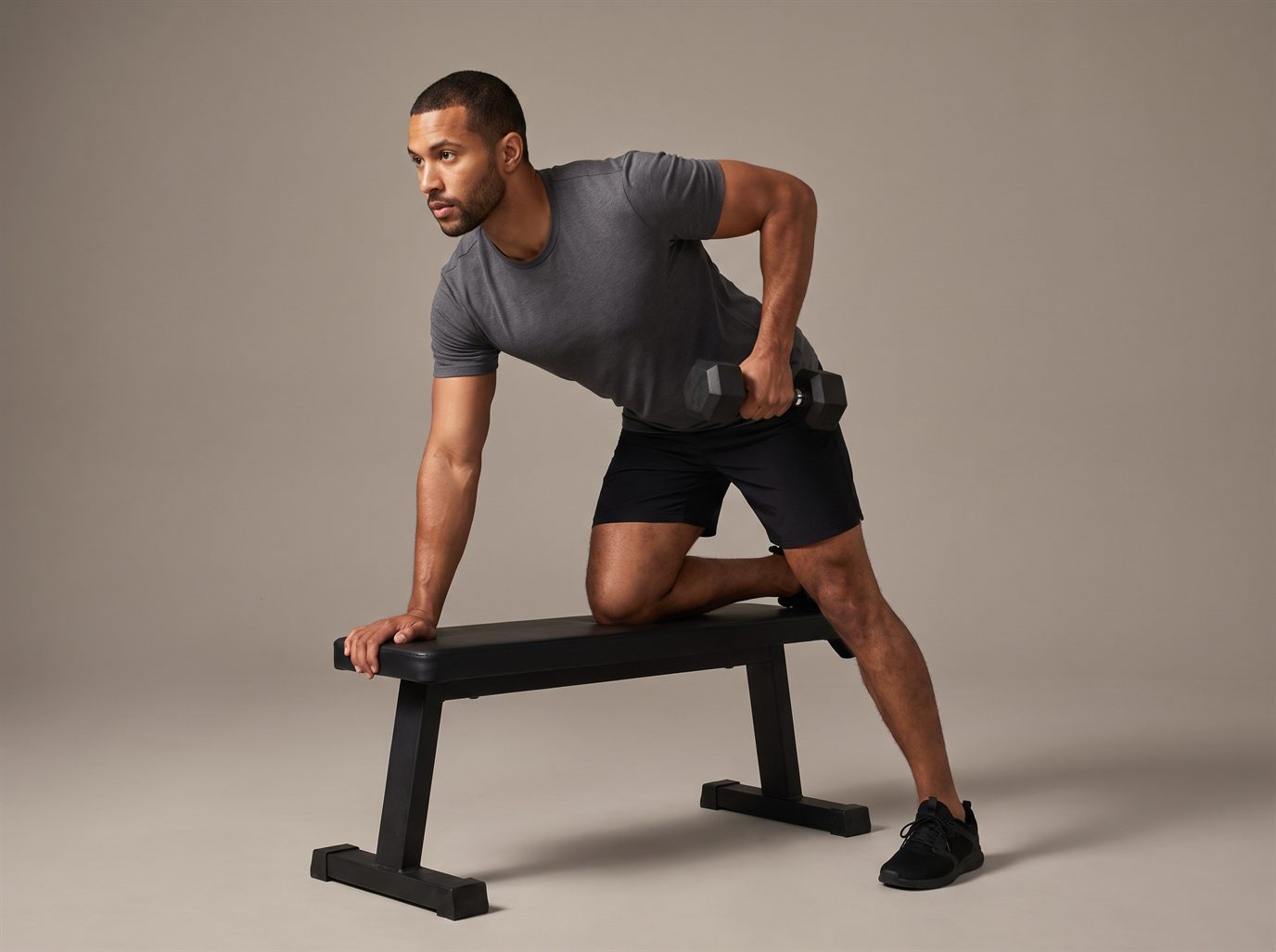
Illustration. The one-arm lat row, braced on a bench. The elbow travels toward the hip, not straight up beside the ribs.
Brace one hand and one knee on a flat bench, or kneel half-kneeling and brace on the bench with one hand. Let the dumbbell hang, then drive the elbow down and back toward the hip.
45°, not parallel. Tilt the torso to roughly 45°. Steeper than a normal row, shallower than a pulldown. That angle puts the dumbbell’s line of pull closest to the lat’s line of action.
Elbow to the hip pocket. The path is diagonal: down and back, not straight up. Pull to the ribs and you have turned this into a horizontal pull for your upper back, which is the most common way people lose the lats on this exercise.
Hips stay square. The moment the torso rotates to finish a rep, the lat has handed the work to the obliques. End the set there rather than twisting through it.
Load: use about 20% less than you would on a machine row. 3 × 10–12 per side, with a one-second squeeze at the top. Run the weaker side first and match the stronger side to it.
This is the exercise usually called the bent-over dumbbell row. The braced version is the same movement with the lower back taken out of it, which lets you spend the whole set on the lat instead of on holding your torso still.
2. The Chest-Supported Dumbbell Row
The bench does the stabilising here, which makes it the most honest row you can do with dumbbells — and the easiest to adjust toward the lats.
Set an adjustable bench to a low incline, lie chest-down, and row both dumbbells at once.
30°, not 45°. As the bench gets steeper, the pull drifts toward the upper traps. Keep it low.
Forehead off the pad. Resting your head lets the neck flex and the upper back round. Keep the head in line with the spine.
Shoulder blades move first. The chest support has removed every way to cheat, so make the first inch of each rep come from pulling the shoulder blades back, hands still. Then bend the elbows.
Now apply the elbow rule. In its standard form this is a horizontal pull, and it is the playbook’s top-ranked replacement for the seated cable row. To bias it toward the lats, use a neutral grip, keep the elbows brushing past your sides rather than flaring out, and finish with the dumbbells beside your lower ribs. That applies the review’s seated-row finding — narrower grip, elbows closer to the body — to the dumbbell version. It is the same principle, not a separately tested exercise, so treat it as a sensible adjustment rather than a proven one.
Load: this is the one dumbbell row where you keep most of your machine load, because the bench replaces the stabilising the machine’s pad did. About 10–15% less, 3 × 10–12 with a one-second hold at the top.
3. The Dumbbell Pullover, and What the Research Actually Says
The pullover is on almost every list of dumbbell lat exercises. It belongs in this workout, but not for the reason most lists give.
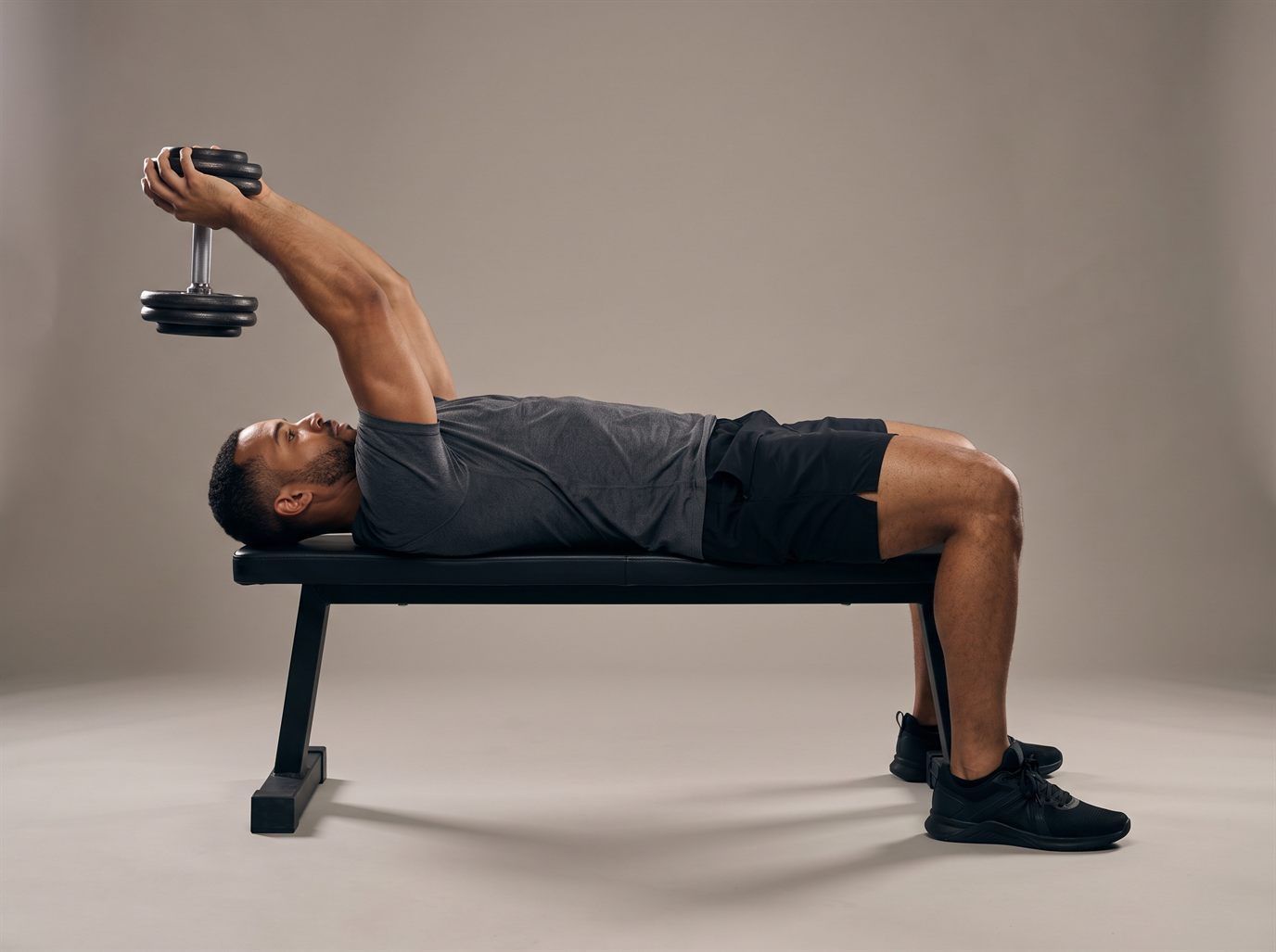
Illustration. The bottom of the dumbbell pullover. Arms overhead, ribs down, low back staying on the bench.
Here is the part that usually gets left out. A 2011 EMG study in the Journal of Applied Biomechanics found that the barbell pullover emphasised the chest more than the lats, and the 2026 review reached the same conclusion across the pullover research: it appears to work the pectoralis major preferentially rather than singling out the lats. The 2011 study was small, eight men using a barbell, but the review’s conclusion points the same way.
I still program it, for a specific job. The pullover trains shoulder extension from a fully overhead position, which loads the lat at a long length — the part of the range that rows barely reach. What it should not be is your main lat exercise. Treat it as the finisher, after the rows have done the heavy lifting.
Set the ribs before the arms move. Exhale, let the ribcage settle toward the pelvis, then lower. Arching to reach further trades lat range for lower-back range.
The elbow angle never changes. Lock a soft bend at the start and hold it. Bending and straightening turns the movement into a triceps extension.
Stop at the stretch, not the pain. End range is where the ribcage wants to lift. Stop an inch before that.
Load: the pullover is hardest at the deep stretch, so start 20% lighter than your first guess, take three seconds on the way down, and stop two reps short for your first two sessions. 3 × 10–12. I learned this one the hard way. I went by what I could handle elsewhere and spent two weeks with a shoulder that did not appreciate it.
The Mistake That Turns Every Row Into a Trap Exercise
Shrugging and rocking. They almost always arrive together.
What it looks like: the hands travel, the shoulder blades do not. The shoulders ride up toward the ears, the torso rocks to help the weight move, and the elbows flare wide. Most of the range comes from the traps and the hips.
Why it happens: the dumbbell is heavier than the target muscles can move on their own, so the body recruits the two strongest things nearby. Both produce hand movement. Neither produces the pattern you came for — and the flared elbow takes the lats out of it completely.
The fix, in order:
- Drop the load by a third.
- Start each rep by pulling the shoulder blades back, hands still.
- Only then bend the elbows.
- Keep the elbows brushing past your sides, not flared out.
The tell that you fixed it: you should feel the work along the outer back and between the shoulder blades, and your neck should feel like it did nothing. If your traps are the sore thing tomorrow, the load was still winning.
A Dumbbell Lat Workout for Your Home Gym
Here are the three exercises in the order I run them.
| Order | Exercise | Sets × reps | Load note |
|---|---|---|---|
| A | One-arm dumbbell row, lat version | 3 × 10–12 per side | About 20% under your machine row, 1s squeeze |
| B | Chest-supported dumbbell row, elbows tucked | 3 × 10–12 | About 10–15% under the machine, 1s hold |
| C | Dumbbell pullover | 3 × 10–12 | 20% lighter than your first guess, 3s down |
Why this order. The one-arm lat row is the most lat-specific of the three, so it goes first while you are freshest. The chest-supported row adds volume with the bench taking your lower back out of it. The pullover goes last because its job is the long-length stretch, and because it is the exercise where fatigue makes the ribs flare.
How to progress. Add reps inside the range before you add weight. When you can hit the top of the range on every set with the cues intact, move up to the next dumbbell increment. That is why adjustable dumbbells with small jumps matter so much for back work.
If you also own a band and a high anchor, swap the pullover for the band lat pulldown. It is the closer match to the machine, and it trains the contraction the pullover misses.
Get the whole system, not just back day
These dumbbell lat exercises cover two of the six machine patterns. The Machine Swap Playbook maps every common gym station to its movement pattern, gives three ranked swaps for each, and puts the load rules for all of them on one printable page.
Eighteen swaps. Forty pages. Free, no upsell.
What You Need for Dumbbell Lat Exercises
Two things: adjustable dumbbells and an adjustable bench. In the playbook’s equipment list they are one purchase, because most dumbbell back work needs a bench to exist at all.
Adjustable dumbbells
What to look for: 5 lb increments below 30 lb, because that is where most back and accessory work lives; at least 50 lb per hand; a locking mechanism you would trust; a handle you can hold when your hands are sweaty; and a compact shape when loaded light, or one-arm rows get awkward against the bench.
I have run long-term tests on the adjustable systems most people are choosing between, and they fail in different places rather than one being best:
- I Used PowerBlock Dumbbells for 6 Months. Here Is What Wore Out First. — nothing broke, but the wear pattern tells you how to store them.
- I Tested Ironmaster Adjustable Dumbbells and Timed Every Plate Change — the most durable, the slowest to adjust.
- I Tested NÜOBELL Adjustable Dumbbells and Checked Whether the Price Holds Up — best handle, wholly dependent on the cradle.
- I Ran Bowflex SelectTech Dumbbells Through 500 Sets and Logged Every Fault — the weakest of the four on wear.
- I Lived With Adjustable Dumbbells for a Year and Here Is What Breaks First — the pattern across all of them.
For one-arm rows in particular, look hard at how compact each system is at light weights. A dumbbell that is long at 25 lb will hit the bench on every rep.
An adjustable bench
All three dumbbell lat exercises here need one: flat for the one-arm row and the pullover, low incline for the chest-supported row. What to look for: a true flat position with no gap at the seat, an incline setting at or near 30°, a pad narrow enough that your shoulder blades can move past it, and a rated capacity above your bodyweight plus your heaviest press, with margin.
My pick is the REP Nighthawk Adjustable Bench: flat, incline and decline in one frame, and it folds away when you need the floor back. Check the incline settings against the 30° guideline before you buy. That is the setting the chest-supported row lives on.
Check the REP Nighthawk on Amazon
Five Things to Check Before Your First Dumbbell Lat Session
- Does your bench have a low incline setting? The chest-supported row wants roughly 30°. A bench that only goes flat and 45° pushes the row toward your traps.
- Are your dumbbell jumps small enough? Back exercises progress in small steps. A jump from 25 to 35 lb is a 40% increase on a one-arm row.
- Can you film one set from the side? The elbow path is almost impossible to judge from the inside.
- Are you pulling to the hip or to the ribs? Check the first rep of every set until the hip-pocket path is automatic.
- Where are you sore the next day? The outer back means the lats worked. The traps or neck mean the load was too heavy or the elbows flared.
Free Tools for Dumbbell Lat Training
- Machine Swap Finder: all three lat pulldown swaps on one card, with the setup cues and the load rule for each.
- Machine Load Converter: enter what you used on the lat pulldown or cable row and get a starting point for each swap, including a dumbbell weight where the numbers convert.
- Loadable Weight Rounder: when the weight you need falls between two dumbbell settings, it shows which one to take and how to close the gap.
- Swap Fault Finder: describe what feels wrong in your own words and get the fix, in order.
Questions People Ask About Dumbbell Lat Exercises
What are the best dumbbell lat exercises?
The one-arm dumbbell row done with the elbow driving toward the hip, and the chest-supported dumbbell row with a neutral grip and the elbows kept close to the body. The dumbbell pullover is worth adding for the stretched position, but research suggests it works the chest more than the lats, so it should not be your main lat exercise.
Can you build your lats with only dumbbells?
Yes, provided the exercises actually put your lats in charge. The lats pull the upper arm down and back toward the torso, and a dumbbell row does exactly that when the elbow stays close to the body and travels toward the hip. The same row with flared elbows mostly trains the upper back instead.
Does the dumbbell pullover work the lats?
It involves them, but EMG research, including a 2011 study and a 2026 review of the pullover literature, found that it emphasises the pectoralis major more than the lats. Use it as a finisher for loading shoulder extension from overhead, not as your primary lat exercise.
Is a dumbbell row a lat exercise or an upper-back exercise?
It can be either. Elbows close to the body and pulling toward the hip bias the lats. Elbows out from the body and pulling straight back toward the ribs bias the upper back and rear delts. A 2026 review of lat EMG research pointed to the upper arm’s position relative to the trunk as a key factor in which muscles do the work.
What angle should the bench be for a chest-supported dumbbell row?
About 30°. As the bench gets steeper, the pull drifts toward the upper traps. A low incline keeps the torso supported and the row where you want it.
How heavy should dumbbells be for lat exercises?
Lighter than you expect. Free weights do not stabilise you the way a machine does, so start about 20% below your machine row weight for one-arm rows and 10–15% below for chest-supported rows. On the pullover, start 20% lighter than your first guess and take three seconds on the way down.
Why do I feel dumbbell rows in my traps instead of my lats?
Usually because the load is too heavy and the elbows are flaring. Drop the weight by a third, start each rep by pulling the shoulder blades back, and keep the elbows brushing past your sides. If your neck and traps are still the sore part the next day, the weight is still too heavy.
The Verdict on Dumbbell Lat Exercises
Dumbbells can replace the lat pulldown, but only if you stop thinking in exercise names.
The one-arm row with the elbow driving to the hip is the best of the dumbbell lat exercises and should do most of the work. The chest-supported row adds volume, and with a neutral grip and tucked elbows it moves toward the lats too. The pullover earns its place for the stretch, and it is worth being honest that research says the chest does much of the work.
What ties them together is one rule: elbows close, pull toward the hip. Get that right and a pair of adjustable dumbbells and a bench will train your lats properly. Get it wrong and you will have a very well-trained upper back and wonder where the lats went.
That habit of matching the movement rather than the machine is what The Machine Swap Playbook is built on. It covers all six machine patterns with eighteen ranked swaps and the load rules for each, on a one-page cheat sheet you can screenshot and use mid-workout.
→ Send me the playbook — it’s free
Affiliate disclosure: WildnSwole earns a commission when you click a link to a partner and make a purchase. As an Amazon Associate, I earn from qualifying purchases. Commissions do not change what the content recommends and they do not add to what you pay.
The content in this article is for general information only and does not constitute medical or personal training advice. Always consult a qualified professional before making changes to your training.
One Response to I Replaced the Lat Pulldown With Dumbbells. Where the Elbow Goes Is the Whole Trick.