Strong Legs Don’t Need a Leg Press. Two Dumbbell Exercises Replace It.
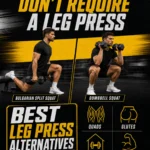
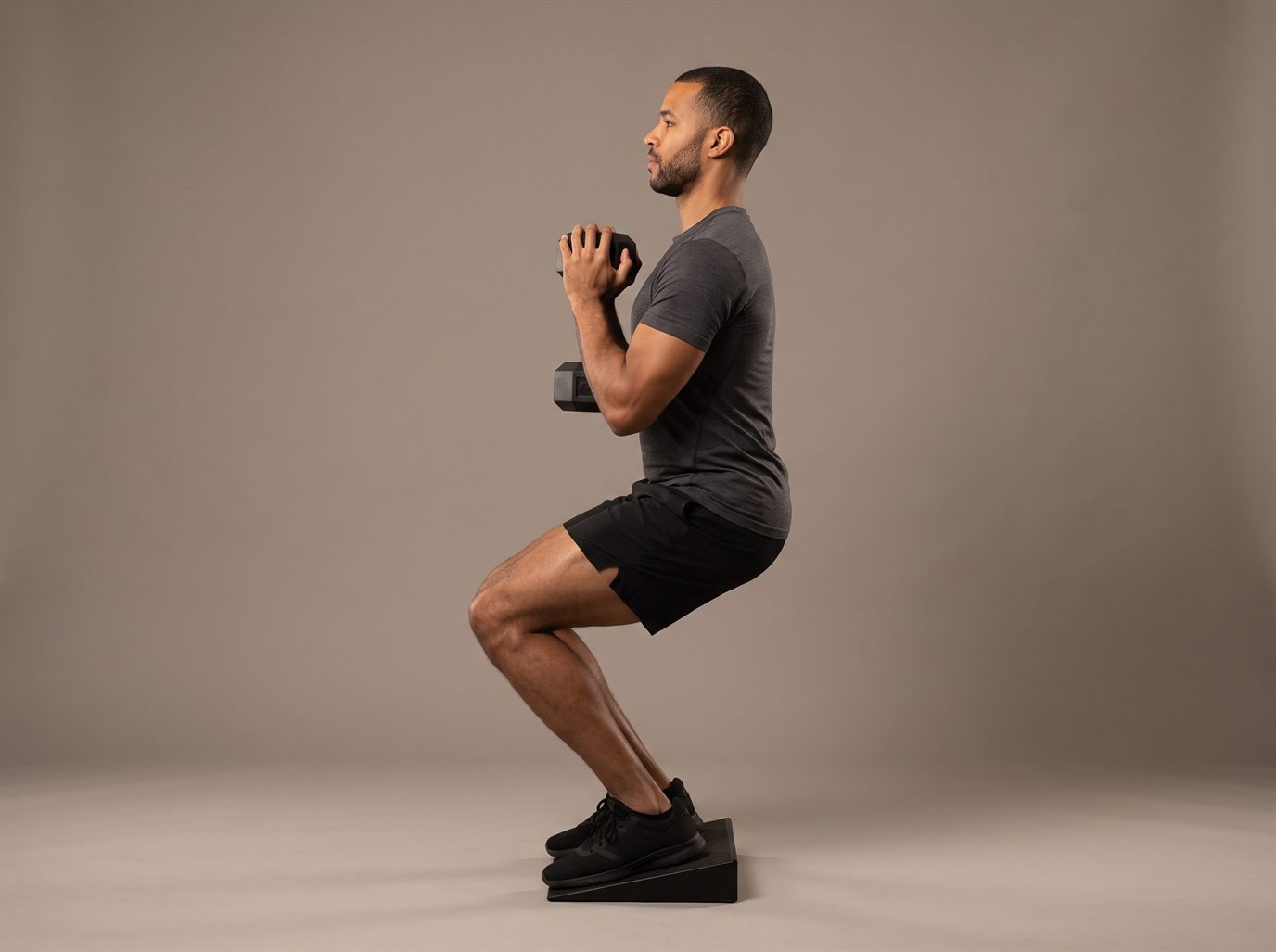
Illustration. The heel-elevated goblet squat. Heels up on a wedge, knees travelling forward, torso upright, one dumbbell held at the chest.
The leg press is the machine people assume they cannot replace at home. It moves big numbers, it holds your back in place, and nothing in a spare room looks remotely like it. But a good leg press alternative does not need to look like the machine. It needs to load the same joints, hard enough, with the equipment you actually own.
I have not had a leg press since I moved my training into a garage in May 2026. Two dumbbell exercises cover the job it did: the Bulgarian split squat and the heel-elevated goblet squat. Add an optional quad finisher that needs no equipment at all, and you have a leg day that covers what the leg press did.
This post covers all three, the research on whether single-leg training really keeps up, the load adjustment that stops the first session from going wrong, and a workout that puts them together. The playbook doesn’t cover the leg press itself, but it does cover the machines next to it, such as the leg extension, hack squat and leg curl. If you want those, the free Machine Swap Playbook has them.
What a Leg Press Alternative Has to Replace
The leg press does three things at once. It extends the knees and hips together under load, which trains the quads and glutes. It supports your back completely, so balance and bracing never limit the set. And because of that support, it lets you move far more weight than you could hold in your hands.
The first one is the job. The other two are conveniences, and they are exactly what dumbbells take away.
That creates a specific problem. A pair of dumbbells cannot come close to a leg press stack, so a two-legged dumbbell squat runs out of load long before your legs run out of strength. For most people training at home, that is where a leg press alternative fails: the exercise is fine, but the weight is too light to matter.
There are two fixes, and the two main exercises in this post use one each:
- Put all the load on one leg. The same dumbbells suddenly weigh twice as much to the working leg. That is the Bulgarian split squat.
- Make the position harder instead of the load heavier. Elevating the heels and pushing the knees forward shifts the work onto the quads, so a lighter dumbbell does more. That is the heel-elevated goblet squat.
1. The Bulgarian Split Squat: The Main Leg Press Alternative
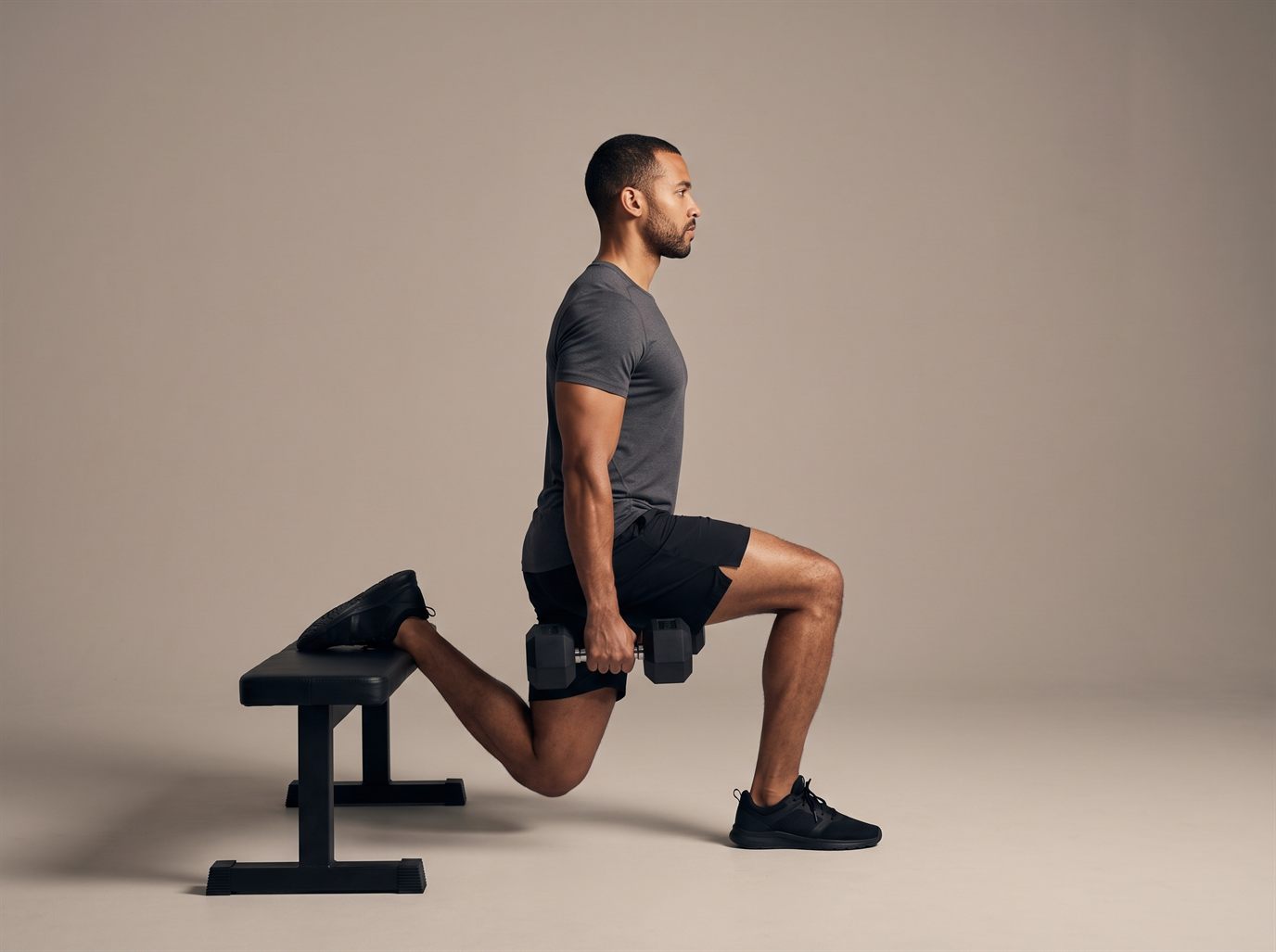
Illustration. The bottom of the Bulgarian split squat. Rear foot laces-down on the bench, front shin close to vertical, torso upright.
If you pick one exercise from this post, pick this one. It is the leg press alternative that scales furthest with the least equipment: a bench and two dumbbells.
Stand a stride in front of a bench, facing away from it. Rest the top of your rear foot on the bench, laces down. Hold a dumbbell in each hand, arms hanging at your sides. Lower straight down until the rear knee is just above the floor, then drive back up through the front foot.
Set the distance once. Too close to the bench and the front knee jams forward and the heel lifts. Too far and you are doing a lunge with your rear hip stretched. At the bottom, the front shin should sit roughly vertical to slightly forward, with the whole front foot flat.
The torso angle chooses the muscle. A more upright torso keeps the work on the front quad. A slight forward lean from the hips shifts more of it to the glute. Neither is wrong. Pick one per session and hold it for every rep.
Go down, not forward. The rep travels vertically. If your body drifts toward the front foot as you descend, the front knee takes the load at an awkward angle and balance becomes the limit instead of your leg.
Load: start with bodyweight for a session to find your stance. Then 3 × 8–12 per leg, weaker leg first, and match the stronger leg to it. If balance is limiting the set, hold one dumbbell and a rack or doorframe with the other hand. Losing some load is better than losing the set to wobbling.
Does single-leg training keep up with heavy two-leg lifting?
That is the real question behind any Bulgarian split squat leg press alternative, and there is direct research on it. Speirs and colleagues (2016) split 18 academy rugby players into two groups for five weeks. One group trained only with the rear-foot-elevated split squat, the other only with the back squat. Both groups improved their back squat strength, and the study found no meaningful difference between them. The single-leg group got stronger at the two-leg lift without training it.
It is worth being clear about what that shows. It was a small study, in young athletes, over five weeks, and it measured strength rather than muscle size. But it answers the worry most people have: that giving up the heavy bilateral machine means giving up strength. On this evidence, it does not have to.
2. The Heel-Elevated Goblet Squat
This is the classic dumbbell squat, adjusted so a single dumbbell can still challenge your quads.
Stand with your heels raised 1–2 inches on a plate, a board or a wedge. Hold one dumbbell vertically against your chest with both hands. Squat straight down, letting the knees travel well forward over the toes, and keep the torso upright.
Knees past the toes is the point. Most squat cues spread the load across the hips. This one deliberately concentrates it at the knee, which is what makes it quad-dominant and why it works as a leg press alternative with far less weight.
Hips stay under the shoulders. The moment the hips travel back, the glutes and lower back take over and the quads get help they did not ask for. Keep the torso tall.
Elevate the heels, not the whole foot. Raising only the heels lets the ankle bend further, so your quads decide how deep you go instead of your ankle mobility.
Load: 3 × 10–12, one dumbbell at the chest. Add depth before you add weight. A deeper rep at the same load is a genuine progression here, and knees under a long lever do not appreciate big jumps. Start with bodyweight if the pattern is new.
3. Optional Quad Finisher: The Reverse Nordic
This one is optional, but it earns its place. The leg press is heavily quad-dominant, and dumbbells limit how much you can load the quads. The reverse Nordic loads them hard with no equipment at all.
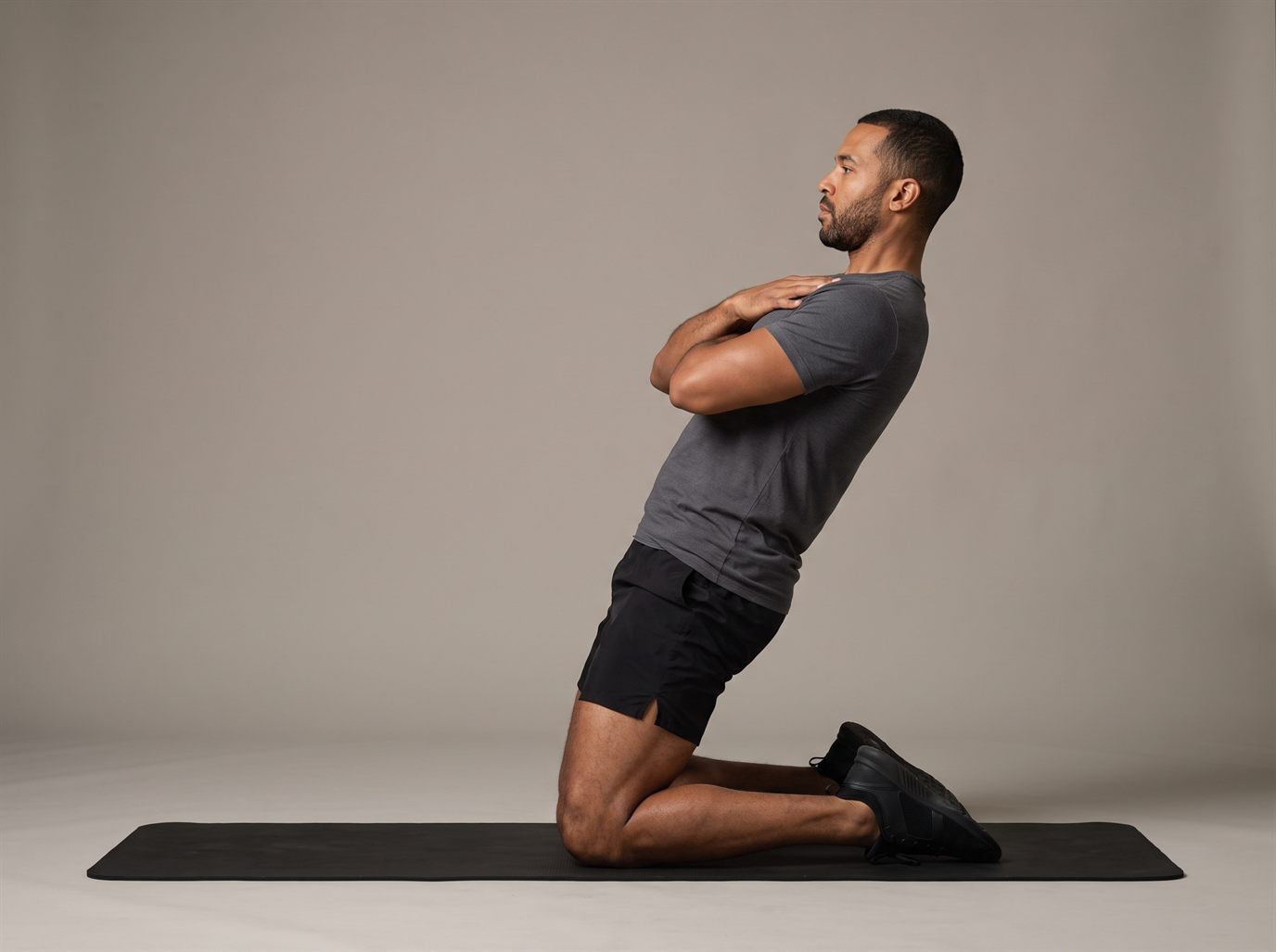
Illustration. The reverse Nordic mid-descent. Knees, hips and shoulders stay in one straight line.
Kneel on a mat with your shins flat and knees together. Squeeze your glutes, then lean back as one straight line from knees to shoulders. Only go as far as you can come back from.
The hips never fold. Squeeze the glutes before you start and hold that squeeze for the whole set. If the hips break, the quads stop working.
Range is the progression. Your range is the point you can still reverse under control. That may be 20° in week one. That is fine.
Four seconds down. The descent is the exercise. Rushing it removes most of the stimulus and all of the safety.
Load: 3 × 6–8 with a four-second descent, bodyweight only, for at least three weeks. To make it easier, put your hands on a bench behind you to share the load.
The mistake that makes it useless
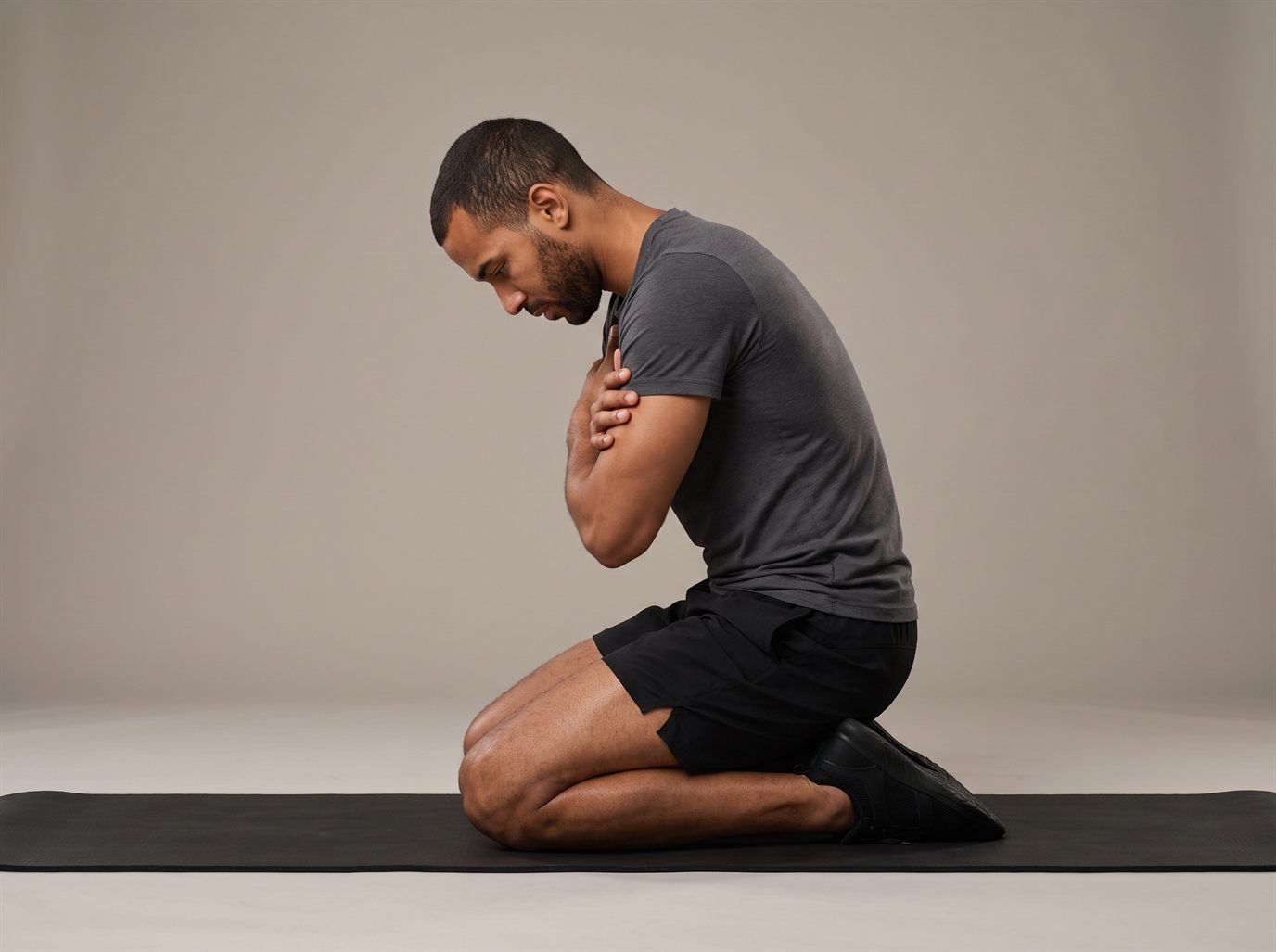
Illustration. Folding at the hips. The body bends at the waist, the glutes drop to the heels and the quads stop working.
Folding at the hips. When the quads run out of strength partway down, the body finds the nearest escape: bending at the waist shortens the lever and lets you keep descending. It feels like more range. It is less work.
The fix: cut the range to whatever you can hold the line through, even 15°. Squeeze the glutes before the first rep, not during. If in doubt, hold a broomstick along your spine; it should touch your tailbone, mid-back and head all the way down.
The tell: a correct reverse Nordic burns across the front of the thighs, just above the knee, and the range feels short. A folded one feels comfortable and reaches the floor. If it was easy, it was not the exercise.
Why the Numbers Will Look Much Smaller Than the Leg Press
Expect a shock the first time. The weight you use for any leg press alternative will be a fraction of what you pushed on the machine, and that is normal.
The machine supports your back and fixes your path, so every pound goes into the legs. The sled also runs on an angle, so the number on the plates is not the load your legs actually move. Take away the support and add balance, and the absolute weight drops sharply for the same effort.
So do not convert numbers. The playbook’s rule applies here directly: match the effort, not the number on the plate. Pick a weight where the last two reps of each set are genuinely hard with clean form. If you finish a set within one or two reps of failure, the session counted, whatever the dumbbell says.
A Leg Press Alternative Workout at Home
| Order | Exercise | Sets × reps | Note |
|---|---|---|---|
| A | Bulgarian split squat | 3 × 8–12 per leg | Weaker leg first; last two reps hard |
| B | Heel-elevated goblet squat | 3 × 10–12 | Add depth before weight |
| C | Reverse Nordic (optional) | 3 × 6–8 | Bodyweight, 4 seconds down |
Why this order. The Bulgarian split squat is the heaviest and most demanding on balance, so it goes first while you are fresh. The goblet squat adds quad volume with less coordination. The reverse Nordic goes last because it needs no load, and because tired quads make the hip-folding error far more likely. Stop the set when the line breaks.
How to progress. Add reps inside the range, then weight. On the split squat, adjustable dumbbells with small jumps make a real difference: going from 25 to 35 lb per hand is a 40% increase on one leg.
Get the whole system, not just leg day
The leg press sits next to three machines people queue for: the leg extension, the hack squat and the leg curl. The Machine Swap Playbook covers all of them. It maps every common gym station to its movement pattern, gives three ranked swaps for each, and puts the load rules on a single printable page.
Eighteen swaps. Forty pages. Free, no upsell.
What You Need to Buy
Adjustable dumbbells, a bench, and something to put under your heels. In the playbook’s equipment list, the dumbbells and bench count as one purchase, because so much dumbbell work needs a bench.
Adjustable dumbbells
For leg work in particular, look for: small increments, because single-leg exercises progress in small steps; enough top weight, at least 50 lb per hand, since your legs will outgrow light dumbbells faster than your arms; and a handle you can hold when your grip is tired, because on split squats your grip often fails before your legs do.
I have run long-term tests on the adjustable systems most people are choosing between:
- I Used PowerBlock Dumbbells for 6 Months. Here Is What Wore Out First. — nothing broke, but the wear pattern tells you how to store them.
- I Tested Ironmaster Adjustable Dumbbells and Timed Every Plate Change — the most durable, the slowest to adjust.
- I Tested NÜOBELL Adjustable Dumbbells and Checked Whether the Price Holds Up — best handle, wholly dependent on the cradle.
- I Ran Bowflex SelectTech Dumbbells Through 500 Sets and Logged Every Fault — the weakest of the four on wear.
- I Lived With Adjustable Dumbbells for a Year and Here Is What Breaks First — the pattern across all of them.
Leg work is also the hardest on an adjustable dumbbell’s mechanism, because heavy dumbbells get set down when your legs are shaking. The durability reviews above are worth reading for that reason alone.
A bench
The Bulgarian split squat needs something stable for the rear foot, at roughly knee height. A weight bench is the obvious choice, and it doubles as the support for easing the reverse Nordic.
My pick is the REP Nighthawk Adjustable Bench: flat, incline and decline in one frame, and it folds away when you need the floor back. Whatever bench you use, check that it does not slide or tip when you load one end with your rear foot.
Check the REP Nighthawk on Amazon
Something for your heels
A spare weight plate or a sturdy board 1–2 inches thick is enough for the goblet squat. You do not need to buy anything for this.
If you also have a band set and a door anchor, my lat pulldown alternative guide and dumbbell lat exercises guide cover the back half of a full home program with the same equipment.
Five Things to Check Before Your First Session
- Is your bench stable with weight on one end? A rear foot on a light bench can tip it. Test it before you add dumbbells.
- Is the bench roughly knee height? Much higher and the rear hip gets stretched hard before the front leg does any work.
- Do you have a way to raise your heels? A plate or a board is enough. Without it, ankle mobility limits your goblet squat depth.
- Is there something to hold for balance? A doorframe or rack for the first few split squat sessions is not cheating.
- Are your knees comfortable with forward travel? The goblet squat and reverse Nordic deliberately load the knee. Build range gradually, and skip anything that causes pain rather than effort.
Free Tools for Replacing the Leg Press
- Machine Swap Finder: all three leg press swaps on one card, with the setup cues and the load rule for each.
- Machine Load Converter: enter what you used on the leg press and get a starting point for each swap, and why the number on the sled does not carry over.
- Loadable Weight Rounder: when the weight you need falls between two dumbbell settings, it shows which one to take and how to close the gap.
- Swap Fault Finder: describe what feels wrong in your own words and get the fix, in order.
Questions People Ask About Leg Press Alternatives
What is the best leg press alternative at home?
The Bulgarian split squat. Putting the load on one leg makes a pair of dumbbells heavy enough to challenge legs used to a leg press, and it only needs a bench. Start with 3 × 8–12 per leg, weaker leg first.
Can dumbbells replace the leg press?
Yes, if you work around the load limit. Dumbbells cannot match a leg press stack in absolute weight, so the exercises have to make lighter loads harder, either by training one leg at a time, as in the Bulgarian split squat, or by shifting the work onto the quads, as in the heel-elevated goblet squat.
Is the Bulgarian split squat as good as the leg press for strength?
For strength, the evidence is encouraging. In a 2016 study, rugby players who trained only with the rear-foot-elevated split squat for five weeks improved their back squat about as much as players who trained the back squat itself. The study was small and short, and it measured strength rather than muscle size.
Why is a goblet squat done with the heels elevated?
Raising the heels 1–2 inches lets the ankle bend further, so the knees can travel forward and the quads take more of the load. Without it, ankle mobility often limits depth before the quads are worked hard.
How much weight should I use compared with the leg press?
Much less, and that is normal. The leg press supports your back and runs on an angle, so its numbers do not translate. Choose a weight where the last two reps of each set are genuinely hard with clean form, and match the effort rather than the number.
What is a reverse Nordic, and do I need it?
It is a bodyweight exercise where you kneel and lean back in a straight line, loading the quads in a stretched position. It is optional, but it is a useful quad finisher when dumbbells limit how hard you can load the quads.
Are leg press alternatives safe for the knees?
They can be, if you build up gradually. The heel-elevated goblet squat and reverse Nordic deliberately load the knee, so add range before weight and stop anything that causes pain rather than muscular effort. If you have an existing knee condition, check with a qualified professional first.
The Verdict on Leg Press Alternatives
Strong legs don’t need a leg press. They need knee and hip extension under a load that is genuinely hard, and the Bulgarian split squat delivers that with a bench and two dumbbells.
The Bulgarian split squat is the leg press alternative to build around. It makes modest dumbbells heavy by putting them on one leg, and the evidence suggests it builds two-leg strength too. The heel-elevated goblet squat adds quad work with a single dumbbell. The reverse Nordic is the optional finisher when you want more quad work without more weight.
What makes it work is the same rule as every other machine swap: match the effort, not the number on the plate. The weights will look small. The last two reps should not feel small.
The leg press was one machine. The Machine Swap Playbook covers eighteen swaps across the six patterns the gym’s queues form around, with a one-page cheat sheet you can screenshot and use mid-workout.
→ Send me the playbook — it’s free
Affiliate disclosure: WildnSwole earns a commission when you click a link to a partner and make a purchase. As an Amazon Associate, I earn from qualifying purchases. Commissions do not change what the content recommends and they do not add to what you pay.
The content in this article is for general information only and does not constitute medical or personal training advice. Always consult a qualified professional before making changes to your training.
Leave a Reply