You Don’t Need a Machine to Train Hamstrings. These Leg Curl Alternatives Work.
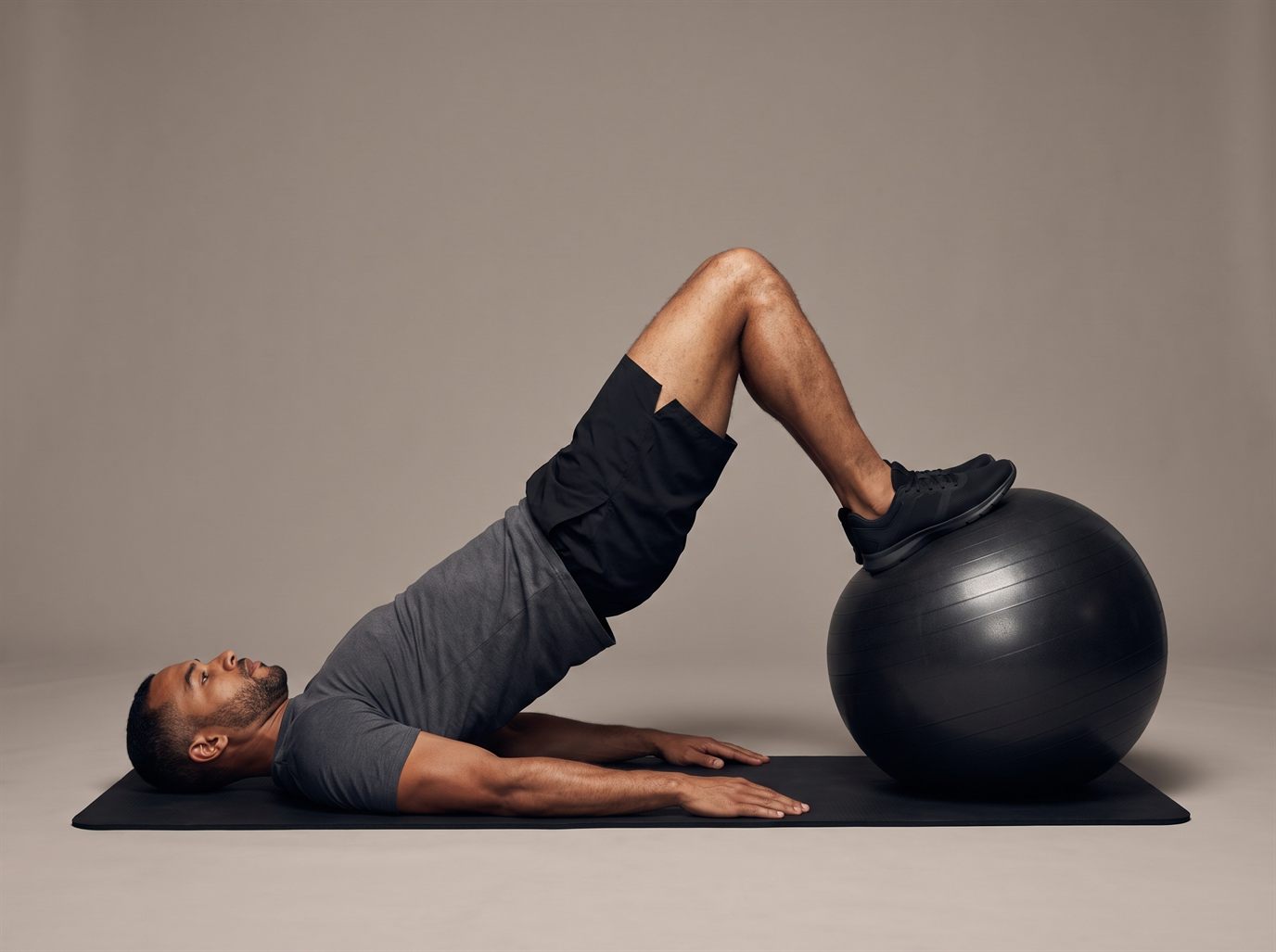
Illustration. The top of a stability ball leg curl. Hips lifted, heels pulling the ball in, upper back and arms on the mat.
The leg curl is one of the easiest machines to replace badly. Most home workouts swap it for Romanian deadlifts and call it done, and that swap misses half of what the machine did. A good leg curl alternative has to bend the knee against resistance, because that is the job the machine was doing.
I have not had a leg curl machine since I moved my training into a garage in May 2026. Three exercises cover what it did and more: the stability ball leg curl, the Nordic ham curl, and the Romanian deadlift. Only the first two are true leg curl substitutes. The third earns its place for a different reason, and understanding why is the most useful thing in this post.
It covers all three, the research on why hamstrings need both kinds of exercise, the mistake that quietly ruins every curl you do without a machine, and a workout that puts them together. If you want the same approach for every other machine you are missing, the free Machine Swap Playbook covers all six patterns.
Why a Leg Curl Alternative Needs Two Kinds of Exercise
Your hamstrings cross two joints. They bend the knee, and they extend the hip. A leg curl machine trains the first job, with your hip pinned still by the pad. A Romanian deadlift trains the second, with your knee held nearly still while your hips travel back.
Same muscles, two different jobs. That is why an RDL is not a leg curl alternative on its own, no matter how sore it makes your hamstrings. As the playbook puts it, in a leg curl the hamstrings work as knee benders rather than hip extenders, which is why your RDLs do not cover this and never did.
The research shows the two jobs load the hamstrings differently. Bourne and colleagues (2017) measured hamstring activation across ten common exercises using EMG and MRI. A hip-extension exercise worked the long hamstring muscles most, while the Nordic curl, a knee-bending exercise, worked a different hamstring, the semitendinosus, most.
That study measured which muscles were working, not how much they grew over months. But it matches the anatomy: a hamstring program that only bends the knee, or only extends the hip, leaves part of the muscle group under-trained. The fix is simple. Use a real leg curl alternative for the knee, and an RDL for the hip.
1. The Stability Ball Leg Curl
This is the leg curl alternative I would start almost anyone on. It needs one piece of equipment, it bends the knee against your bodyweight, and it makes your glutes hold a bridge the whole time, which the machine never asked of them.
Lie on your back with your heels on top of a stability ball and your arms flat on the floor. Lift your hips into a bridge. Keeping the hips up, pull the ball in toward you by bending your knees, then roll it back out slowly until your legs are almost straight.
Bridge first, then curl. Get the hips up before the first rep, and keep them up for every rep. The curl comes from the knees; the hips just hold position.
Hips stay high. The moment your hips sag toward the floor, the hamstrings stop bending the knee against load and the rep turns into a roll. If you cannot keep them up, the set is over.
Slow on the way out. Take two to three seconds to roll the ball away. The lowering phase is where most of the work happens.
Load: 3 × 10–15, bodyweight. When that gets easy, progress to one leg at a time with the other held off the ball. A single-leg ball curl is a genuinely hard exercise, and it doubles the load on each hamstring without buying anything.
2. The Nordic Ham Curl: The Hardest Leg Curl Alternative
This is the playbook’s top-ranked leg curl alternative, and the strongest hamstring exercise you can do without a machine. It is also the one to ramp into carefully.
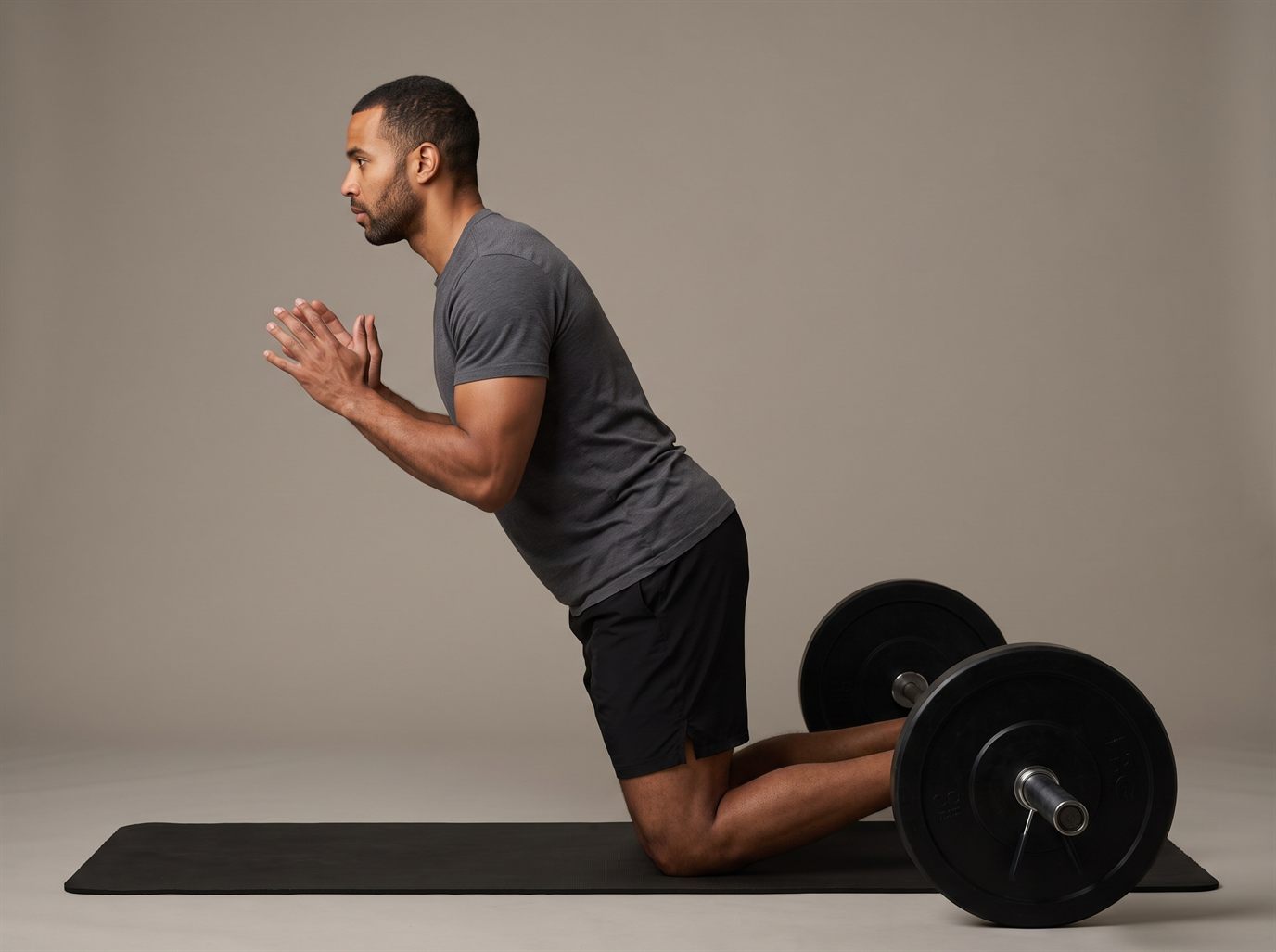
Illustration. The Nordic ham curl mid-descent. Body rigid from knees to head, hips extended, hands ready to catch the floor.
Kneel on a mat with your ankles anchored under something that will not move: a loaded barbell, the underside of a heavy couch, or a partner’s hands. Keep your body in one straight line from knees to head, then lower yourself toward the floor as slowly as you can. Catch yourself with your hands, and push off the floor to get back up.
Anchor something that will not move. If the anchor shifts mid-rep, you fall on your face. Test it before you load it.
The descent is the whole exercise. Lower as slowly as you physically can. You are not expected to curl yourself back up for months. Pushing off the floor to reset is part of the exercise.
Hips extended. Squeeze your glutes and hold one line. Bending at the waist shortens the lever and lets you cheat the range.
Load: 3 × 4–6 with a five-second descent, but start with two sets of three in week one. This exercise produces more soreness per rep than anything else in the playbook. To make it easier, put your hands on a raised bench so they take over earlier.
3. The Romanian Deadlift: Training the Other Half
The Romanian deadlift is not a leg curl alternative, but it belongs in the same workout. It trains the hamstrings’ other job, extending the hip, and it loads them in a long, stretched position that the leg curl never reaches.
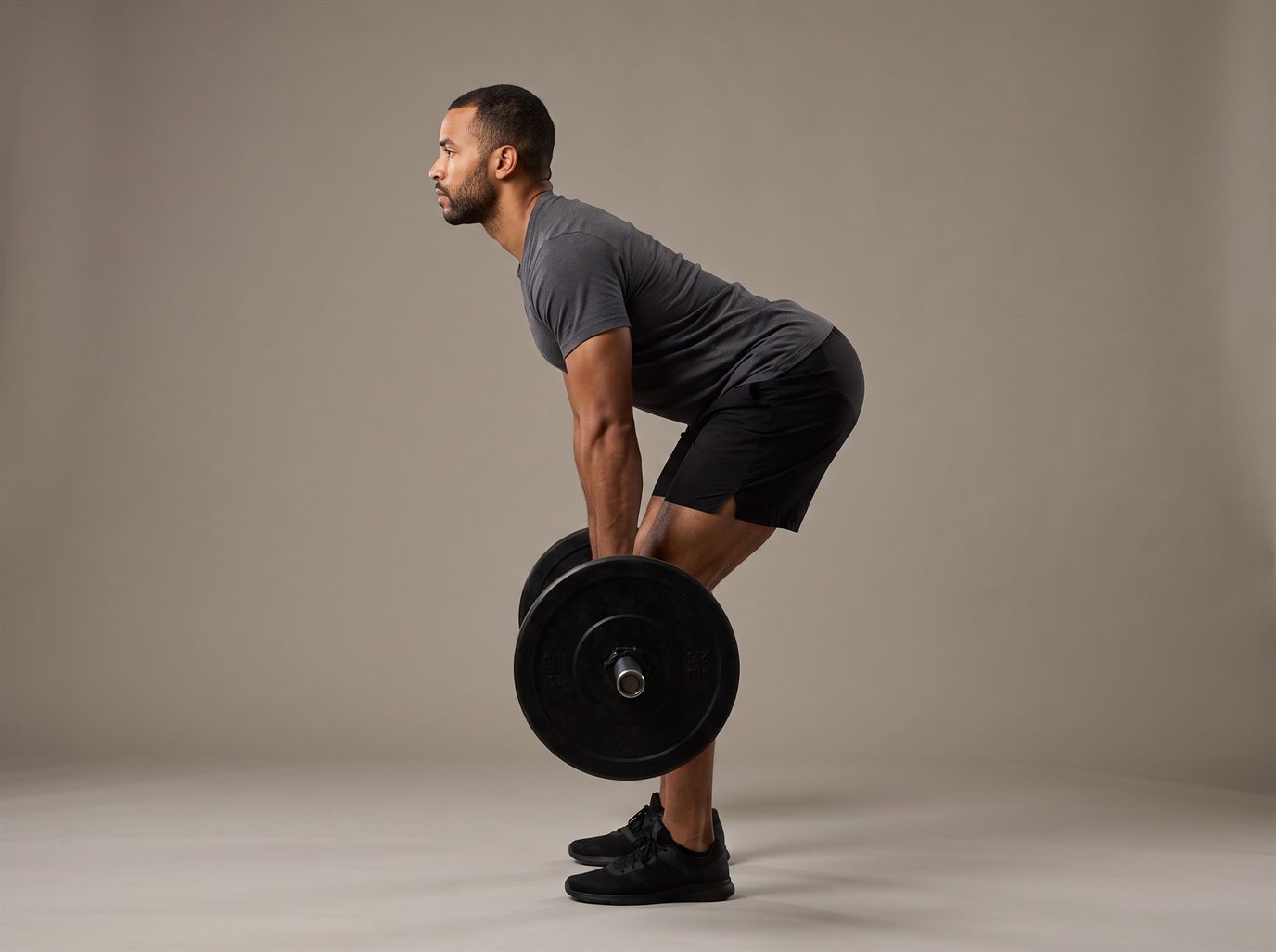
Illustration. The bottom of a Romanian deadlift, shown with a barbell. With dumbbells, the position is identical: hold one in each hand in front of your thighs.
Stand holding a dumbbell in each hand in front of your thighs. Push your hips back, not down, and let the dumbbells slide down the front of your legs. Keep your back flat and your knees slightly bent. Stop when your hamstrings reach their limit, then drive your hips forward to stand.
The weight goes down because the hips went back. Not the other way round. Push your hips toward the wall behind you and let the dumbbells follow. If you think about lowering the weight, you will bend at the spine.
Keep the dumbbells on your legs. Shave the thighs and shins on the way down and up. Weight that drifts forward is weight your lower back is about to take.
Your hamstrings set the depth, not the floor. Stop the moment your lower back starts to round. For most people that is mid-shin; for some it is just below the knee. Both are correct.
Load: start 15% lighter than your first guess, take three seconds on the way down, and do 3 × 8. Expect real hamstring soreness after the first session.
If you have a bench: the dumbbell lying leg curl
The playbook’s other leg curl alternative is the dumbbell lying leg curl. Lie face down on a flat bench with one light dumbbell clamped between your feet, and curl your heels toward your glutes. Keep your hips pressed into the bench and curl past 90°, because the last third of the range is where the machine works you hardest. Your feet limit how heavy you can go, so treat it as a high-rep option: 3 × 15–20 with the heaviest dumbbell you can hold securely.
The Mistake That Ruins Every Leg Curl Alternative
Letting your hips move. On a lying leg curl it shows up as the hips lifting off the bench; on a ball curl, as the hips sagging toward the floor. Either way, the hamstrings have stopped doing the job you came for.
It happens because the hamstrings cross two joints. When bending the knee gets hard, the body shortens the hamstrings from the hip end instead, which makes the rep feel possible. A machine’s hip pad prevents this. On a ball, a bench or the floor, nothing does, except you.
The fix, in order:
- Make it easier: drop the weight, or go back to two legs on the ball.
- Squeeze your glutes before the first rep, and hold that squeeze throughout.
- On a bench, press the front of your hips into the pad on every rep. On a ball, keep your hips at bridge height.
- End the set the first time your hips move.
The tell that you fixed it: on lying curls, rest a light object on your lower back. If it stays put through every rep, your hips stayed put too.
A Leg Curl Alternative Workout at Home
| Order | Exercise | Sets × reps | Note |
|---|---|---|---|
| A | Romanian deadlift | 3 × 8 | Start 15% light, 3 seconds down |
| B | Nordic ham curl (optional) | 3 × 4–6 | Start with 2 × 3 in week one, 5 seconds down |
| C | Stability ball leg curl | 3 × 10–15 | Hips high; progress to one leg |
Why this order. The RDL is the heaviest lift and needs your lower back fresh, so it goes first. The Nordic, if you use it, goes next, while your hamstrings still have the strength to control the descent. The ball leg curl finishes the session because it is the safest to push close to failure.
Why both halves. Parts A and C are what make this a complete hamstring session: one trains the hip, the other bends the knee. Skip either and you are back to training half the muscle group.
Get the whole system, not just leg day
The leg curl is one of six machine patterns. The Machine Swap Playbook maps every common gym station to its movement pattern, gives three ranked swaps for each, including the leg curl, leg extension and back extension, and puts the load rules for all of them on one printable page.
Eighteen swaps. Forty pages. Free, no upsell.
What You Need to Buy
A stability ball, adjustable dumbbells, and optionally a bench. The Nordic curl needs nothing except something heavy to anchor your ankles under.
A stability ball
The cheapest piece of equipment in this post, and the one that unlocks the most practical leg curl alternative. Look for a burst-resistant ball, since you will be putting your weight on it, sized to your height (a 65 cm ball suits most adults between roughly 5’7″ and 6’2″), and a pump included, because a ball loses air over time and a soft ball makes curls harder to control.
My pick is the TRX Stability Ball. Check the size against your height before you buy.
Check the TRX Stability Ball on Amazon
Adjustable dumbbells
For the Romanian deadlift, look for enough top weight, at least 50 lb per hand, since your hamstrings and glutes can handle far more than your arms, and a handle you can hold when your grip is tired. Your grip often gives out on RDLs before your hamstrings do.
I have run long-term tests on the adjustable systems most people are choosing between:
- I Used PowerBlock Dumbbells for 6 Months. Here Is What Wore Out First. — nothing broke, but the wear pattern tells you how to store them.
- I Tested Ironmaster Adjustable Dumbbells and Timed Every Plate Change — the most durable, the slowest to adjust.
- I Tested NÜOBELL Adjustable Dumbbells and Checked Whether the Price Holds Up — best handle, wholly dependent on the cradle.
- I Ran Bowflex SelectTech Dumbbells Through 500 Sets and Logged Every Fault — the weakest of the four on wear.
- I Lived With Adjustable Dumbbells for a Year and Here Is What Breaks First — the pattern across all of them.
A bench (for the dumbbell leg curl)
Only needed for the lying leg curl, and useful for making the Nordic curl easier. My pick is the REP Nighthawk Adjustable Bench: flat, incline and decline in one frame, and it folds away when you need the floor back.
For the rest of leg day, my leg press alternative guide covers the quads with the same equipment.
Five Things to Check Before Your First Session
- Is your ball the right size and fully inflated? A ball that is too small or too soft makes the curl wobbly and harder to control.
- Do you have a Nordic anchor that truly will not move? Test it with your full weight before your first rep.
- Is your floor clear around the ball? It will roll if you lose it. Give yourself space.
- Are you ready to start light? Both the Nordic and the RDL produce a lot of soreness in the first week. Start with less than you think.
- Can you film one set? Hips moving is hard to feel from the inside, and it is the mistake that matters most.
Free Tools for Replacing the Leg Curl
- Machine Swap Finder: all three leg curl swaps on one card, with the setup cues and the load rule for each.
- Machine Load Converter: enter what you used on the leg curl and get a starting point for each swap.
- Swap Fault Finder: describe what feels wrong in your own words and get the fix, in order.
Questions People Ask About Leg Curl Alternatives
What is the best leg curl alternative at home?
The stability ball leg curl for most people, and the Nordic ham curl once you are ready for something harder. Both bend the knee against resistance, which is what the leg curl machine does. The ball curl needs only a stability ball; the Nordic needs only something heavy to anchor your ankles under.
Can Romanian deadlifts replace leg curls?
Not on their own. RDLs train the hamstrings by extending the hip, while leg curls train them by bending the knee. Research shows the two load the hamstrings differently, so a complete hamstring workout includes both an RDL and a knee-bending exercise such as the ball leg curl or Nordic curl.
Are Nordic curls better than leg curls?
They are harder and load the hamstrings very heavily while they lengthen, which makes them one of the best hamstring exercises there is. They also cause a lot of soreness, so start with two sets of three and a slow five-second descent, and build up gradually.
How do I make the stability ball leg curl harder?
Move to one leg at a time, with the other leg held off the ball. It roughly doubles the load on each hamstring. You can also slow the roll out to three or four seconds.
What size stability ball do I need?
A 65 cm ball suits most adults between roughly 5’7″ and 6’2″. Shorter people usually do better with 55 cm, and taller people with 75 cm. Inflate it fully, because a soft ball makes curls harder to control.
Why do my hips drop during ball leg curls?
Because your hamstrings are tired and your body is shortening them from the hip end. Squeeze your glutes before the first rep, keep your hips at bridge height, and end the set the first time they sag.
Do I need a leg curl machine to build hamstrings?
No. Bending the knee against resistance, with the ball leg curl or Nordic curl, and extending the hip, with the Romanian deadlift, covers everything the machine does and more. The key is including both kinds of exercise, not the equipment.
The Verdict on Leg Curl Alternatives
You don’t need a machine to train hamstrings. You do need to train both of their jobs.
The stability ball leg curl is the leg curl alternative to start with: cheap, effective and hard to get badly wrong. The Nordic ham curl is where to go when it stops being hard. The Romanian deadlift isn’t a leg curl alternative at all, and that is exactly why it belongs next to one, because it trains the hamstrings through the hip.
Get that split right and a stability ball, a pair of dumbbells and a heavy couch will train your hamstrings more completely than the machine ever did.
That habit of matching the movement rather than the machine is what The Machine Swap Playbook is built on. It covers all six machine patterns with eighteen ranked swaps and the load rules for each, on a one-page cheat sheet you can screenshot and use mid-workout.
→ Send me the playbook — it’s free
Affiliate disclosure: WildnSwole earns a commission when you click a link to a partner and make a purchase. As an Amazon Associate, I earn from qualifying purchases. Commissions do not change what the content recommends and they do not add to what you pay.
The content in this article is for general information only and does not constitute medical or personal training advice. Always consult a qualified professional before making changes to your training.
Leave a Reply