I Built 5 Power Racks in My Garage and Checked Every Upright. Squaring Mattered More Than Steel.
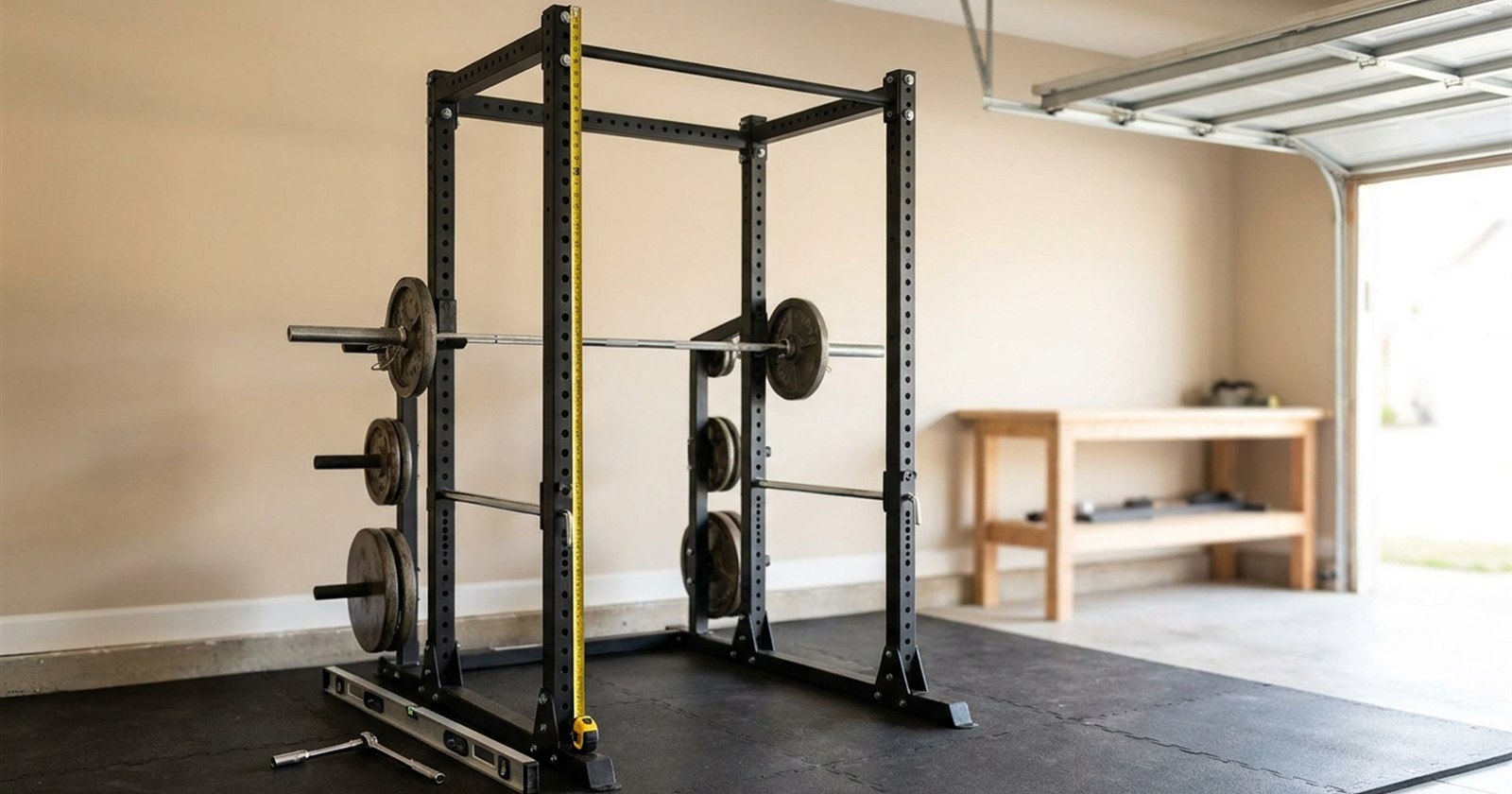
Illustration. A tape down one upright and a level on the floor: how true the frame sat mattered more than how thick the steel was.
A home gym power rack can look perfectly straight in the product photos and still arrive with uneven welds, slightly different hole positions, or uprights that lean once the frame is bolted together. Those imperfections are usually small. They still matter.
A rack that is a little out of square makes safety straps hang unevenly. An attachment fits one upright and binds on the other. The pull-up bar fights you during assembly, and the whole frame can rock even when the garage floor looks level.
I wanted to see how much variation there really is between popular racks, so I built five of them in the same garage and checked each one the same way. I compared every upright from top to bottom, checked hole alignment, inspected welds and hardware, squared each frame, and trained in each rack with the same barbell lifts. Testing ran through January 2025. Models and prices were last checked in November 2026.
The rack is the anchor of most garage gyms. Nearly every barbell swap in the free Machine Swap Playbook starts with a bar sitting in J-cups, so the frame holding it is worth getting right.
The short version: the REP PR-4000 was the best home gym power rack overall. The Rogue RML-390F had the best build quality, the Titan T-3 was the budget pick, the Bells of Steel Hydra was the most customizable, and the Major Fitness F22 was the best all-in-one. None of the five was perfect, and how carefully I squared each frame changed the result almost as much as the steel did.
The Five Racks I Built
| Rack | Uprights | Price (Nov 2026) | Best for |
|---|---|---|---|
| REP Fitness PR-4000 | 3×3″ 11-gauge, 1″ hole spacing through the bench zone | from $809.94 at REP | Most garage gyms |
| Rogue RML-390F Monster Lite | 3×3″ 11-gauge, flat-foot base, made in Ohio | $935 at Rogue | Build quality |
| Titan Fitness T-3 Series | 2×3″ 11-gauge, bolt-down | from $519.97 at Titan | Tight budgets |
| Bells of Steel Hydra (four-post) | 3×3″, 5/8″ holes | from $1,080.89 at Bells of Steel | Customization |
| Major Fitness F22 | All-in-one with dual pulleys | $706.79 on Amazon | Cable work in one frame |
The specs come from the makers’ own listings. The REP PR-4000 product page, for example, lists 3×3-inch 11-gauge steel and a 1,000 lb rackable capacity. Prices change often, so treat them as a snapshot.
One difference matters before you compare anything else. The Titan T-3 uses 2×3-inch uprights, while the REP, Rogue and Hydra use 3×3. Attachments built for one size don’t fit the other, so the tube size decides which accessories your home gym power rack can ever take.
How I Checked Each Home Gym Power Rack
I wanted more than the listed dimensions. For every rack I checked:
- Upright height, width and depth, at the bottom, middle and top of each post
- The distance between the uprights, side to side and front to back
- Hole diameter and the hole-to-hole spacing
- Base width and crossmember length
- Both diagonal measurements across the base
- Whether the J-cups and safeties sat at the same height on both sides
I checked each upright at several points because steel tubing is not always uniform from top to bottom.
The diagonals were the most useful check. When a rectangular frame is square, the two corner-to-corner measurements across the base are equal or extremely close. A difference doesn’t always mean a factory fault, though. Loose bolts, an uneven floor or tightening the frame in the wrong order can all pull a rack out of square.
So I built each rack loosely first, checked the alignment, and only then tightened the hardware.
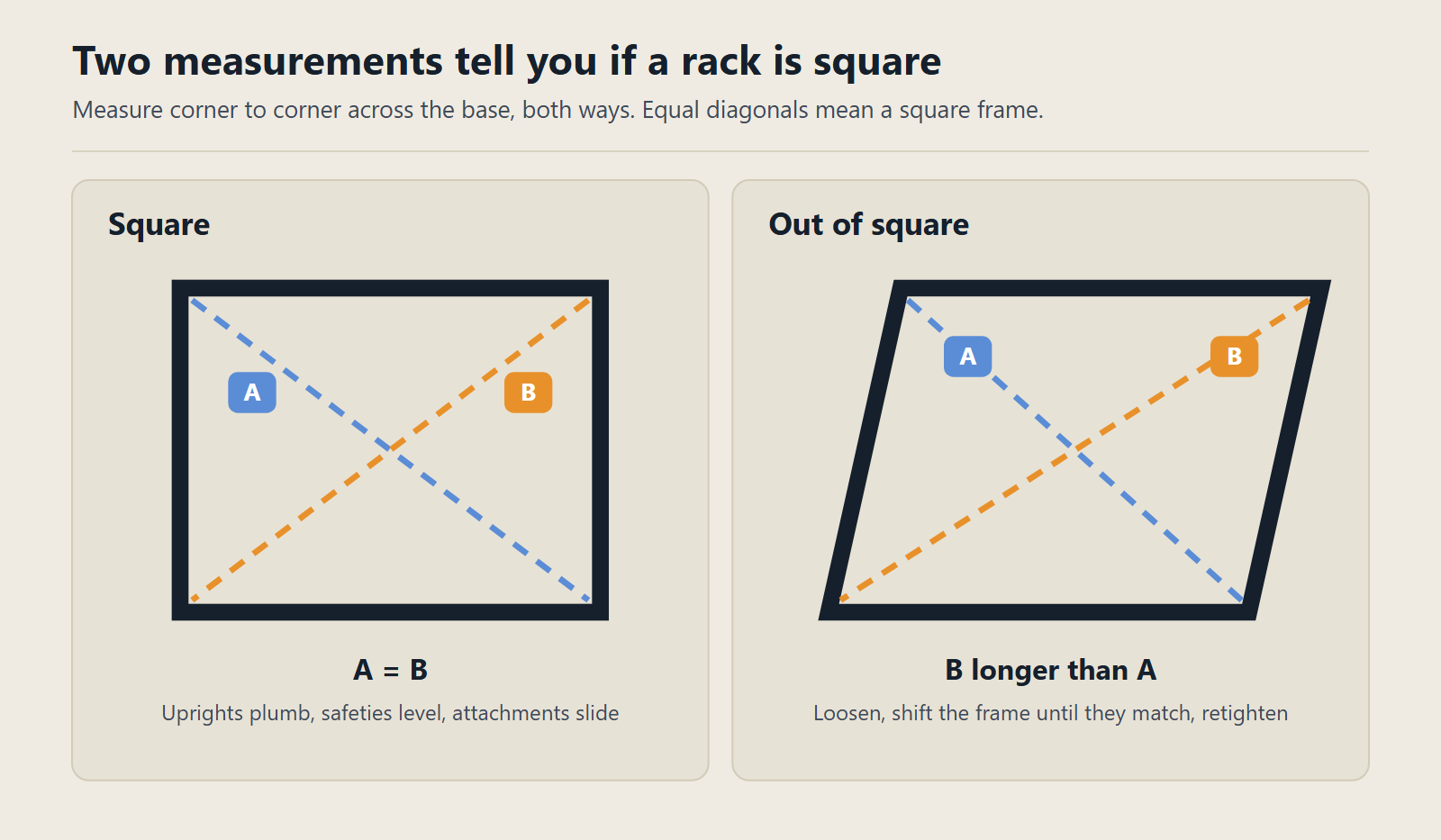
Figure 1. Two corner-to-corner measurements across the base. Equal diagonals mean a square frame.
The Garage Floor Complicated Everything
My garage floor looked level until I started squaring racks on it.
Like most garages, it slopes slightly toward the door for drainage. That left a small gap under one side of some racks and made a few frames look uneven before any weight went on them.
I built every rack on the same marked area and checked the floor with a long level first. For freestanding racks I used thin shims where needed. For racks designed to be bolted down, I tested them before and after anchoring wherever that was practical.
That step mattered, because a rack shouldn’t be blamed for movement the floor causes.
Some designs still handled the slope better than others. Wide flat-foot racks stayed more stable without anchoring. Narrower racks with smaller contact points showed the slope more clearly.
Best Overall: REP Fitness PR-4000
The REP PR-4000 gave the best overall experience. Its uprights were consistent, the hardware felt substantial, and the frame was easy to square. It also comes in enough configurations to suit both a compact garage and a larger one.
Its uprights were among the most consistent. I checked each post low, middle and high. Any differences were small enough that attachments moved between the posts without getting noticeably tighter or looser. The hole spacing stayed consistent through the bench zone, so the J-cups and safeties lined up on both sides without counting mismatched holes.
Assembly was straightforward but heavy. A second person helped. I kept every bolt hand-tight at first, installed the crossmembers and pull-up bar, then measured the diagonals and shifted the frame until they were nearly identical. Only then did I tighten everything. The result sat square and stayed stable.
It felt secure on everything I tried: back squats, front squats, bench presses, rack pulls, pull-ups, pin presses and safety-bar squats. Unanchored, it moved slightly during aggressive pull-ups, but the movement was controlled, not alarming. Loading plate storage onto it made it steadier still.
The attachment range is a real advantage. The PR-4000 takes different safeties, pull-up bars, storage, cable systems and specialty attachments. You won’t need most of them, but the room to grow is useful.
It wasn’t perfect. The finish wore a little around the most-used holes. The J-cups needed careful placement to avoid scraping the uprights. One crossmember needed a bit of pressure before its bolt holes lined up. Once the rack was built, none of that affected performance.
The PR-4000 won because it was good at everything that matters: accurate enough for attachments, stable enough for serious lifting, expandable, and cheaper than the premium alternatives. If I could keep only one home gym power rack from this group, it would be this one.
See the REP PR-4000 at REP Fitness
Best Build Quality: Rogue RML-390F Monster Lite
The Rogue RML-390F felt like the most industrial rack in the group. The steel, hardware, welds and finish all looked like equipment built for years of hard use, and it is made in Columbus, Ohio.
Its uprights were consistent top to bottom. The holes were predictable, accessories fit securely, and once tightened the frame had very little side-to-side play. The tube edges and welds were cleaner than on several of the cheaper racks. That didn’t automatically make it lift better, but it added confidence.
The flat-foot base suits a garage you can’t drill. It spreads the frame across a larger area and stayed stable through squats and bench presses without anchors. The tradeoff is footprint: Rogue lists 48 by 49 inches for 30 inches of inside depth, so the base reaches further into the room than a standard four-post rack. In a small garage those extra inches can get in the way of storage or a car.
It trained beautifully. The J-cups sat firmly, the safeties lined up evenly, and reracking a heavy squat didn’t make the frame move. Pull-ups caused a little motion, less than I expected from a freestanding rack.
Its drawback is value, not quality. The rack feels premium, and accessories plus shipping push the total higher. The flat-foot design also limits some storage and attachment layouts. If you value American manufacturing and a proven ecosystem, the cost may be worth it. For a price-conscious garage gym, the REP PR-4000 gave me a very similar experience for less.
See the Rogue RML-390F at Rogue
Best Budget Rack: Titan Fitness T-3 Series
The Titan T-3 was the best value of the cheaper racks. It isn’t as refined as the REP or Rogue, but it gives you a proper enclosed lifting space for a lot less money.
The uprights were usable but less consistent. One post varied slightly across its upper section, though not enough to stop standard attachments fitting. The holes worked, but the finish around some of them was rougher.
It needed the most adjustment to square. When I first fitted the upper crossmembers, the Titan T-3 frame looked slightly twisted. Loosening the bolts, shifting the base and tightening everything again in order fixed most of it.
The welds were functional rather than pretty. Some were less uniform, and the powder coat had small cosmetic flaws. None of that made the rack unsafe in my testing, but it showed where the savings came from.
Once squared, it was stable. Squats, bench presses and pull-ups all felt solid. It benefited from being bolted down or weighted, especially for lifts done toward the front of the rack. It didn’t feel as solid as the Rogue, but it performed better than its price suggests.
The Titan T-3 suits you if you want a full rack on a limited budget, a compact footprint and basic attachments, and you can anchor it. Plan on extra time checking alignment during the build, and remember that its 2×3-inch uprights take 2×3 attachments only.
Get the whole system, not just the rack
A home gym power rack only pays off when you know what to do in it. The Machine Swap Playbook turns the machines you’d queue for at a commercial gym into barbell, dumbbell and bench swaps you can run in your garage, ordered by movement pattern so you can build a full session around the rack you own.
Eighteen swaps. Forty pages. Free, no upsell.
Best for Customization: Bells of Steel Hydra
The Bells of Steel Hydra was one of the most customizable racks I built. It supports a huge range of layouts, storage, cable attachments and accessories.
Its uprights were accurate. They checked out consistently, and the holes were cleanly cut. J-cups and safeties moved between positions without binding. The frame squared easily as long as I left the bolts loose until the whole rack was together.
Modularity is the point. You can build it as a basic rack and add storage, different pull-up bars, cable attachments, lever arms, safety straps, plate storage and multi-grip parts later. That suits someone who wants to grow one rack into a complete training station over time.
It was stable in its basic form, and like most racks it felt more planted with plates stored at the back, which helped resist movement during pull-ups and heavy reracks.
Its faults are about hardware and buying. Some hardware took more effort to align than I expected. The sheer number of configurations also makes buying harder: it is easy to keep adding accessories and end up far above the base price. The Hydra was competitive with the REP PR-4000, but the REP was the more straightforward rack to own in my garage.
See the Hydra at Bells of Steel
Best All-in-One: Major Fitness F22
The Major Fitness F22 takes a different approach. Instead of being only a power rack, it adds a dual-pulley cable system so one frame covers more exercises. That makes sense in a garage where the rack also has to handle pulldowns and rows.
Its uprights were adequate for the included parts, but it felt less standardized than the premium modular racks. The dimensions and hole pattern are tied more closely to Major Fitness’s own accessories, so third-party attachments are less predictable. The uprights were straight enough for safe use, but the finish and consistency weren’t at the REP or Rogue level.
It was the most complicated build. The pulleys, cables and guide points add more chances for small mistakes. A cable routed on the wrong side of a pulley rubs or feels uneven, so take your time with the routing.
Once built correctly, it does a lot. Squats and bench presses felt reasonable, and the cables add pulldowns, rows, curls and triceps work. If you’re replacing a gym’s cable stack, see my lat pulldown alternatives for what a dual pulley can and can’t cover. The compromise is that the frame felt less refined under heavy barbell work than the REP or Rogue.
The F22 suits you if you want exercise variety and would rather not buy a separate functional trainer. It’s less attractive if you mainly want the strongest, simplest barbell rack you can get.
Check the Major Fitness F22 on Amazon
How the Five Racks Compared
The checks showed one clear pattern: none of the five racks was perfect. Every one had small differences between posts, hole positions and diagonals. What mattered was whether those differences affected assembly, attachments or training.
| Rack | Upright consistency | Squaring the frame | Attachment fit |
|---|---|---|---|
| REP PR-4000 | Excellent | Easy to correct | Excellent |
| Rogue RML-390F | Excellent | Very good | Excellent |
| Titan T-3 | Acceptable | Needed adjustment | Good |
| Bells of Steel Hydra | Very good | Good | Very good |
| Major Fitness F22 | Acceptable | Most complicated | Best with its own parts |
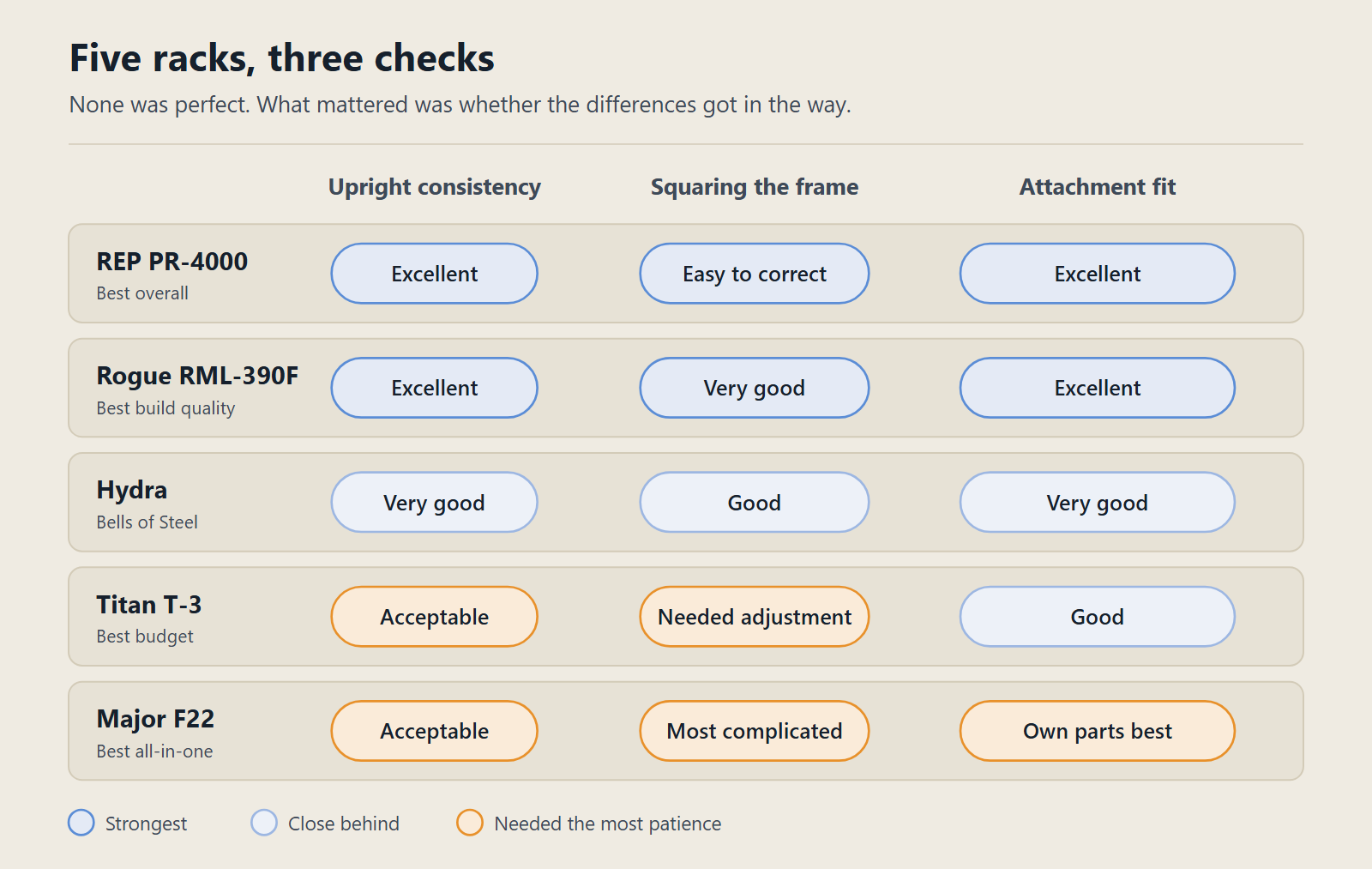
Figure 2. How the five racks compared on the three checks that affected building and training.
The REP and Rogue were the most consistent overall. The Titan and Major Fitness needed more patience, but both were fully usable once assembled properly.
Does a Small Difference in a Home Gym Power Rack Matter?
Not every difference is a problem. A tiny variation in an upright’s width can be coating thickness or normal manufacturing tolerance. It starts to matter when:
- Attachments bind
- The J-cups fit differently on each upright
- Safety pins won’t pass through
- The frame can’t be squared
- The pull-up bar won’t line up
- One upright visibly leans
- Hardware has to be forced into place
None of the five developed a fault bad enough to stop assembly. The cheaper racks simply needed more correcting.
How to Square a Power Rack During Assembly
Assembly affected the final result almost as much as manufacturing quality. Tightening every bolt as I went was the biggest mistake I could have made. This order worked far better:
- Build the frame with every bolt hand-tight.
- Install all the crossmembers.
- Check the floor with a long level.
- Measure both base diagonals.
- Shift the frame until the diagonals match.
- Check the upright spacing at the top and the bottom.
- Tighten the bolts gradually, working around the frame.
- Measure again.
- Anchor or shim the rack if it needs it.
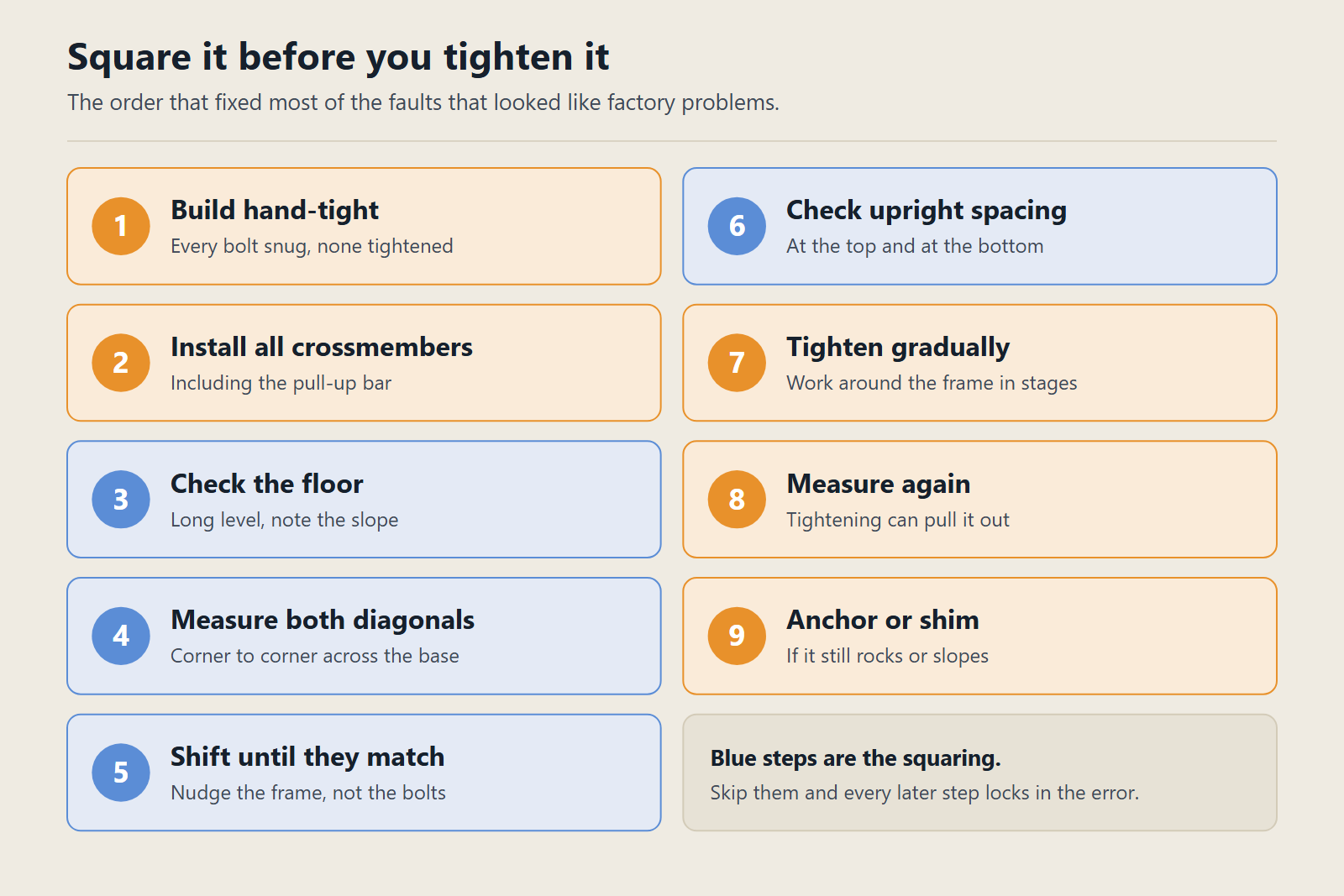
Figure 3. The assembly order that fixed most of the faults I saw.
That process fixed several faults that looked like manufacturing problems. A rack that looked crooked at first often came square once I loosened the bolts and repositioned the frame.
Which Home Gym Power Rack Felt Safest?
All five racks were safe to use once assembled correctly.
- The Rogue felt the most overbuilt.
- The REP felt almost as secure and offered better value and more customization.
- The Titan was safe for normal home lifting but gained the most from anchoring.
- The Hydra felt stable, especially with plates stored at the back.
- The Major Fitness was fine for regular home training, though I’d choose the REP or Rogue for consistently heavy barbell work.
If you’ll train alone, whichever rack you buy, set the safeties for every heavy set. A rack only protects you if the safeties are at the right height.
Which Power Rack to Buy
- Most garage gyms: REP Fitness PR-4000. The best mix of accurate uprights, stability, attachments and price.
- Build quality first: Rogue RML-390F. The cleanest heavy-duty construction, and a flat-foot base you don’t have to bolt down.
- Tight budget: Titan Fitness T-3. More work to square, strong performance for the money.
- A rack you’ll keep expanding: Bells of Steel Hydra. The most modular of the five.
- Cables and a rack in one frame: Major Fitness F22. The most exercise variety without a separate cable machine.
The rack is half of a pressing station. Before you order a bench to go with it, read how to pair a squat rack and bench so the two fit together, and what to check on a weight bench pad.
Five Things to Check Before You Buy a Home Gym Power Rack
- Your ceiling height. Measure it, then check the rack’s height and leave room above the pull-up bar for your head and hands.
- The upright size. 2×3 and 3×3 racks take different attachments. Pick the size whose accessories you’ll actually want.
- Your floor. Check it with a long level. A sloped garage floor needs shims, anchors or a wide flat-foot base.
- Hole spacing through the bench zone. Closer spacing (1 inch on the PR-4000) lets you set J-cups and safeties exactly where you need them.
- The total price. Add the safeties, pull-up bar, storage and shipping you’ll need, not just the base rack.
Free Tools for Training in a Home Gym Power Rack
- Machine Swap Finder: type any gym machine and get three ranked swaps, with a gear line showing which ones need a rack or a bench.
- Machine Load Converter: turn the weight you used on a gym machine into a starting load for the barbell or dumbbell swap.
- Loadable Weight Rounder: see what your plate jumps mean in practice, and which load to use when your target falls between two.
Questions People Ask About Home Gym Power Racks
What is the best home gym power rack?
Of the five I built, the REP Fitness PR-4000. Its uprights were consistent, the frame squared easily, attachments fit properly, and it stayed stable through squats, bench presses and pull-ups. The Rogue RML-390F was better built but cost more.
How do I know if my power rack is square?
Measure both diagonals across the base, corner to corner. If they are equal or within a fraction of an inch, the frame is square. If one is longer, loosen the bolts, shift the frame until they match, then tighten gradually.
Should I bolt my power rack to the floor?
Bolting down helps most with narrow, lighter racks and with pull-ups or lifts done near the front. A wide flat-foot rack like the Rogue RML-390F, or any rack loaded with plate storage, can be stable without anchors on a level floor.
What is the difference between 2×3 and 3×3 power racks?
The tube size. 3×3 uprights are heavier and take a wider range of attachments. 2×3 racks such as the Titan T-3 cost less, but their accessories aren’t interchangeable with 3×3 ones, so choose the size before you plan add-ons.
Why does my power rack wobble?
Usually an uneven floor, bolts tightened in the wrong order, or a frame that isn’t square. Check the floor with a level, measure both diagonals, and retighten in stages. Shims, anchors or plates stored on the rack fix most of what’s left.
Is a budget power rack safe?
The Titan T-3 was safe for normal home lifting once squared and anchored. Budget racks tend to need more care during assembly, with rougher welds and finish, rather than being weaker in use.
Is an all-in-one power rack worth it?
If you want cable work without buying a separate machine, yes. The Major Fitness F22 added pulldowns, rows and curls. For the strongest, simplest barbell rack, a dedicated rack like the REP PR-4000 felt more solid.
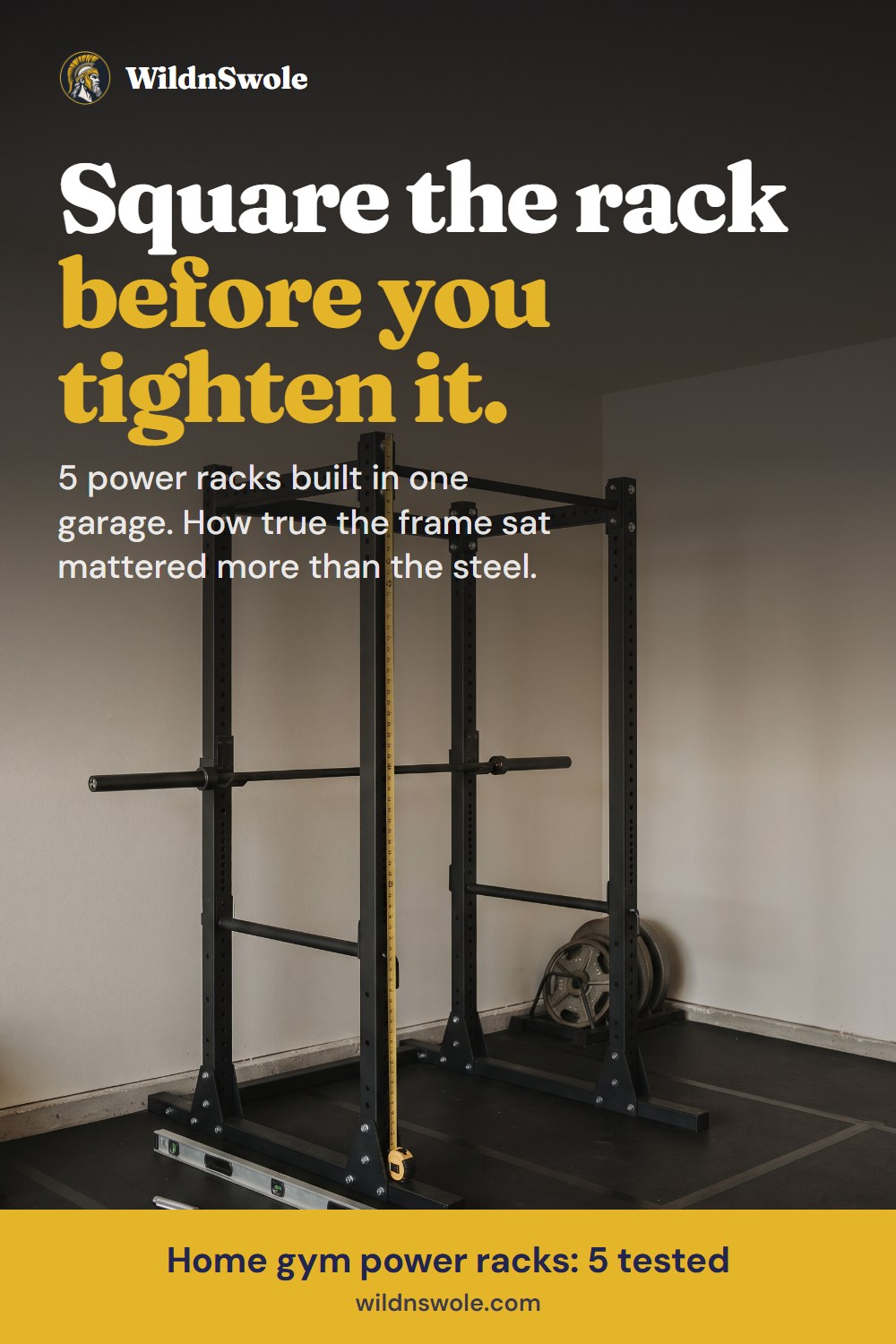
Illustration. The short version on one page. Save it for the day the rack arrives.
The Verdict on Home Gym Power Racks
Building five racks taught me that quality isn’t one number. Steel thickness matters, but so do hole consistency, weld quality, hardware, attachment fit and how easily the frame squares.
The Rogue RML-390F had the most premium construction. The Titan T-3 was the strongest budget value. The Bells of Steel Hydra was the most customizable, and the Major Fitness F22 was the most practical all-in-one. The REP PR-4000 balanced all of it best: consistent uprights, a frame that squared easily, attachments that fit, and stability through every lift I tried. It suits a first serious garage gym and still leaves room to grow.
No rack arrived perfectly suited to my sloped floor. The best home gym power rack was the one I could square accurately, that stayed stable under load and that took useful attachments without forcing compromises. For my garage, that was the REP PR-4000.
Once the rack is in, the next question is what to train in it. The Machine Swap Playbook covers eighteen swaps across the six patterns the gym’s queues form around, with a one-page cheat sheet you can screenshot and use mid-workout.
→ Send me the playbook — it’s free
Affiliate disclosure: WildnSwole earns a commission when you click a link to a partner and make a purchase. As an Amazon Associate, I earn from qualifying purchases. Commissions do not change what the content recommends and they do not add to what you pay.
The content in this article is for general information only and does not constitute medical or personal training advice. Always consult a qualified professional before making changes to your training.
Leave a Reply