I Followed a Strict Progressive Overload Plan for 16 Weeks. Here’s What Counted as Progress.


Illustration. Progress lives in the small plates and the log as much as in the big ones.
Progressive overload sounds simple: add weight, do more reps, do more sets, or make the exercise harder in some measurable way, then repeat long enough and strength and muscle follow. That was the theory behind my 16-week progressive overload workout plan.
To take out as much guesswork as I could, I wrote strict progression rules for every major lift and kept a training log of every working set: load, reps, rest, estimated effort, technique quality, and whether the set met the target to progress. The main lifts were the bench press, back squat, Romanian deadlift, overhead press, weighted pull-up, chest-supported row, incline dumbbell press and rear-foot-elevated split squat, plus isolation work like lateral raises, leg curls, triceps extensions and curls. If you train at home and the plan calls for machines you don’t own, the free Machine Swap Playbook has the free-weight swaps.
This is one lifter’s 16 weeks, not a study. The rep sequences below are example patterns that show how the progression behaved, not my exact log, and your lifts will move at their own pace.
The short version: the plan worked, but it didn’t produce a smooth upward line. Bench press and rows progressed steadily. Squats improved in waves. The overhead press stalled early. Romanian deadlifts were limited by fatigue rather than strength, and several isolation exercises improved mostly through better control, not heavier weight. The biggest lesson about progressive overload: it doesn’t mean adding load every week. It means building a system that recognizes progress even when the plates on the bar stay the same, plus a deload week before fatigue buries it.
The Progressive Overload Rules I Followed
I used double progression for most exercises (my 4 day workout split post walks through it in detail). Every movement had a fixed number of working sets, a target rep range, a minimum technique standard, a limit on how close to failure I’d go, and a rule for when the weight could go up.
Say an exercise was programmed for three sets of six to eight. I kept the same load until I could hit all three sets at eight with consistent technique and without going past the planned effort. Only then did the weight go up, after which reps usually dropped back toward six and the cycle started again. Main lifts usually stopped with one to three strong reps left; isolation exercises sometimes went closer to failure.
Why not just add weight every week?
Adding weight every session works well for many beginners. It gets less reliable as loads rise and recovery starts to matter. A strict weekly weight increase would have left me three bad choices: add weight despite worse technique, miss the target again and again, or rewrite the plan every time the jump became unrealistic.
Double progression gave me more ways to win. Same load, more reps: progress. Same reps, better technique: useful progress. Same work with less effort or shorter rest: adaptation. The system stayed strict without needing the bar to get heavier every week, and that’s the core of how to progressive overload once you’re past the beginner stage. The research backs this up: a 2022 study by Plotkin, Schoenfeld and colleagues in trained lifters found that adding reps at a fixed load and adding load at fixed reps produced similar muscle and strength gains over eight weeks. Both are progressive overload.
How I Logged Every Lift
For every working set I wrote down the exercise, load, reps, rest time, estimated reps in reserve, a technique rating, any pain or discomfort, and whether the set met the standard. The technique rating was deliberately simple:
| Rating | Meaning |
|---|---|
| A | Clean rep speed and full range |
| B | Acceptable, minor slowdown |
| C | Completed, but technique changed noticeably |
| D | Failed the standard or shortened the range |
Only A and B sets counted toward progression. A finished rep didn’t automatically count if I bounced the bar, cut the range, lost position or used momentum the exercise didn’t call for. That stopped the log from rewarding worse movement just because a number went up.
The Weekly Structure and Starting Targets
I ran a four-day upper/lower split: upper strength Monday, lower with a squat focus Tuesday, rest Wednesday, upper volume Thursday, lower with a hinge and single-leg focus Friday, and the weekend off. Main lifts showed up once or twice a week: one heavy bench day plus an incline or dumbbell variation, one main squat day plus a secondary squat pattern Friday, two row variations, and Romanian deadlifts once as the main hinge (and once lighter during some phases).
My starting progressive overload workout plan:
| Exercise | Working sets | Rep range | Progression rule |
|---|---|---|---|
| Bench press | 4 | 5–8 | Add weight when all sets reach 8 |
| Back squat | 4 | 4–7 | Add weight when all sets reach 7 |
| Romanian deadlift | 3 | 6–10 | Add weight when all sets reach 10 |
| Overhead press | 3 | 5–8 | Add weight when all sets reach 8 |
| Weighted pull-up | 4 | 4–8 | Add load when all sets reach 8 |
| Chest-supported row | 3 | 8–12 | Add weight when all sets reach 12 |
| Incline dumbbell press | 3 | 8–12 | Move up when all sets reach 12 |
| Split squat | 3 per leg | 8–12 | Add load when all sets reach 12 |
The rules were clear. The lifts did not progress at the same speed.
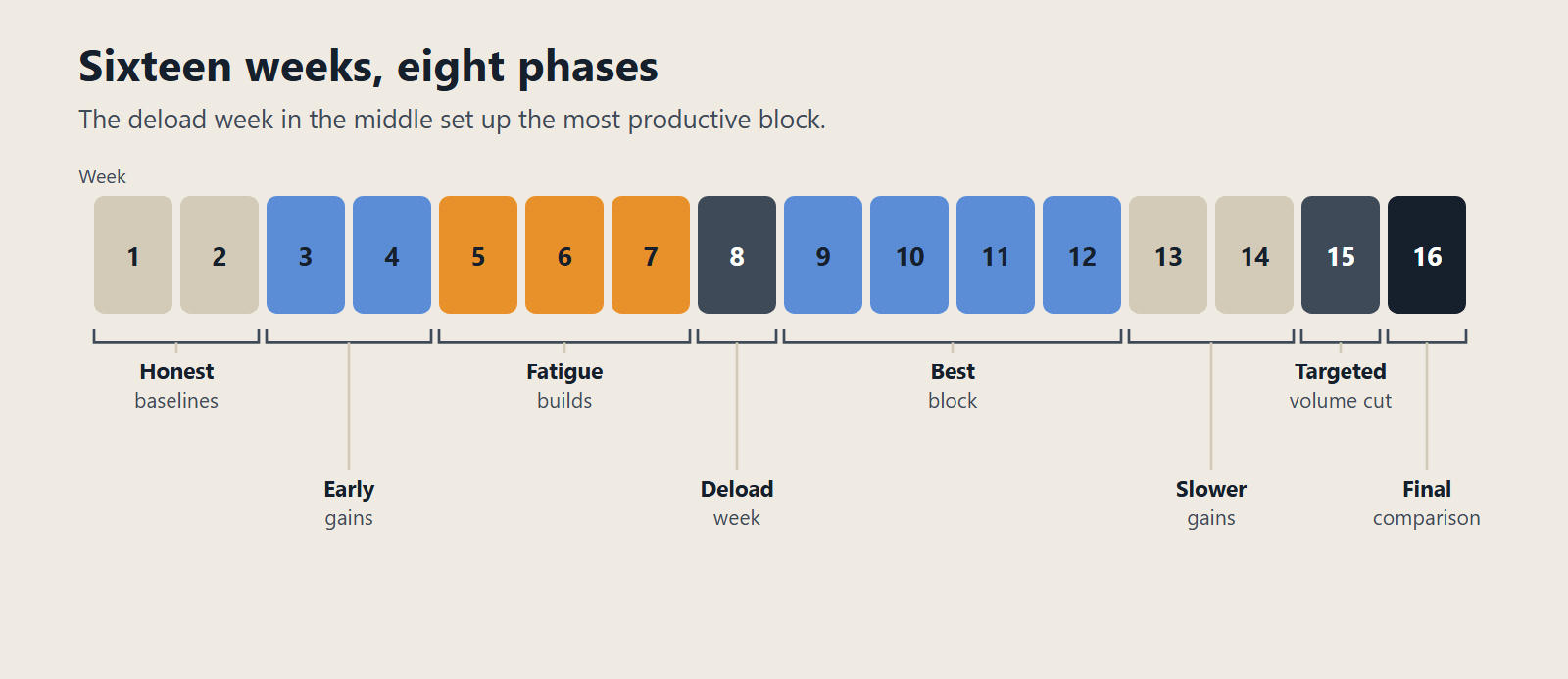
Figure 1. Sixteen weeks in eight phases. The deload week in the middle set up the best block of the plan.
Weeks 1 and 2: Honest Baselines
The first two weeks weren’t about pushing. They were about fixing my starting weights. I’d picked several loads based on what I believed I could lift rather than what I could repeat cleanly across every planned set. Bench was close. Squats were slightly too heavy. The overhead press was clearly too aggressive, and split squats were more fatiguing than I expected.
I cut the starting load on anything that produced C-rated sets in week one. It felt like going backward. It improved the entire program. A strict progressive overload plan depends on an honest baseline: if the starting weight is already near your limit, the system has nowhere to go.
The Bench Press Progressed Most Smoothly
The bench gave the clearest upward trend. For the first several weeks, progress came from reps rather than load, in a pattern like this:
| Week | Reps across 4 sets | Total |
|---|---|---|
| 1 | 7, 7, 6, 6 | 26 |
| 2 | 7, 7, 7, 6 | 27 |
| 3 | 8, 7, 7, 7 | 29 |
| 4 | 8, 8, 8, 8 | 32, add weight |
Example pattern, not my exact log.
After hitting the top of the range, I added weight, and the next session dropped back toward five or six reps a set. That made waves in the log rather than a straight line. The bench progressed well because the setup never changed (same rack height, bench position, grip and pause standard every week) and because most sets stayed short of failure, enough fatigue to drive progress without making the next week unpredictable. It slowed in the final month but never fully stalled.
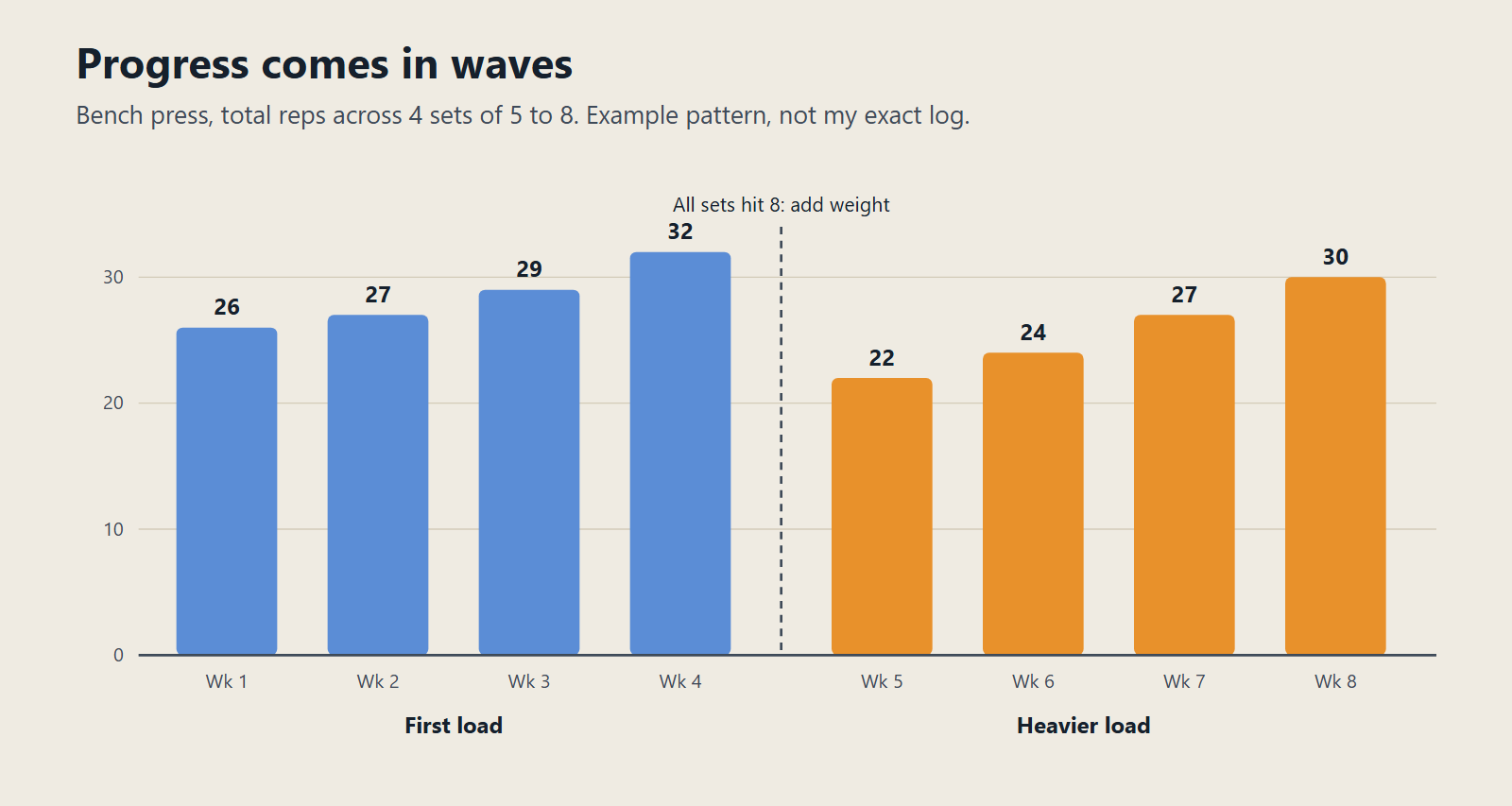
Figure 2. Progress in waves. Each drop is a load increase, not a step backward. Example numbers.
Back Squats Improved in Uneven Waves
Squats were much less predictable. Load mattered, but so did sleep, lower-back fatigue, ankle mobility and how recovered my legs were from Friday. Some weeks a weight moved smoothly; the next week it felt much heavier.
In the first month I steadily added reps and my technique improved from practicing the same setup and depth. Once the load went up, progress slowed, and the top of the four-to-seven range got hard to reach on all four sets.
The first plateau lasted three weeks at the same load. The first two sets improved; the last ones stayed stuck. I first read that as failure, because the progression rule hadn’t been met. The log said otherwise:
| Week | Reps across 4 sets | Total |
|---|---|---|
| 6 | 6, 5, 5, 4 | 20 |
| 7 | 6, 6, 5, 5 | 22 |
| 8 | 7, 6, 6, 5 | 24 |
Example pattern, not my exact log.
The weight hadn’t changed. The total work had. That’s still progressive overload.
Romanian Deadlifts Became a Recovery Problem
RDLs progressed fast at first, since the six-to-ten range left room to add reps before adding load. But they caused far more fatigue than the set count suggested: hamstrings, glutes, grip, lower back and general recovery all took a hit, and as the load rose, Friday’s session started affecting the next Monday and Tuesday.
My mistake was treating the RDL like an isolation exercise with a wide rep range. Chasing the top of the range on every set made the final reps slow, and the lift started to feel more like survival than controlled hamstring work. I narrowed the rep range and stopped sets earlier. Load progression slowed; the rest of the program got better.
The Overhead Press Stalled First
The overhead press was the first lift to stop progressing under the original rules. Small weight jumps were a big percentage change on a light lift, and requiring all three sets at eight reps got harder and harder. I spent several weeks bouncing between similar totals, something like 8-7-6, 8-7-7, 8-8-6, 8-7-7. It wasn’t declining. It just wasn’t hitting the trigger.
Why it stalled: it competed with bench press, incline pressing, triceps work, lateral raises and general shoulder fatigue. My pressing muscles were trained several times a week even though the strict overhead press only showed up once. The progression rule judged the lift in isolation; my body experienced the whole week.
The fix: smaller load jumps wherever possible, and a new rule. Instead of every set reaching eight, I used a total-rep target with the same technique standard, which let it progress without waiting for every set to match. Still strict, just a better fit for the lift.
How to Progressive Overload When Load Isn’t the Answer
Several lifts taught me that adding plates is only one lever.
Weighted pull-ups improved slowly but steadily, mostly through reps, with a small plate added once four clean sets reached the top of the range. The log also showed that bodyweight matters: a pull-up with the same added load at a higher bodyweight is more total resistance, so I started recording bodyweight next to the external load.
Chest-supported rows were the easiest lift to progress. The stable setup kept my lower back out of it, and progress came through extra reps, better pauses at the top, longer controlled lowering, less torso movement and small load jumps. For several weeks the load and reps stayed the same while the movement got cleaner. Tracked by weight alone, those weeks would have looked like nothing happened.
Incline dumbbell presses had a practical problem: the jump to the next dumbbell was sometimes too big, so I’d hit three sets of 12 with one pair and fall well short with the next. I handled it by temporarily going past the top of the range, slowing the lowering, adding a pause, progressing one set before the rest, using small add-on weights when available, and accepting a temporary drop below the range. (My 100 lb adjustable dumbbell comparison covers which designs have the smallest jumps.)
Split squats were easy to log and hard to progress. Heavier loads affected balance, grip, breathing, quads, glutes and adductors, and the second leg always started more tired. I alternated which leg went first and logged each side separately, which exposed a small but consistent difference between them. Progression required both legs to meet the standard, which slowed increases but stopped the stronger side hiding the weaker one.
Isolation exercises like lateral raises, curls, leg curls and triceps extensions didn’t respond well to aggressive load jumps, which brought shorter range, more momentum and worse joint position. They progressed through more reps, cleaner technique, longer pauses, slower lowering, better control at the stretch, and extra sets when recovery allowed. Less visible, but still measurable.
Get the whole system, not just the progression
Progressive overload only works if you can repeat the same exercise for weeks. The Machine Swap Playbook turns gym machines into barbell, dumbbell and bench swaps you can keep and progress at home, ordered by movement pattern, so your log stays comparable from week to week.
Eighteen swaps. Forty pages. Free, no upsell.
Weeks 5 to 7: Fatigue Built Up
By week five the program wasn’t new anymore. Several lifts were heavier, total reps were up, and the same four-day schedule was creating more fatigue. Readiness started slipping in small ways: longer warm-ups, more joint stiffness, less motivation before Tuesday, slower final sets and more B ratings instead of A. No single workout was a disaster, but the trend was heading the wrong way. I pushed on for two more weeks because performance hadn’t clearly dropped. That was a mistake.
Week 8: My First Deload Week
The deload week came once several lifts stopped improving at the same time. I cut working sets, load on the main lifts, isolation work and how close I went to failure, but kept the same exercises and schedule so the movements stayed familiar. It felt almost too easy. By the end of the week my joints felt better, warm-ups were quicker and motivation was back, and the next week several lifts immediately matched or beat their pre-deload numbers.
Don’t wait for the program to collapse. A deload week shouldn’t require a failed lift first. The warning signs showed up before loads dropped: rep totals stalling across several exercises, more technique changes, lingering soreness, joint irritation, worse readiness, and workouts feeling harder for no clear reason. Waiting for a missed lift would have been a late response.
Weeks 9 to 12: The Best Block
The four weeks after the deload week were the most productive of the plan. Bench rose smoothly, squats moved through the earlier sticking point, rows and pull-ups improved and the split squats evened out. Nothing about the exercises had changed; the fatigue had simply come down. Sometimes the plan is still working, and fatigue is just hiding the adaptation.
By week 10 I’d stopped using one universal progression rule:
| Lift | Progression rule that worked |
|---|---|
| Bench press, squat | Set-by-set rep targets |
| Overhead press | Total-rep target, smaller load jumps |
| Romanian deadlift | Narrower rep range, stricter technique cutoff |
| Weighted pull-up | Track bodyweight plus added load |
| Rows | Tempo and pause improvements count |
| Dumbbells | Wider rep ranges to absorb big jumps |
| Isolation work | Control and target-muscle tension before load |
That didn’t weaken the system. It made it more precise.
Weeks 13 to 16: Slower Progress, Smarter Adjustments
The last month started with slower gains, as expected: loads were heavier and many lifts had already gone up several times. Bench still progressed by smaller margins, squats depended on excellent recovery, the overhead press stayed hard, and RDL progression was deliberately conservative. Progress hadn’t stopped. It had changed scale. Early on I could add several reps across a lift in a week; later, one extra rep across all working sets was a meaningful win.
Failed targets were data, not verdicts. When I missed a progression target, I repeated the load the next week, checked whether total reps had improved, reviewed sleep, soreness and technique, reduced the load only if performance fell repeatedly, and changed the exercise only for pain or persistent technical problems. One bad session stayed one bad session; a pattern called for action.
Week 15 got a targeted cut instead of another full deload week. Fatigue was creeping back, but only on some lifts, so I dropped one working set from squats, RDLs and overhead presses and left bench and rows alone because they were still progressing. A deload doesn’t have to hit every exercise equally.
Week 16 was the comparison. I didn’t test one-rep maxes, because the plan was built around repeatable working sets. I compared starting and ending working loads, reps at the same load, total reps, technique quality, effort, joint comfort and consistency. Every major lift improved in at least one of those, by very different amounts.
How Each Lift Finished
| Exercise | Main form of progress | How hard it was to progress |
|---|---|---|
| Bench press | Load and reps | Moderate |
| Back squat | Load, reps, consistency | High |
| Romanian deadlift | Load and technique control | High fatigue cost |
| Overhead press | Total reps, small load jumps | Hardest |
| Weighted pull-up | Reps and added load | Moderate |
| Chest-supported row | Load, reps, control | Most consistent |
| Incline dumbbell press | Reps first, then load | Limited by dumbbell jumps |
| Split squat | Reps, load, side-to-side balance | High local fatigue |
The bench showed the best mix of more load and more reps. The squat’s load went up, but the bigger win was consistency in depth, bracing and rep quality. The RDL improved moderately, and the real success was learning to stop sets before fatigue changed the movement. The overhead press finished with a modest load increase and better total reps. Pull-ups improved in added load and rep quality. Rows rose steadily in weight and control. Incline dumbbell progress came through reps first, and split squats improved while the gap between legs shrank.
What Counted as Progressive Overload, and What Didn’t
By the end, I counted all of these as progress: more weight, more reps, more total reps across sets, better range of motion, cleaner technique, longer pauses, slower controlled lowering, less rest for the same performance, lower effort at the same work, better side-to-side balance, steadier execution, and more work without more joint discomfort. Adding weight stayed important. It just wasn’t the only valid outcome.
I stopped counting these: shortening the range, adding momentum, bouncing reps, quietly stretching rest periods, changing technique to move more load, ignoring pain, adding sets that hurt the next workout, and grinding out ugly reps just to hit the target. They made the numbers in the log bigger while making the exercise less comparable. Progressive overload needs a stable standard.
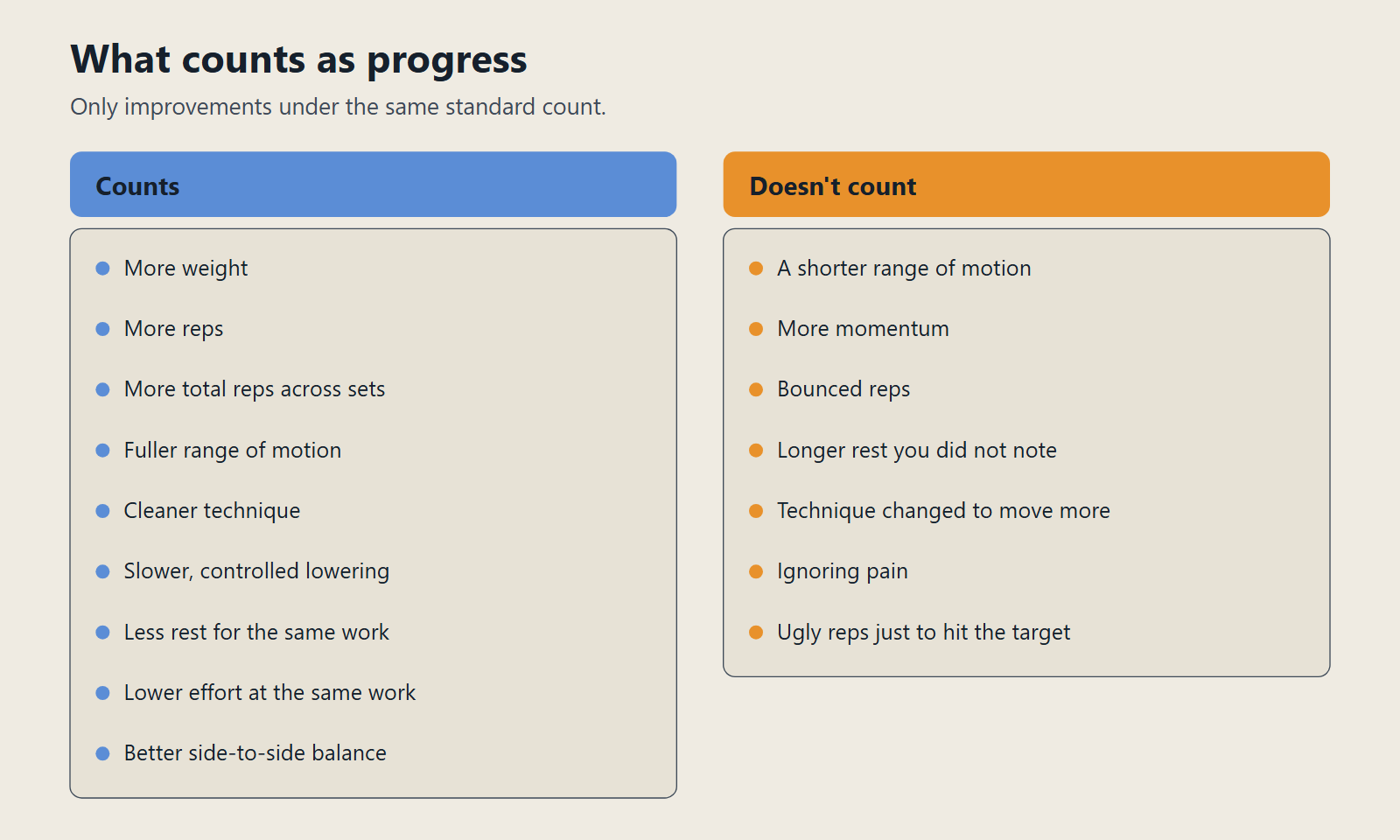
Figure 3. Only progress under the same standard counts.
The Biggest Mistake: Forcing the Calendar
The strict plan sometimes made me feel I had to progress because another week had passed. Your body doesn’t progress on a weekly deadline. Some lifts were ready to go up after two weeks, others needed four or five, and forcing the increase only produced failed sets and worse technique. The progression rule should decide when the load goes up, not the week number.
Keep rest times consistent. Eight reps after two minutes of rest isn’t the same as eight after five. I started tracking rest more carefully, kept a consistent range for main lifts and shorter rests for isolation work, and didn’t cut rest to make sessions harder. Rest is one more variable that has to hold still before you can judge progress.
Bodyweight, food and sleep showed up in the log too. Pressing and squatting felt better when I ate consistently, poorly fueled sessions meant lower readiness, and sleep was the strongest daily predictor of all. After a bad night, squat warm-ups felt heavier, overhead pressing slowed, RDLs felt less stable and technique needed more concentration, while bench and supported rows were less affected. The more demanding the lift on the whole body, the more clearly sleep showed up. The plan could organize training; it couldn’t fully make up for inconsistent recovery.
How to Progressive Overload: My Plan Now
If you’re working out how to progressive overload on your own plan, I’d keep the same approach, with these changes:
- Use exercise-specific rep ranges. Not every lift needs the same progression system.
- Start conservatively. The first weeks should leave room to improve.
- Schedule a deload week before fatigue peaks, around the middle of the block, and stay flexible on the exact timing.
- Use smaller load jumps, especially for the overhead press and smaller exercises.
- Rate technique next to every number. A rep only counts if it meets the standard.
- Don’t raise load and volume at the same time. Doing both at once drives fatigue up too fast.
- Review trends every four weeks. Day-to-day swings matter far less than the longer pattern.
A good progressive overload workout plan also needs the right weekly volume underneath it; my guide to how many sets per muscle group per week covers that side, and my best workout split ranking covers how to spread the sessions.
Who a Strict Progressive Overload Workout Plan Suits
It suits you if you like logging workouts, use the same exercises week to week, want objective rules, can resist changing the program on impulse, value technique, train several times a week, understand progress will be uneven, and are willing to take a deload week. It’s especially useful if you tend to change exercises before giving them enough time to work.
It may frustrate you if you prefer highly varied workouts, dislike tracking numbers, change gyms or equipment often, want every session to feel spontaneous, see repeated loads as failure, train through unpredictable pain, or can’t keep exercise standards consistent. Strict tracking only creates clarity when the data is comparable.
Five Things to Check Before Your First Session
- An honest baseline. Pick starting loads you can repeat cleanly on every set, not your best day.
- A rule for every lift. Sets, rep range, effort limit and the exact trigger for adding weight.
- A technique standard. Decide what a counted rep looks like before you start logging.
- Small enough jumps. Fractional plates or add-on weights for presses and dumbbells; my free Loadable Weight Rounder shows what your jumps mean in practice.
- A planned deload week. Pencil one in around the middle of the block.
Free Tools for Progressive Overload at Home
- Machine Swap Finder: type any gym machine your split calls for and get three ranked swaps, with a gear line showing which ones need a rack or a bench.
- Machine Load Converter: turn the weight you used on a gym machine into a starting load for the barbell or dumbbell swap.
- Loadable Weight Rounder: see what your plate jumps mean in practice, and which load to use when your target falls between two.
Questions People Ask About Progressive Overload
What is progressive overload?
Progressive overload means gradually making training more demanding so your body keeps adapting. You can add weight, reps, sets, range of motion or control, as long as the exercise standard stays the same.
Do you have to add weight every week for progressive overload?
No. Adding reps at the same load, improving technique, slowing the lowering or doing the same work with less effort all count. A 2022 study found adding reps and adding load produced similar gains.
How do you progressive overload with dumbbells?
Push past the top of your rep range, slow the lowering, add pauses, or progress one set at a time until you can handle the next dumbbell. Small add-on weights help when the jump is too big.
What is a deload week?
A deload week is a planned lighter week where you cut sets, load and effort while keeping the same exercises. It lets fatigue drop so the progress you’ve built can show up when you return to full training.
How often should you take a deload week?
When the warning signs show up, not on a fixed schedule: rep totals stalling across several lifts, lingering soreness, joint irritation and worse readiness. In my 16-week plan that was around week eight.
Why did my progressive overload stall?
Usually fatigue, overlap or a rule that doesn’t fit the lift. My overhead press stalled because bench, incline pressing and lateral raises loaded the same muscles; smaller jumps and a total-rep target fixed it.
What does a progressive overload workout plan look like?
Each exercise gets fixed sets, a rep range and a rule for adding weight, usually when every set reaches the top of the range. My plan used four sets of 5 to 8 on the bench press and three sets of 8 to 12 on rows.
What shouldn’t count as progressive overload?
Shorter range of motion, more momentum, bounced reps, longer hidden rest periods, changed technique and ignored pain. They inflate the numbers while making the lift less comparable.
The Verdict on Progressive Overload
The 16-week progressive overload plan worked. Every major lift improved, but not through the same mechanism. Bench and rows responded to classic double progression, squats improved through load, reps and consistency, Romanian deadlifts needed stricter fatigue control, the overhead press needed smaller jumps and a total-rep target, and dumbbell and isolation work progressed through wider rep ranges and better execution. The plan also needed a deload week and a later volume cut; without them, the strict rules would have measured accumulated fatigue instead of adaptation.
Adding weight was the clearest form of progress, but it wasn’t the one that showed up every week. Some weeks improved by one rep, others through cleaner technique, shorter rest, better control or a lower effort rating, and those changes built the base for later load increases. Performance moved day to day with sleep, stress and soreness; progress showed up over weeks. Progressive overload isn’t a demand to add weight every Monday. It’s making the same movements gradually more demanding while keeping them recognizable. Once I treated it that way, the log became far more useful and the plan far easier to sustain.
Progression is easiest when your exercises stay the same week to week, at home too. The Machine Swap Playbook covers eighteen swaps across the six patterns the gym’s queues form around, with a one-page cheat sheet you can screenshot and use mid-workout.
→ Send me the playbook — it’s free
Affiliate disclosure: WildnSwole earns a commission when you click a link to a partner and make a purchase. As an Amazon Associate, I earn from qualifying purchases. Commissions do not change what the content recommends and they do not add to what you pay.
The content in this article is for general information only and does not constitute medical or personal training advice. Always consult a qualified professional before making changes to your training.
Leave a Reply