I Ran a 5 Day Workout Split for 12 Weeks and Kept a Training Log. Here’s What It Taught Me.

Illustration. The log stays by the bar; the patterns only show up when you write every session down.
A 5 day workout split sounds like the ideal middle ground. It trains more often than a three- or four-day program without the near-daily grind of six days. Each session can stay focused, weekly volume spreads across several workouts, and two days stay free for rest.
That was the appeal. I wanted to know whether a 5 day workout split would actually improve my training or just make my week harder to manage, so instead of judging it from memory I ran one for a 12-week block and kept a training log the whole way: exercises, sets, reps, loads, how many reps I had left, session length, soreness, joint comfort, readiness, missed workouts and anything I changed. If you train at home and the plan calls for machines you don’t own, the free Machine Swap Playbook covers the barbell, dumbbell and bench swaps.
This is one lifter’s block, not a study. Your recovery depends on your sleep, stress, food, age and training history. What I can share is what the log made obvious, what I changed, and the 5 day workout plan I’d start from next time.
The short version: the split worked. My bench press, pull-ups and rows improved, shorter sessions were easier to focus on, and I liked having a clear purpose each day. But five training days in a row piled up fatigue by Friday, my shoulders and elbows took more repeated stress than the day labels suggested, and one missed workout could knock the whole week sideways. A 5 day workout split is productive. It’s also less forgiving than four days.
The 5 Day Workout Split I Used
I wanted every major muscle trained twice a week without repeating the same workout. The schedule:
| Day | Session |
|---|---|
| Monday | Upper body strength |
| Tuesday | Lower body strength |
| Wednesday | Push hypertrophy |
| Thursday | Pull hypertrophy |
| Friday | Legs hypertrophy |
| Saturday | Rest |
| Sunday | Rest |
This is an upper lower push pull legs hybrid, sometimes called ULPPL. It isn’t a bro split, because the strength days train muscles that come back later in the week, and it isn’t a strict push pull legs routine, because the first two days are built around heavy compound lifts. It gave chest, back, shoulders and legs two exposures each, more direct arm work later in the week, and two rest days in a row.
On paper it distributed training well. In practice, Monday through Friday became one long, uninterrupted block of lifting, and that detail shaped almost everything that followed.
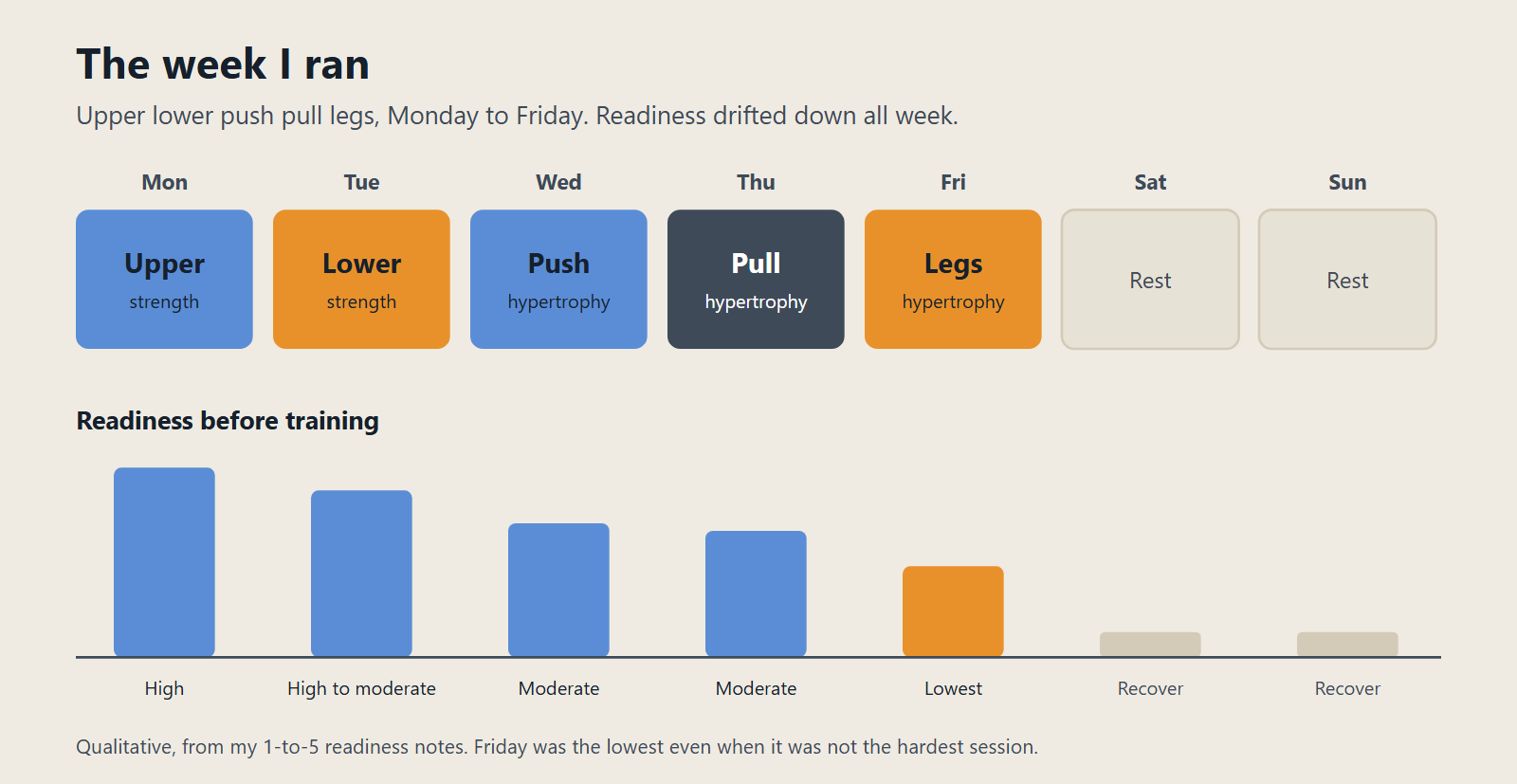
Figure 1. Five days in a row. Readiness drifted down across the week even when the muscles changed.
My Goal for the Block
I wasn’t peaking for a meet. The goal was to build strength while adding moderate muscle-building volume, progressing on the bench press, back squat, Romanian deadlift, pull-ups, barbell rows and overhead press, with enough accessory work for chest, back, delts, quads, hamstrings, glutes, arms and calves.
A 5 day workout routine seemed ideal because no single session had to hold everything. That assumption was mostly right. The harder question turned out to be how hard each session should be.
How I Kept the Training Log
I used a plain notebook, not an app. For each exercise: load, reps, working sets, an estimate of reps left before failure, any discomfort, and whether technique felt normal. At the end of each session: total time, readiness from 1 to 5, session quality from 1 to 5, soreness going in, joint discomfort, and one short note about what went well or badly.
The readiness scale:
| Rating | Meaning |
|---|---|
| 5 | Fully recovered and motivated |
| 4 | Minor fatigue, normal performance |
| 3 | Noticeable fatigue but trainable |
| 2 | Poor readiness, reduced performance |
| 1 | Skip the session or swap in recovery work |
The log made patterns obvious that I’d otherwise have missed. It’s the single habit I’d recommend to anyone trying a new 5 day workout plan. (My best workout split ranking uses the same 1-to-5 check across six different schedules.)
The Planned Sessions in My Upper Lower Push Pull Legs Week
- Monday, upper strength: barbell bench press, weighted pull-ups, overhead press, barbell row, plus one triceps and one biceps exercise. Controlled heavy work in lower-to-moderate rep ranges, not max attempts.
- Tuesday, lower strength: back squat, Romanian deadlift, split squat or leg press, a hamstring curl and calf raises. Usually the most draining session of the week.
- Wednesday, push hypertrophy: incline dumbbell or machine press, a second chest press, lateral raises, triceps extensions and optional chest isolation. Lighter than Monday, taken closer to failure.
- Thursday, pull hypertrophy: pulldown or pull-up variation, chest-supported row, a second row or pullover, rear-delt work and curls. Often the most comfortable day: stable exercises, little whole-body fatigue.
- Friday, leg hypertrophy: hack squat, front squat or leg press, a lunge or split squat, leg curls, leg extensions and calf raises. Torn between the two sleds? See hack squat vs leg press.
The program looked balanced. The fatigue wasn’t always.
Weeks 1 to 4: Novelty, Then Real Progress
The first two weeks of the 5 day workout routine felt excellent. Every session had a clear purpose and a shorter exercise list than my previous full-body and upper/lower programs, and most workouts took about an hour. Monday and Tuesday were demanding but came after the weekend; Wednesday through Friday felt easier because the work was more bodybuilding-style. Readiness sat mostly at 4 or 5.
The biggest early benefit was psychological. Knowing I could save volume for later in the week took away the urge to cram extra exercises into each session.
By week three, the repeated practice paid off. My bench felt more consistent because chest came back on Wednesday, and pulling improved because Monday’s heavy pull-ups and rows were followed by more supported pulling on Thursday. Lower-body progress was messier. Tuesday’s heavy squats and Romanian deadlifts left soreness that sometimes lasted into Friday. I could finish the leg hypertrophy day, but the first few sets felt stiff. That was the first sign that a 5 day workout split doesn’t automatically give every muscle ideal spacing: several days between sessions isn’t the same as recovering from Tuesday’s workload.
At the four-week mark the bench, pull-ups and rows were all moving up, squats were consistent, the overhead press was slow, Friday’s legs were hit and miss, and my elbows were starting to complain. I hadn’t missed a session. It looked like a runaway success, though the later weeks showed that perfect early attendance was partly novelty.
Weeks 5 and 6: Fatigue Became Predictable
Week five is when the 5 day workout routine started to feel like a real commitment. Training Monday through Friday meant every weekday included preparing, lifting, showering, logging and recovering. No single session was long, but the weekly demand was high, and my readiness followed the same shape every week: high on Monday, high to moderate on Tuesday, moderate midweek, lowest on Friday, even when Friday wasn’t the hardest workout.
The body-part focus changed every day. The overall workload didn’t. Grip, lower back, shoulders, elbows and motivation never fully reset between sessions.
Shoulders and elbows were working more than the labels said
The split seemed to separate upper-body stress carefully: heavy pressing and pulling Monday, pushing Wednesday, pulling Thursday. But that put my shoulders and elbows to work three times in four days. Different muscles, same joints. By week six I had mild elbow tenderness after curls, less enthusiasm for triceps extensions, longer shoulder warm-ups, less comfortable overhead pressing and more stiffness at the start of Thursday’s session. Nothing turned into an injury, but it showed how much the day labels understated the load on the supporting tissues.
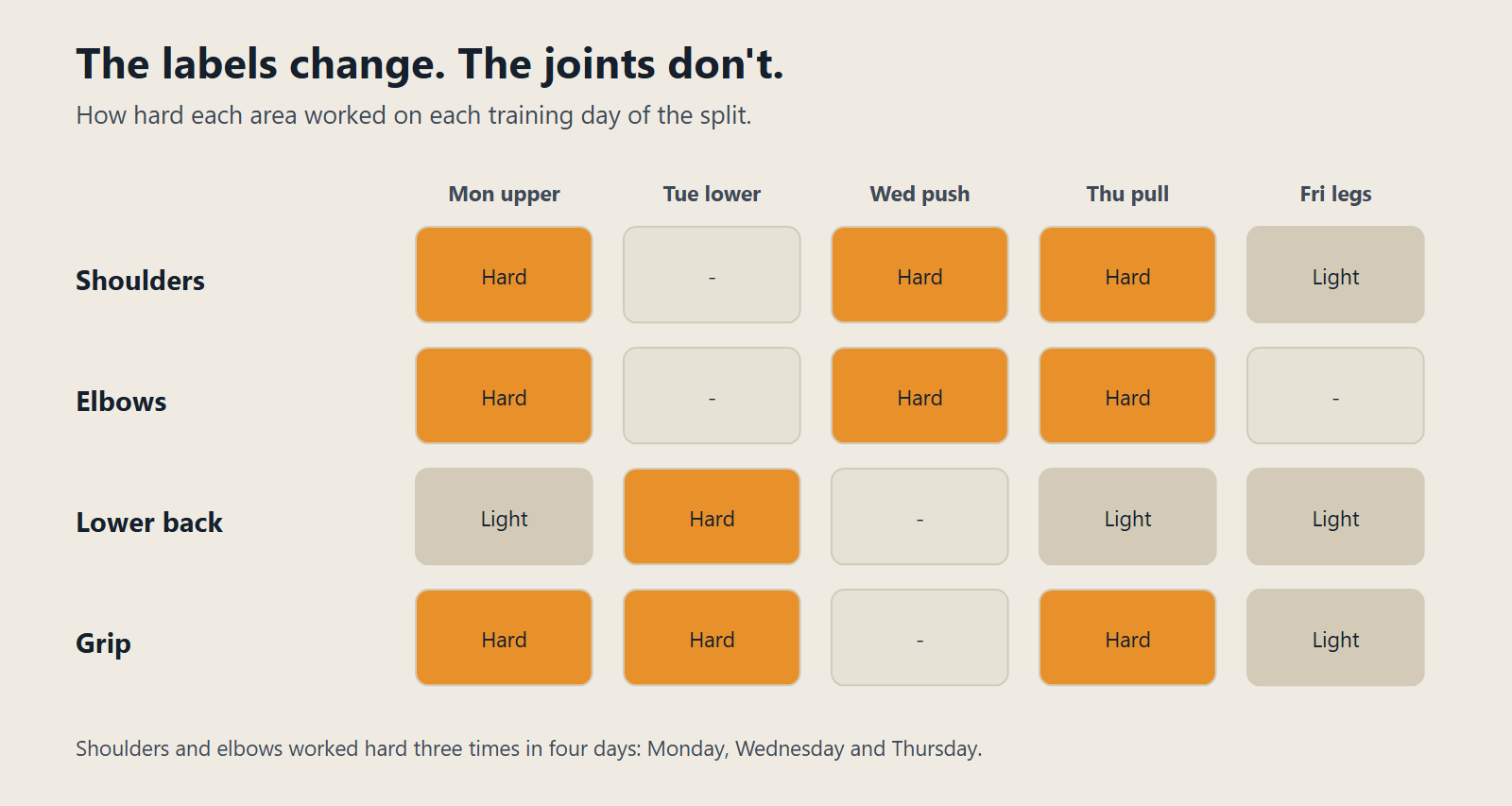
Figure 2. Muscle labels change every day; the joints doing the work mostly don’t.
The fix: cut Monday’s arm work
My first change was removing the curls and triceps work from Monday. I’d only added them because the session looked incomplete without them. The arms were already working hard on bench, pull-ups, rows and overhead press, and they got direct work on Wednesday and Thursday anyway. Dropping two Monday accessories shortened the session and helped my elbows almost immediately. It was one of the most useful changes of the whole block.
A 5 day workout split doesn’t need every session to feel complete on its own. The week is the complete unit.
Get the whole system, not just the split
A 5 day workout plan leans on machines: leg press, hack squat, pulldowns, leg extensions. The Machine Swap Playbook turns each of those into a barbell, dumbbell or bench swap, ordered by movement pattern, so the whole week runs in a home gym.
Eighteen swaps. Forty pages. Free, no upsell.
Weeks 7 and 8: Missed Sessions Exposed the Weak Spot
My first missed session came in week seven, and it wasn’t fatigue. A scheduling conflict made Thursday’s pull day impossible. Moving it to Saturday seemed obvious, but Saturday was half of my recovery block, so doing it there left only Sunday off. Skipping it meant losing a whole pull workout. I moved it to Saturday at reduced volume, and the next Monday felt less fresh than usual.
In week eight I missed Friday’s legs and didn’t make it up. That helped recovery but cut that week’s lower-body volume substantially. A four-day upper/lower week would have been far easier to rearrange than a 5 day workout routine. With five distinct sessions, every missed day removes a specific training focus, and moving one workout changes the next: pull day after leg day changes lower-back recovery, legs on the weekend lower Monday’s readiness, and merging missed exercises into another day makes that session too long.
The answer wasn’t to panic over one missed workout. I kept the schedule and stopped trying to cram every lost set into the remaining days. That made the program more sustainable, and confirmed it was less flexible than I’d expected.
The Midpoint Review
At six weeks I read back through the log for the whole 5 day workout plan. Sessions averaged about an hour, Thursday’s pull day was usually the shortest and Tuesday’s lower strength day the longest. Readiness was highest on Monday and lowest on Friday.
The lifts progressing most consistently were the bench press, pull-ups, chest-supported rows, incline dumbbell press and leg curls. The least consistent were the overhead press, Friday’s squat variation, split squats, heavy Romanian deadlifts and triceps isolation work. The pattern was clear, and it applies to any 5 day workout split: movements early in the week, or with low whole-body fatigue, progressed best.
Weeks 9 and 10: Giving the Two Leg Days Different Jobs
By week nine, Tuesday’s heavy squats plus heavy Romanian deadlifts were spilling into Friday. I turned Tuesday into a clear squat-strength day: back squat, a lighter Romanian deadlift, one single-leg exercise, a hamstring curl and calf raises. Friday became the higher-volume leg day, built mostly on machines and dumbbells.
Recovery improved straight away, and my lower back liked it too: Friday’s exercises were more stable and needed less bracing than another heavy barbell session. Total leg work barely dropped, which is why I’d build any 5 day workout plan with two leg days that do different jobs.
I’d assumed heavy reps on Tuesday and light reps on Friday would spread the fatigue by themselves. That was too simple. A heavy barbell squat and a high-rep split squat are both exhausting in different ways. The two days needed to differ in exercise stability, spinal loading, joint stress, rep range, proximity to failure and total sets, not just in the label.
Weeks 11 and 12: The Program Settled
The last two weeks were less exciting than the first two, and that was useful. The novelty was gone, exercise selection had settled, and I knew which sessions needed restraint. Readiness still sagged through the week, but less after the Monday arm and Tuesday hinge changes. I missed one push day in week 12 to a schedule clash and didn’t chase the lost volume.
I finished the block stronger than I started it, and ready for a deload. The upper lower push pull legs split had stayed productive for 12 weeks. I wouldn’t have run it unchanged for another 12.
Attendance: Why the Misses Mattered More Than the Count
I made the large majority of the planned sessions in the 5 day workout routine. A handful were missed, a couple were moved to another day, and one was cut short because of poor readiness. None was abandoned partway through.
The useful part wasn’t the completion rate. It was why sessions were missed. Most came down to scheduling; one I skipped on purpose to protect recovery; one I dropped because moving it would have wrecked the rest of the week. Without the log I’d have read every miss as a motivation problem. Sometimes the schedule itself just wasn’t flexible enough.
How Each Main Lift Responded
I didn’t test one-rep maxes, because this wasn’t a peaking block. I compared working sets instead.
- Bench press: the clearest improvement, more load for similar reps and technique. Monday heavy work plus Wednesday chest volume drove progress without much soreness.
- Squat: moderate gains, more consistent once Tuesday’s total lower-body demand came down.
- Pull-ups: improved, both weighted and bodyweight, though I had to trim direct biceps work to keep my elbows happy.
- Rows: better load and control. A heavy unsupported row Monday plus a chest-supported row Thursday was a good pairing.
- Overhead press: the least progress. It competed with bench, incline pressing and lateral raises, and my shoulders often felt worked even when they weren’t sore.
- Romanian deadlift: improved, then stalled. Pushed hard every Tuesday, it wrecked my lower back and hamstrings for the rest of the week. A more moderate load helped everything else.
Soreness Isn’t the Whole Story
Soreness showed up mostly in the quads, hamstrings, chest and upper back. Chest soreness rarely affected the next session; leg soreness sometimes affected Friday. My arms were rarely sore at all, yet my elbows were clearly accumulating fatigue. Muscles can recover while joints stay irritated. Had I logged only soreness, this upper lower push pull legs program would have looked far easier to recover from than it was.
Session Length and Motivation
Shorter, focused sessions were one of the 5 day workout split’s best features, usually an hour or a little more, with Tuesday running longest because of warm-ups and heavy compounds. The hypertrophy days were faster thanks to stable exercises and quick setups. But five shorter sessions didn’t save time overall: once warm-ups, cleanup and showers were counted, five days still took more of my week than four.
Motivation followed the week. Monday felt fresh after the weekend. Tuesday stayed productive because it felt different from Monday. Wednesday was mixed, some weeks fun, other weeks just more pressing too soon after Monday. Thursday was reliably enjoyable. Friday was the lowest, even with a well-designed leg session, because it was the fifth day in a row. The hardest part of a 5 day workout routine wasn’t any single workout. It was carrying the sequence through to Friday.
What I Changed in the 5 Day Workout Routine
- Removed direct arm work from Monday
- Lowered Tuesday’s Romanian deadlift intensity
- Used more stable leg exercises on Friday
- Capped overhead pressing volume
- Stopped trying to make up every missed set
- Kept most compound sets short of failure
- Cut redundant exercises
- Shortened sessions on low-readiness days
None of it changed the basic structure. All of it made recovery easier.
A 5 Day Workout Plan to Start From
This is the 5 day workout plan I’d start from today, with the changes above already built in. Sets and reps are typical starting ranges, not my logged numbers. RIR is reps in reserve: how many more good reps you could have done.
| Day | Exercise | Sets × reps | RIR |
|---|---|---|---|
| Mon: upper strength | Barbell bench press | 3 × 4–6 | 2 |
| Weighted pull-up | 3 × 5–8 | 2 | |
| Overhead press | 2 × 6–8 | 2 | |
| Barbell row | 3 × 6–8 | 2 | |
| Tue: lower strength | Back squat | 3 × 4–6 | 2 |
| Romanian deadlift (moderate) | 2 × 6–8 | 3 | |
| Split squat | 2 × 8–10 | 2 | |
| Leg curl | 2 × 10–12 | 1 | |
| Calf raise | 3 × 10–15 | 1 | |
| Wed: push | Incline dumbbell press | 3 × 8–12 | 1–2 |
| Machine or dumbbell chest press | 2 × 10–12 | 1 | |
| Lateral raise | 3 × 12–20 | 0–1 | |
| Triceps extension | 2 × 10–15 | 0–1 | |
| Thu: pull | Pulldown or pull-up | 3 × 8–12 | 1–2 |
| Chest-supported row | 3 × 8–12 | 1 | |
| Pullover or second row | 2 × 10–15 | 1 | |
| Rear-delt raise | 2 × 12–20 | 0–1 | |
| Curl | 2 × 10–15 | 0–1 | |
| Fri: legs | Leg press, hack squat or front squat | 3 × 8–12 | 1–2 |
| Lunge or split squat | 2 × 10–12 | 1–2 | |
| Leg curl | 3 × 10–15 | 0–1 | |
| Leg extension | 2 × 12–15 | 0–1 | |
| Calf raise | 3 × 12–20 | 0–1 |
That lands most major muscles at roughly 8 to 14 hard sets a week. My guide to how many sets per muscle group per week goes deeper on weekly volume. A meta-analysis by Schoenfeld, Ogborn and Krieger found a graded dose-response between weekly sets and muscle growth, with 10 or more sets per muscle a week trending best, so this is a reasonable middle. Add sets only if your readiness stays around 4. Keep the heavy compounds short of failure and save the 0-RIR sets for isolation work.
At home? The machine slots all have free-weight swaps: see my leg press alternative, lat pulldown alternative and leg curl alternative guides, and the leg extension attachment review for Friday’s extensions.
The Best and Worst of the 5 Day Workout Split
The best parts: focused sessions with a clear purpose, good upper-body frequency (chest and back loved two exposures a week), shorter workouts, room for both strength and hypertrophy exercises without cramming, a reliable two-day weekend recovery block, and a weekday routine that became automatic.
The worst parts: five days in a row of accumulating fatigue, shoulder and elbow overlap the labels hid, low Friday readiness, poor flexibility when a session moved, more warm-ups and setups each week, and a constant temptation to fill short sessions with unnecessary exercises.
Who an Upper Lower Push Pull Legs Week Suits
A 5 day workout split like this suits you if you like training on weekdays and keeping weekends free, prefer focused sessions, train for both strength and size, sleep and eat reliably, can keep volume in check, have stable accessory exercises available and rarely need to move workouts around. It’s especially good if you dislike long upper/lower or full-body sessions.
Choose something else if your schedule is unpredictable, you recover slowly, you take every set to failure, you have recurring elbow or shoulder trouble, you want heavy compounds every session, you need several days between lower-body workouts, or you travel often. For those lifters, four days usually gives nearly the same training quality with easier recovery. My 4 day workout split post lays out that week day by day. My best workout split comparison covers the four-day upper lower option in detail.
What I’d Do Next Time
I’d keep five sessions but stop running them back to back:
| Day | Session |
|---|---|
| Monday | Upper strength |
| Tuesday | Lower strength |
| Wednesday | Rest |
| Thursday | Push |
| Friday | Pull |
| Saturday | Legs |
| Sunday | Rest |
That keeps the upper lower push pull legs structure but breaks up the fatigue. The cost is losing a fully free weekend. A rotating five-day schedule that doesn’t force every session into one calendar week is another option. The right choice depends on whether convenience or recovery matters more to you.
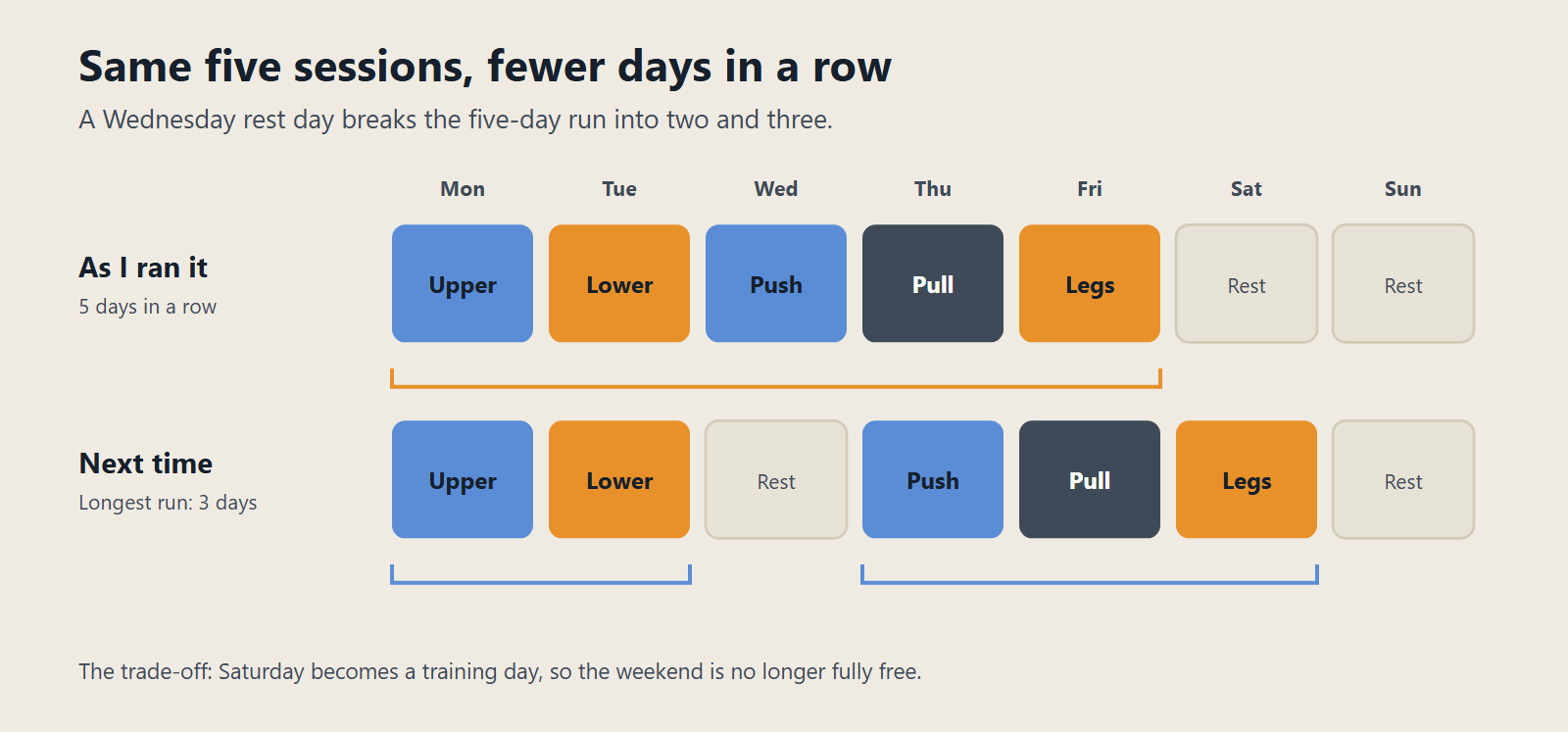
Figure 3. Same five sessions. A Wednesday rest day breaks five in a row into two and three.
Five Things to Check Before Your First Session
- Your calendar. Can you reliably train on all five days of a 5 day workout plan, and do you know what you’ll do when one moves?
- Days in a row. Five straight days builds fatigue. Consider a midweek rest day.
- Joint overlap. Count how many days your shoulders, elbows and lower back work hard, not just which muscles are listed.
- Two different leg days. Make one a heavy barbell day and the other a stable, machine or dumbbell day.
- A log. Write down sets, reps, load, reps in reserve and a 1-to-5 readiness score. The patterns only show up on paper.
Free Tools for Running a 5 Day Workout Split at Home
- Machine Swap Finder: type any gym machine your split calls for and get three ranked swaps, with a gear line showing which ones need a rack or a bench.
- Machine Load Converter: turn the weight you used on a gym machine into a starting load for the barbell or dumbbell swap.
- Loadable Weight Rounder: see what your plate jumps mean in practice, and which load to use when your target falls between two.
Questions People Ask About the 5 Day Workout Split
Is a 5 day workout split good?
Yes, if you can train five days reliably and recover from them. A 5 day workout split gives focused sessions and twice-a-week frequency, but it’s less flexible than four days and fatigue builds when all five days are back to back.
What is the best 5 day workout split?
An upper lower push pull legs week (upper strength, lower strength, push, pull, legs) trains everything twice and mixes heavy and lighter days. A five-day push pull legs rotation is the other strong option.
Is a 5 day workout plan better than 4 days?
Not automatically. In my block, five days gave slightly better session focus but slightly worse weekly recovery. A four-day upper lower split gets nearly the same frequency with more rest and much easier rescheduling.
How long should a 5 day workout routine take?
About an hour per session is typical. Shorter, focused workouts are one of the split’s strengths, but five sessions still take more weekly time than four once warm-ups and cleanup are included.
What should you do if you miss a day on a 5 day split?
Usually just carry on. Moving a session into your rest days or cramming missed sets into the next workout often costs more recovery than the lost volume is worth.
How many sets per muscle should a 5 day workout split have?
Roughly 8 to 14 hard sets per major muscle a week is a reasonable start. Research shows more weekly sets tend to produce more growth, but only add them if your readiness stays good.
Should you train to failure on a 5 day split?
Mostly no. Keep heavy compound sets one to three reps short of failure and save true failure for safer isolation exercises. Frequent failure training made every session harder to recover from.
Can you do an upper lower push pull legs split at home?
Yes. With a rack, a barbell, a bench and adjustable dumbbells you can cover every day, using free-weight swaps for the leg press, pulldown, leg curl and leg extension.
The Verdict on the 5 Day Workout Split
The 12-week block produced real progress. Bench press, pull-ups, rows and several hypertrophy lifts improved, the sessions stayed focused at about an hour, and I made the large majority of planned workouts. The main limitation was the fatigue that built from Monday to Friday. My muscles were never all sore at once, but readiness fell as the week went on, and my shoulders, elbows, grip and lower back overlapped far more than the body-part labels suggested.
The split worked best after I cut redundant accessory work, gave the two leg days different jobs, used more stable exercises later in the week and stopped treating every missed set as a debt. A 5 day workout split can work extremely well if you enjoy frequent training and keep a reliable schedule, but it isn’t automatically better than four days. The biggest lesson from the log wasn’t which lift progressed fastest. It was that a good split has to survive the final weeks, after the motivation becomes ordinary. This one did, once I stopped trying to make every session as hard as possible.
Whatever version of the week you run, the machine days are easier at home with the right swaps. The Machine Swap Playbook covers eighteen swaps across the six patterns the gym’s queues form around, with a one-page cheat sheet you can screenshot and use mid-workout.
→ Send me the playbook — it’s free
Affiliate disclosure: WildnSwole earns a commission when you click a link to a partner and make a purchase. As an Amazon Associate, I earn from qualifying purchases. Commissions do not change what the content recommends and they do not add to what you pay.
The content in this article is for general information only and does not constitute medical or personal training advice. Always consult a qualified professional before making changes to your training.
Leave a Reply